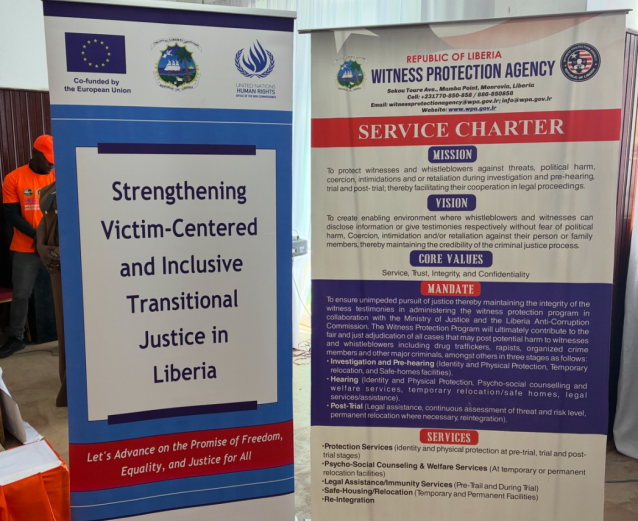
Liberia’s Witness Protection Agency is seeking to strengthen safeguards for victims, witnesses and whistleblowers under its proposed five-year plan. Credit: Anthony Stephens/New Narratives.
Summary:
- Liberia’s Witness Protection Agency has proposed a US$20.54 million five-year strategy that would establish safe houses, rapid-response capacity and stronger safeguards for victims, witnesses and whistleblowers.
- The plan comes as Liberia moves towards establishing with war-crimes and anti-corruption courts that will depend heavily on witness testimony and whistleblowers.
- The Agency says it has major obstacles: safe houses and other critical infrastructure, and current government funding falls far short of the plan’s projected cost.
Liberia’s Witness Protection Agency is proposing a five-year, US$20.54 million plan to build a nationwide system for protecting victims, witnesses and whistleblowers as the country moves toward establishing war crimes and anti-corruption courts that will significantly increase the number of witnesses and whistleblowers needing protection.
The plan, reviewed at a two-day gathering of government officials, human rights advocates and international partners in Monrovia last week, calls for trained protection officers, secure case-management systems and mechanisms to relocate people facing threats. It also seeks to strengthen Liberia’s witness and whistleblower laws and secure more reliable financing.
“We believe we have a lot of work to do,” said Maxwell Grigsby, the agency’s director. The consultation was necessary, he said, because protecting witnesses would require government institutions and other organizations to work together.
“That is why we could not sit in our offices to develop a five-year strategic plan for a subject matter that will affect multiple entities,” Grigsby said. “What play will we be doing? How will that play address the realities? How will other actors know the role they have to play, the referral path, and how to address issues that affect real human beings?”
The plan is the first comprehensive strategy developed by the Agency, which experts say is central to building the trust and confidence needed for victims, witnesses and whistleblowers to come forward and cooperate with investigations and prosecutions. The ambitious plan also comes as Liberia’s renewed push for accountability for wartime atrocities and corruption is expected to put greater pressure on a protection system being built by an Agency that has been operational for only about nine months.
The cases against more than a dozen perpetrators accused of crimes in Liberia’s civil conflicts brought by prosecutors in Europe and the United States, have shown that there is almost no forensic or documentary evidence to support cases of crimes committed in the wars, some of which date back more than 30 years. That means cases in Liberia’s court will rely heavily, as the international trials have done, on witness testimony.
For would-be witnesses and whistle-blowers, the danger of coming forward are not theoretical.
In 2023, New Narratives documented 12 cases of government whistleblowers over the previous 14 years who had allegedly faced retaliation. Seven died in circumstances their families alleged were connected to efforts to silence them- though there was no official finding of criminal activity in any of the cases – four lost their jobs, and three others fled the country or went into hiding.
It is against that history that the Agency is trying to build a protection system that remains in its infancy. It has no safe house of its own, limited vehicles and protection personnel, and most of its operations are concentrated in Montserrado. Its five-year strategy proposes two safe houses in Montserrado and three elsewhere in the country, giving authorities secure places to move witnesses and their families when they are in danger.
The Agency estimates that building the system from 2026 through 2030 will cost US$20.54 million. US$6 million is earmarked for protection operations and US$5 million for strengthening its institutional capacity. Financing is expected to come from the national budget, a proposed Victim, Witness and Whistleblower Trust Fund and international donors. The fund would be financed by a one-cent levy on every gallon of petroleum imported into the country.
The Agency also wants a 24-hour emergency desk and agreements with the police and the government’s Executive Protection Service for rapidly moving witnesses out of danger. It plans to train security and justice officials in safely transporting protected witnesses and eventually station protection officers in all 15 counties.
Agency director Grigsby said Liberians with sensitive information have often not felt safe remaining in the country after disclosing wrongdoing.
“We have to change this,” Grigsby said. “We are hoping that just by doing this plan, people will start to think differently. They will believe that they can give testimony in Liberia, stay in Liberia, without having to be so afraid about their safety and our survival.”
But with limited government resources and an exodus of international aid, funds available to the Agency will likely be limited.
The 2026 national budget allocated US$700,000 to the Witness Protection Unit, with government budget projections of US$390,000 for fiscal year 2027 and US$401,000 for 2028 — far below the spending envisioned in the five-year strategy.
The Agency wants the government to commit money specifically to witness protection over several years, beyond its regular operating budget. International donors would be asked to help pay for safe houses, technology, specialized training and psychological services, while the government would cover salaries and other routine expenses.
Oretha Snyder Davis, commissioner for prosecution at the Liberia Anti-Corruption Commission, said financing had to be treated as part of the protection system itself.
“Financing must be considered a strategic part,” of protecting witnesses, Davis said, as a panelist during the program. “We need diversified financing that allows government and development partners to accompany each other.”
The gathering brought together government institutions working on witness and victim protection and international donors.
Hassan Bility, director of the Global Justice and Research Project, Liberia’s leading war crimes investigation group, renewed his call for lawmakers to reduce their salaries and benefits, which often exceed the salaries of lawmakers in European countries with vastly larger national revenue. He demanded they redirect some of the savings toward the proposed courts and witness protection.
The Legislature passed the Witness Protection Act and Whistleblower Act in 2021, but Grigsby said there are gaps, including inadequate penalties for people who violate protections and weaknesses in oversight. The Agency wants both laws amended and clearer rules established for how people enter the protection program and how their information is handled.
The Agency says those changes would require amendments to go through the Legislature, followed by regulations and detailed procedures governing how the agency operates. The Agency has not provided a timetable for when the proposed amendments would be submitted to lawmakers.
International experts took the opportunity to support the Agency’s calls for support, reminding government, lawmakers and stakeholders in the court that victims are at the reason for this court to be held.
“Let us make sure that victims, witnesses, remain at the heart of what we are doing,” said Christian Mukosa, country representative for the Office of the United Nations High Commissioner for Human Rights in Liberia.
Credible witness protection “is essential for accountability, for access to justice, and for ensuring that victims, witnesses, and human rights defenders can participate safely and meaningfully in national processes,” said Solène Coma, a policy officer and economist in the European Union’s Partnership Section.
She said the European Union was supporting Liberia’s victim-centered transitional justice process through its partnership with the UN Human Rights Office in Liberia and national institutions, including the War and Economic Crimes Court Office.
“Transitional justice, like witness protection, is a collective effort,” Coma said.
This story was a collaboration with New Narratives as part of the Investigating Liberia project. Funding was provided by the U.N. Office of the High Commissioner for Human Rights and the European Union. The funders had no say in the story’s content.
See more Liberia News Network stories in Google Search by adding LNN as one of your Preferred Sources.
★ Add LNN as a Preferred Source