
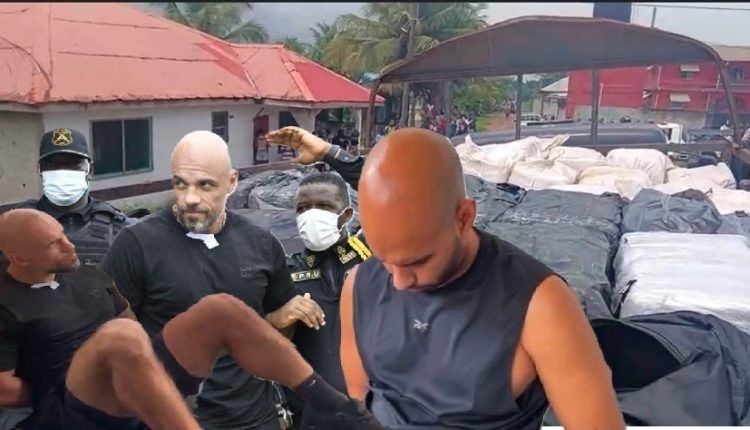
Liberia’s recent narcotics seizures have exposed a problem that extends far beyond any simple analysis. In fact, what initially appeared to be a straightforward criminal investigation has now seemingly evolved into something far more troubling: evidence suggesting the existence of a sophisticated and well-coordinated transnational trafficking network that has exploited weaknesses within key national institutions. As new information continues to emerge, two fundamental questions deserve public attention: Are we examining the full picture, or have public debate and political discourse become narrowly focused on convenient targets? Are we ignoring the glaringly obvious problems within our institutions as we search instead for quick and convenient answers?
Individual Blame vs Institutional Accountability:
`Michael U.S Browne

When the first narcotics-related arrests were made at Roberts International Airport, much of the public conversation quickly centered on Global Logistics Services (GLS) and its manager, Paul King. Soon, members of the Liberian Senate began calling for terminating the company’s concession even before judicial proceedings had established actual culpability. Roberts International Airport, much of the public conversation quickly centered on Global Logistics Services (GLS) and its manager, Paul King. Soon, members of the Liberian Senate began calling for terminating the company’s concession even before judicial proceedings had established actual culpability. Subsequent investigations and major drug seizures in Margibi County, however, now appear to suggest that Liberia and some of its neighbors are confronting a far larger and more sophisticated criminal enterprise. Clearly, therefore, public discussion should evolve accordingly rather than focusing narrowly on one company or one individual. Shouldn’t we examine larger systemic vulnerabilities that may have enabled these criminal operations to flourish?
The Evolving Public Narrative:
As recent investigative activity has uncovered broader institutional failures and more complex criminal networks, the intensity of the public discussion is changing. That is both logical and appropriate. Whether this shift reflects political considerations and imperatives, or other factors, is open to interpretation. Nevertheless, it raises legitimate questions about whether and how accountability is being pursued fairly and consistently. The noble cause of justice should never be selective or driven solely by uninformed public sentiment. Facts matter.
Questions in the Atmosphere:
Questions in the Atmosphere In order to truly dismantle the trafficking threat and protect Liberian society, the public needs answers to several important questions. First, what is the current status of investigations surrounding the disappearance of Michael Brown? What became of Oscar Brown? Has the Ministry of Justice completed and released its internal investigation regarding the prison officials connected to Michael Brown’s escape? Second, how were illicit shipments able to move through Roberts International Airport and other monitored transit corridors? What became of investigations involving airport security personnel responsible for screening cargo and passengers? Third, who owned or controlled the property in Margibi County where the record narcotics cache was reportedly discovered? Who facilitated leases, visas, residency documentation, and other administrative processes connected to the foreign nationals under investigation? Fourth, what did/does Liberia National police Inspector General (IG) Gregory O.W Coleman mean when he referred to members of government being involved in the current drug trafficking quagmire? These questions are not intended to assign guilt. Rather, they seek transparency regarding the institutional safeguards that should protect Liberia.
A Challenge to National Sovereignty:
If organized criminal networks are capable of penetrating our key public institutions, the implications extend well beyond narcotics enforcement. A state that cannot consistently enforce its laws risks undermining confidence in its legal institutions. Investors become concerned; businesses increasingly become vulnerable to reputational damage, extortion, or premature administrative and legislative actions. National security also becomes more threatened if criminal organizations are able to exploit weaknesses within border control, immigration, customs, or other government systems. These concerns are not unique to Liberia. The truth is that around the world, transnational criminal organizations often succeed by exploiting institutional weaknesses rather than relying solely on sophisticated logistics. That reality makes institutional reform just as important as criminal investigations and prosecution.
Transparent Introspection Over Simple Assumptions:
The success of any investigation should ultimately be measured not by the number of headlines it generates, but by whether it identifies and dismantles the full criminal network responsible. Don’t the Liberian people deserve investigations that are thorough, transparent, and guided by evidence rather than public pressure or political expediency? Shouldn’t allegations should be tested through full due process? Don’t the Liberian people deserve investigations that are thorough, transparent, and guided by evidence rather than public pressure or political expediency? Shouldn’t allegations should be tested through full due process? Don’t the Liberian people deserve investigations that are thorough, transparent, and guided by evidence rather than public pressure or political expediency? Shouldn’t allegations should be tested through full due process? Should we ignore obvious institutional failures or should they be fully examined? Should we not prioritize accountability as the standard applied to every individual found linked to the investigation —regardless of position, influence, or affiliation? Only by asking difficult questions and insisting on objective answers can Liberia strengthen public confidence in its institutions and demonstrate that the rule of law applies equally to all. Don’t we deserve this?
