
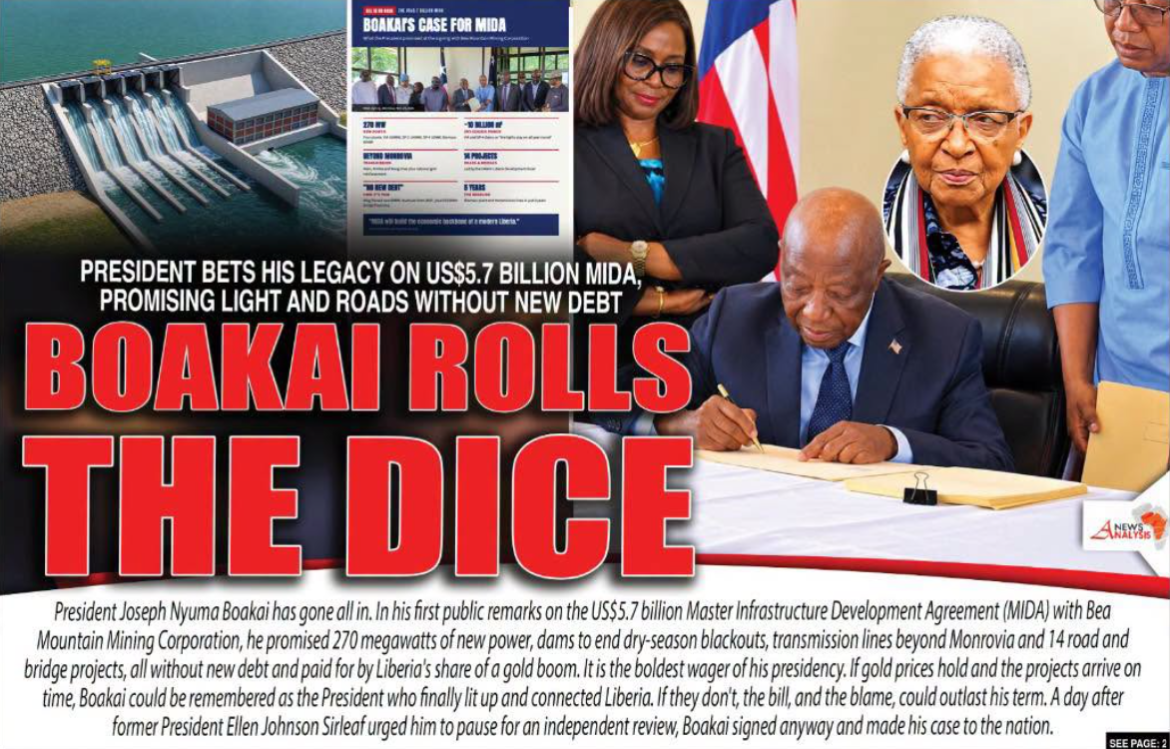
Monrovia – President Joseph Nyuma Boakai has put his presidency behind a single agreement.
Speaking publicly for the first time on the US$5.7 billion Master Infrastructure Development Agreement (MIDA) with Bea Mountain Mining Corporation (BMMC), the President cast Wednesday’s signing as a turning point for the country.
“Today marks a historic day for Liberia as we lay the foundations for tomorrow,” Boakai said, according to prepared remarks obtained by FrontPageAfrica. “As I have always said, it is time that we ‘Think Liberia, Love Liberia, and Build Liberia.’ And this is being demonstrated here today.”
It is the boldest move of his administration: a bet that one company-backed deal can do what decades of donor programs have not, and give Liberia reliable power and roads that connect every region.
Two Problems, One Deal
Boakai framed MIDA as a direct attack on what he called “two longstanding binding constraints that limit Liberia’s growth”: the lack of electricity and the lack of roads.
On power, the numbers he presented are significant. Four new plants are expected to add 270 megawatts, more than three times the capacity of Mount Coffee, the country’s main hydro plant. The President said the system could eventually “support over 1000 megawatts down the road.”
He presented the VIA and SP-4 dams as the answer to the dry-season blackouts that have long frustrated Liberians and businesses. Together they would hold “around 10 billion cubic meters of water, so that the lights stay on all year round, even in the dry season.”
New transmission lines and grid upgrades are meant “to ensure that the power generated is transmitted beyond Monrovia,” he said. The 14 road and bridge projects, he added, fit his ARREST Agenda “to ensure that development reaches every region of our country.”
“Da What Will We Eat?”
Boakai anticipated the most common Liberian question about any large deal: what is in it for ordinary people?
“I know some will ask, ‘Da What will we Eat?’” he said. “The fact is, this Agreement holds more for every Liberian.”
His answer was concrete. He promised steadier power so “children [can] study at night” and families can store food for longer; clinics and hospitals that “keep their machines running”; and “power for the welder, the tailor, the barber, and the shopkeeper, without the daily cost of generator fuel.” He also pointed to market access for farmers and “thousands of new jobs and skills for our young people.”
The message was clear: MIDA is presented not only as an engineering project but as a kitchen-table promise.
Answering the Debt Question
The President also faced the issue head-on. A day earlier, former President Ellen Johnson Sirleaf had warned on ELBC Radio that the US$5.7 billion “has to be paid back” and urged an independent African Development Bank review.
“There have also been concerns about debt to Liberia under this Agreement and how we will pay for it as a country,” Boakai acknowledged.
His answer is the core of the bet. “Leveraging the rise in gold price,” he said, the government has arranged with BMMC “to ring-fence new revenue streams from the Corporation beginning 2027 to pay for the cost of all projects.” Government talking points add that BMMC “will continue to contribute to the Consolidated Account” and that these are “entirely new revenue sources.”
To reassure doubters, Boakai noted that BMMC has agreed to a US$500 million bridge financing facility “to ensure the projects do not run out of money and stall during the construction period.”
In short, the President is saying that Liberia can build without borrowing in the traditional sense, by using a gold windfall that did not exist before.
The Promise and the Clock
Boakai ended with a firm commitment. “My promise is this: we will deliver within five years, with the Biomass plant and transmission lines completed in just two years. In short, MIDA will build the economic backbone of a modern Liberia.”
That promise defines the gamble. The two-year projects would arrive around late 2028, ahead of the October 2029 elections, and give the President visible results to show voters. The dams and the full road program are due by about 2031, after his term ends in January 2030. His legacy will depend on work his successor must complete.
What Has to Go Right
For Boakai’s bet to pay off, several things must hold:
• Gold must stay strong. The financing explicitly depends on “the rise in gold price.”
• Delivery must be fast. Two dams, four plants, three transmission corridors and 14 road projects in five years is extremely ambitious.
• The money must add up. Government documents give the cost as both “more than US$5.45 billion” and “about US$5.7 billion.”
• Trust must be built. Sirleaf’s call for independent technical review, and her question about whether the President is getting “the right information,” still need an answer.
Sirleaf does not oppose the goals. “We want more roads; we want more lights,” she said, “but we have to be careful.”
The Stakes
If MIDA delivers, Boakai could be remembered as the President who switched on the lights in the counties and finally connected the country by road, something his supporters would say no post-war leader managed. If it stumbles, the deal could follow him into the 2029 campaign and well beyond.
Either way, the President has made his choice clear. As he put it on Wednesday: “This is being demonstrated here today.”
See more Liberia News Network stories in Google Search by adding LNN as one of your Preferred Sources.
★ Add LNN as a Preferred Source