
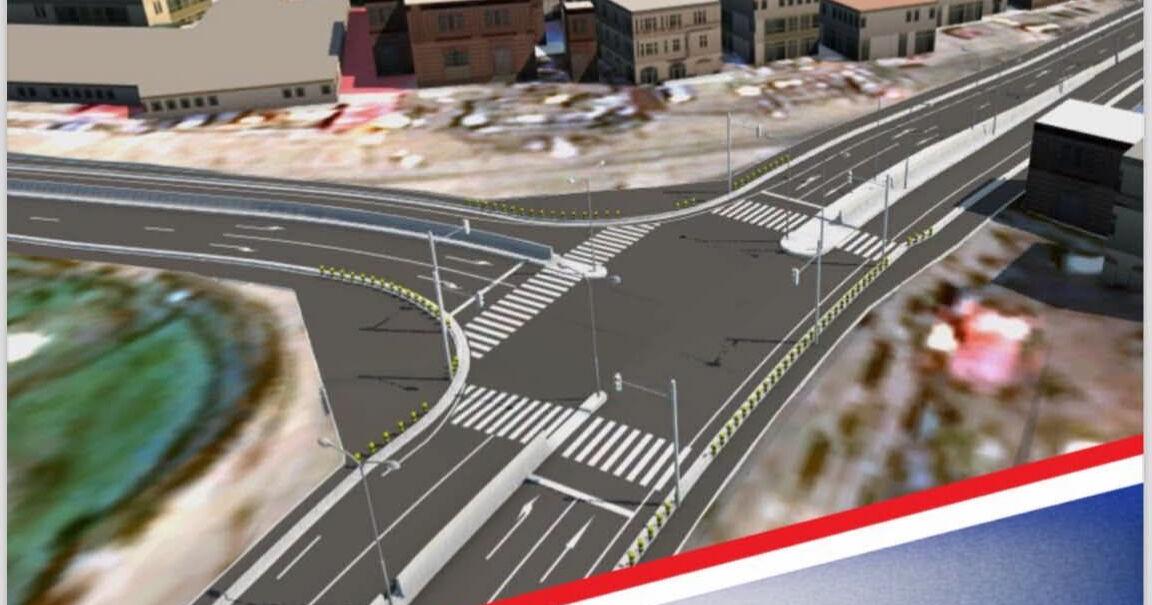
President Joseph Nyuma Boakai on Friday officially broke ground for the extension of the Japan Freeway from the Freeport of Monrovia to the Gabriel Tucker Bridge, describing the short but strategic 1.9-kilometer corridor as a vital artery in Liberia’s economic system.
Speaking at the ceremony held at the Freeport of Monrovia, President Boakai characterized the project as far more significant than its length suggests, calling it “the lifeline of Liberia’s economy” due to its central role in connecting the nation’s principal seaport to the capital and facilitating the movement of goods, services, and people.
“This road is the lifeline of Liberia’s economy, linking the nation’s principal seaport to the capital and supporting the daily movement of people, goods, and commerce, as well as regional trade,” the President said.
The groundbreaking marks another major milestone in the Boakai administration’s infrastructure expansion drive, coming just three months after the launch of two large-scale road projects: 255 kilometers of feeder and highway roads in western Liberia and the Mendikorma–Voinjama Highway project in the northwest.
Although relatively short, the Japan Freeway extension is expected to deliver significant economic and logistical benefits. President Boakai said the upgraded corridor will strengthen economic activity, reduce travel time, improve mobility, and enhance the daily lives of thousands of commuters and businesses that rely on the route.
The project will involve a complete reconstruction of the existing roadway with modern, climate-resilient infrastructure designed to address long-standing challenges, including flooding, inadequate drainage, and persistent traffic congestion.
Planned works include improved drainage systems, reinforced pavement structures, upgraded street lighting, pedestrian safety enhancements, and improved traffic flow design to ease congestion along one of Monrovia’s busiest transport corridors.
The project carries an estimated cost of approximately ¥2.7 billion Japanese Yen (about US$16 million), fully financed through a grant from the Government of Japan.
President Boakai expressed deep appreciation to Japan for its continued partnership with Liberia, highlighting decades of support delivered through the Japan International Cooperation Agency (JICA).
“On behalf of the Government and people of Liberia, I extend our profound appreciation to the Government and people of Japan for their friendship and generous support over many decades,” Boakai said. “This ceremony is a celebration of an enduring friendship between two nations and a demonstration of what genuine international partnership can achieve.”
Reflecting on the corridor’s history, President Boakai recalled its earlier identity as Somalia Drive before its initial reconstruction with Japanese support.
“Many Liberians still remember this road as Somalia Drive. After its reconstruction with generous assistance from the Government of Japan, this important corridor became a model of modern road infrastructure in Liberia,” he said.
In recognition of Japan’s role, the government renamed the corridor the Japan Freeway, which the President described as a permanent symbol of bilateral cooperation and goodwill.
According to the government, the construction phase is expected to generate approximately 175 direct jobs for Liberians, alongside indirect employment opportunities for suppliers, transport operators, and small businesses operating along the route.
President Boakai said the project aligns with his administration’s ARREST Agenda for Inclusive Development, which prioritizes infrastructure as a driver of economic transformation, private sector expansion, job creation, and improved public service delivery.
“My Government remains committed to this agenda. We will continue to seek ways to expand and modernize Liberia’s transportation network through strategic partnerships with development partners and the private sector,” he stated.
The President praised the Ministry of Public Works for its role in advancing the project from planning to implementation, and also acknowledged the contributions of Japanese partners, including JICA, Dai Nippon Construction Co., Ltd., and Eight-Japan Engineering Consultants, Inc.
He urged continued collaboration among stakeholders to ensure successful delivery of the project and called on residents and commuters to remain patient during the construction period.
“To residents and commuters, I ask for your patience and cooperation during construction,” he said.
Closing the ceremony, President Boakai formally declared the project launched.
“It is now my honor, on behalf of the people of Liberia, to officially declare the Extension of the Japan Freeway Project launched and to proceed with the groundbreaking.”
Following his declaration, officials from Liberia and Japan jointly turned the soil, marking the official commencement of construction on the critical corridor linking the Freeport of Monrovia to central parts of the capital.
