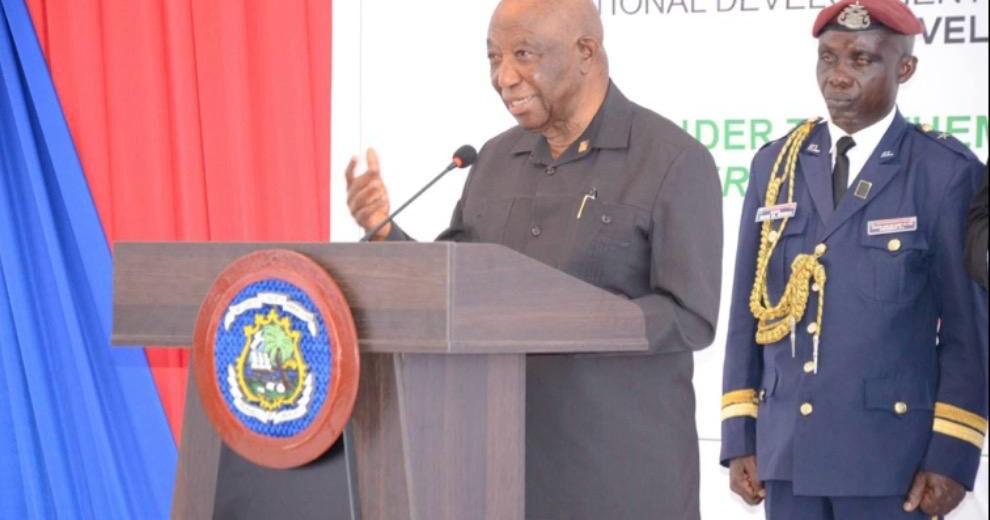
President Joseph Nyuma Boakai, Sr. has put ministries, agencies and other government institutions on notice, demanding accelerated implementation of the ARREST Agenda for Inclusive Development (AAID) and warning that officials who fail to perform could be removed from their positions.
The President said his administration would no longer tolerate implementation delays, weak reporting, institutional bottlenecks or excuses from government officials, stressing that Liberians expect tangible improvements in their lives.
Boakai made the remarks Tuesday, August 11, 2026, during the National Steering Committee meeting on the National Development Plan—the ARREST Agenda for Inclusive Development 2024–2029—held at Monrovia City Hall.
The meeting was held under the theme, “Consolidating AAID Gains, Accelerating Implementation into Measurable and People-Centered Outcomes,” and brought together senior government officials, development partners, members of the private sector, civil society and other stakeholders to assess the first year of AAID implementation and review the draft first- and second-quarter 2026 implementation reports.
In a forceful special statement, President Boakai said the government’s promise when it launched the AAID on January 15, 2025, was to move beyond plans and rhetoric and deliver concrete improvements to the Liberian people.
“When we launched the ARREST Agenda for Inclusive Development in January 15, 2025, our promise to the Liberian people was to move beyond plans,” Boakai said.
“I have seen a lot of plans, plenty of plans. We have seen and heard a lot of rhetoric. We want to deliver tangible results—improve livelihoods, want to drive on better roads, and be able to drink better quality water.”
The President said the National Steering Committee meeting was therefore an opportunity to honestly assess what the government had accomplished, identify weaknesses and determine how implementation could be accelerated.
While acknowledging progress during the first 12 months of implementation, Boakai said achievements had not been consistent across government.
“We have made progress. We must admit,” he said, while commending ministers, government agencies, commissions, the private sector, civil society, development partners and Liberians in the diaspora for their contributions.
He said enhanced coordination among government institutions and increased efforts to mobilize resources for key interventions represented important steps toward sustainable development.
But Boakai warned that the government must also confront areas where implementation had fallen short.
“We must be honest with ourselves that the achievements have not been consistent in the same areas. Efforts fell short. Implementation gaps, delays, institutional bottlenecks were still present,” he said.
The President said those shortcomings require immediate action, insisting that the government must deliver its development agenda within the established timeframe.
“Government is fully dedicated to achieving results, and the people expect better. By national plan, all institutions are hereby on notice to implement the full range of their sector interventions without further delay,” he declared.
Boakai emphasized that the warning was serious, cautioning government officials against allowing travel and other activities to interfere with productivity.
“You could ask for permission to travel. Sometimes we don’t want to say no, but we also see the effect on your productivity. Trust me, we are quite aware of the shortcomings,” he said.
The President said his administration inherited a government with significant institutional and operational challenges but warned that continued excuses would not satisfy Liberians.
“Liberians are not going to forgive you because you have good excuses,” he said.
Boakai also delivered a pointed message on merit, accountability and appointments within government, saying officials should not expect promotions simply because they have political or personal connections.
He said leadership positions must be earned through performance.
“I want to be honest with you that in instances when we see that people are not measuring, with all due respect, we have to ask you to move elsewhere and get rid of people,” the President said.
He explained that reassignment or removal should not necessarily be interpreted as a judgment that an individual is incapable, but rather that the person may be better suited to another responsibility.
“It is not because you are not good, but you may be good for something else,” he said.
Boakai further warned officials against promoting people based on personal relationships.
“Don’t bring people to your office because they relate to you or they are family or friends. They are not going to help you,” he said.
According to the President, government employment and promotion must be based on performance.
“People ask you for a job and you allow them to get a job, then times they come to ask you for you to talk to the people to promote them. I don’t do that. You get a job, you earn a promotion, and promotion, if you have leadership, is based on your performance,” he said.
The President also placed government institutions on notice over delays and weaknesses in submitting implementation reports, describing timely reporting as a non-negotiable obligation.
“Reliable and timely reporting is also necessary for effective governance and for sound decision making,” Boakai said.
“Timely reporting is not a negotiable obligation for every institution implementing AAID interventions.”
He warned that delayed, incomplete or inconsistent reports undermine the government’s ability to measure progress, identify gaps and respond to emerging challenges.
“When the reports are delayed, it weakens coordination, it hampers performance and limits our ability to respond swiftly to emerging issues. It also undermines transparency and accountability,” he said.
Boakai directed ministries, agencies and development partners to submit reports on time and in the agreed format established by the Ministry of Finance and Development Planning.
“Repeated delays, inconsistencies, incomplete submissions are not going to be acceptable, and actions will be taken,” he warned.
He said the government intends to strengthen its data systems and institutional capacity while developing an integrated platform capable of supporting real-time monitoring and reporting.
“Our vision is to develop an integrated system that supports timely reporting and informed decision making at every level,” Boakai said.
Using a football analogy, the President stressed the importance of monitoring performance while government programs are being implemented rather than waiting until the end of the process.
“All of us who watch football have seen at the end of the game, when we lose the game, we sit and it doesn’t help you. The game is over,” he said.
He urged government institutions to provide regular, high-quality reports to enable the National Steering Committee to effectively oversee implementation, make informed decisions and hold institutions accountable.
President Boakai also issued a strong warning over the management of resources by public corporations, saying state-owned resources must be used for national development rather than personal benefit.
“I think some people have the belief that the resources of those corporations belong to them personally. They can use it at their discretion,” he said.
Boakai cautioned public corporation managers against excessive spending and the acquisition of expensive vehicles and other benefits without considering their broader impact on government finances.
“All of those resources are for the development of this country. You don’t just sit down and say, ‘I want to buy so many cars because we make profit.’ The moment you go down, the government becomes responsible to bail you out,” he said.
He said public corporations have a responsibility to manage their resources efficiently while ensuring that those resources contribute to national development.
The President stressed that Liberia’s resources are limited while the expectations of citizens continue to increase.
“It is therefore imperative that every dollar be managed with the highest level of integrity,” Boakai said.
“We have a duty to ensure that the public resources are used wisely and strategically in the ways that deliver real and measurable improvement in the lives of our citizens.”
Boakai called for greater concentration on high-impact interventions capable of directly improving the lives of Liberians.
He identified job creation, education, healthcare, telecommunications, water security and infrastructure as priority areas requiring urgent attention.
“We have a duty to critically evaluate our current position and identify priority areas, enabling us to fast-track high-impact interventions that directly transform the lives of our people,” he said.
The President said the impact of government projects should not be underestimated, noting that the construction of a road or opening of a clinic could have significant consequences for communities.
“You do not know how much the people of the country feel when you open a road. You don’t know when you open a clinic what it means to you. It’s just a clinic, but it’s saving lives, empowering people,” he said.
He urged officials to ensure that resources are directed toward interventions with the greatest possible impact.
Boakai also called for a clearer understanding of what constitutes job creation, saying the government must better communicate with citizens about the employment opportunities being generated through its programs.
The President praised Liberians in the diaspora who continue to return home and contribute to the country’s development, saying their return reflects confidence in Liberia’s progress.
He also commended development partners for their continued support and urged them to align their programs and resources with Liberia’s national priorities.
“Together we can eliminate duplications, maximize impact and accelerate sustainable development,” he said.
Turning to the private sector, Boakai said the AAID provides opportunities for Liberian businesses and investors to contribute to economic growth and industrialization.
“The ARREST Agenda offers an opportunity to invest, innovate and industrialize by unlocking the economy’s potential,” he said.
He called for greater participation of competent Liberian-owned businesses with proven records of performance, saying qualified Liberians should not be treated merely as spectators in the country’s development process.
Boakai also emphasized the role of civil society organizations, describing them as partners and a bridge between government and citizens.
He said civil society should not only identify government weaknesses but should also contribute to improving planning and implementation.
In one of the more reflective portions of his remarks, President Boakai challenged Liberians to change their mindset about poverty and development.
He recalled telling Liberians in the diaspora that while Americans often say, “we shall overcome,” Liberians could perhaps say they would “come over.”
He argued that Liberia possesses many of the natural and human resources needed to provide its citizens with a better standard of living, but that achieving prosperity requires collective effort.
Boakai also reflected on Liberia’s past Poverty Reduction Strategy, questioning whether the national ambition should merely be to reduce poverty or to create genuine prosperity.
“If you want to reduce poverty, you come from poorest to poorer. Do you want to be poor? You say poor,” he said.
The President said Liberia should aspire not merely to reduce poverty but to become a prosperous nation.
“We want to be rich,” he declared.
He stressed that national development cannot be achieved by the government alone and requires responsibility from every citizen.
Using sanitation as an example, Boakai urged Liberians to take personal responsibility for maintaining their communities.
“If you go out in the street there and you litter the street, you are not helping us,” he said.
According to the President, the ARREST Agenda’s focus on inclusive development means every Liberian has a role to play in transforming the country.
The President said Liberia must learn to recognize and build upon its successes rather than constantly focusing on its shortcomings.
He pointed to improvements he observed during a recent visit to Buchanan and said Liberians should be honest enough to acknowledge positive developments when they occur.
“We have to be honest with ourselves. We can do it,” Boakai said.
He urged members of the National Steering Committee to use the meeting to make critical policy decisions, identify implementation bottlenecks and establish strategies for accelerating high-impact projects.
The President said the ultimate responsibility of the committee is to provide strong policy oversight and ensure that every government intervention is aligned with national priorities and delivers measurable results.
He called on implementing institutions to uphold high standards of accountability and performance, warning that corrective action must follow where implementation is inadequate.
“Progress must be tracked. Results must be reported transparently, and where implementation is lacking, corrective action must be taken,” he said.
Boakai concluded by thanking government officials, development partners, private sector actors, civil society organizations and other stakeholders for their participation, saying their presence demonstrated a commitment to Liberia’s development.
He called for renewed collective effort to ensure that the ARREST Agenda moves beyond policy documents and delivers visible improvements in the lives of Liberians.
See more Liberia News Network stories in Google Search by adding LNN as one of your Preferred Sources.
★ Add LNN as a Preferred Source