
By Staff Writer | Smart News Liberia
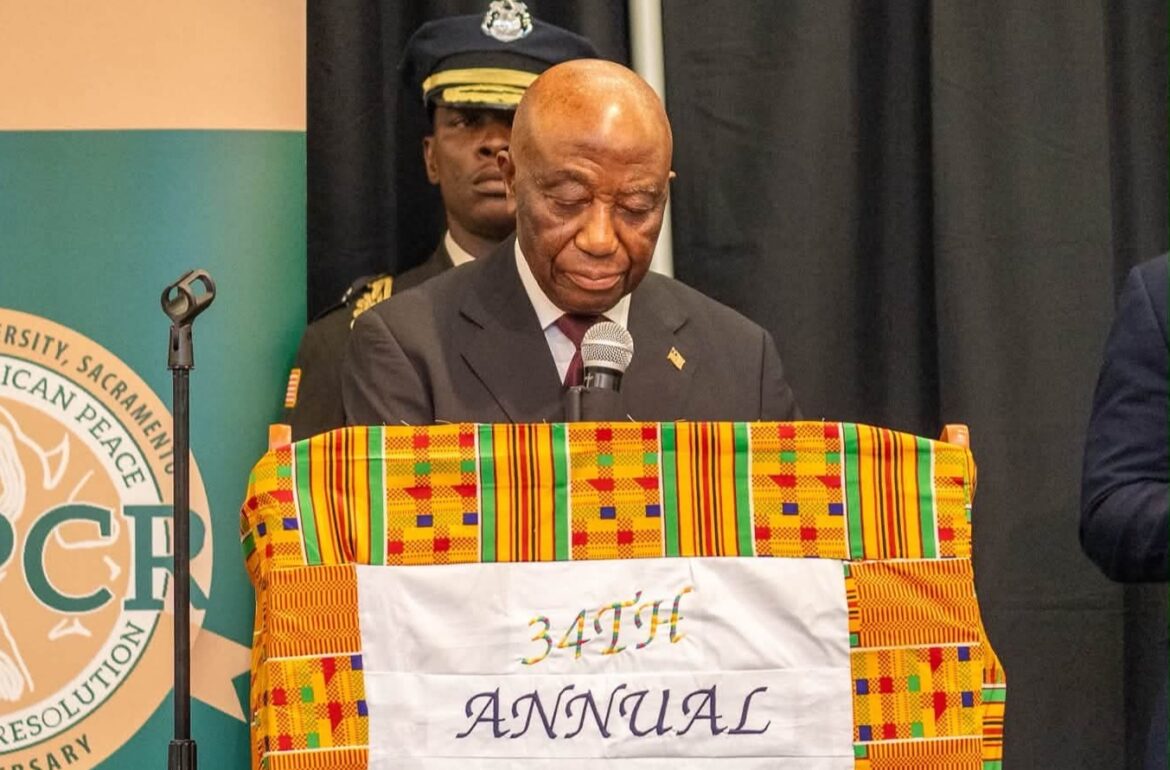
CALIFORNIA, USA – President Joseph Nyuma Boakai has used an international platform in the United States to call for a new generation of peace leaders across Africa, declaring that the continent’s future stability depends heavily on how governments treat and empower young people today. Speaking Saturday, April 25, 2026, at the 34th Africa Peace Awards hosted by the Center for Africa Peace and Conflict Resolution at California State University, Sacramento, Boakai accepted a distinguished peace honor while delivering a sweeping address on conflict prevention, justice, governance, and youth inclusion.
Standing before diplomats, academics, diaspora leaders, students, and members of the Liberian community in Sacramento, President Boakai said he accepted the award “with deep humility and profound gratitude,” thanking the organizers and the university for the recognition. He noted that the honor was not personal, but belonged to the people of Liberia who endured years of war and emerged committed to reconciliation and national renewal.
“This honor is not mine alone,” Boakai declared. “I receive it on behalf of the resilient people of Liberia, men, women, youth, and children who endured conflict and emerged with an unyielding commitment to peace, reconciliation, and renewal.”
The Liberian leader reflected on the nation’s bloody civil conflict between 1989 and 2003, reminding the audience that more than 250,000 people lost their lives while institutions collapsed and families were torn apart. Yet he said Liberia’s greatest triumph was not merely surviving the war, but choosing peace over vengeance when the guns fell silent.
“Even in our darkest hours, the Liberian spirit did not yield,” Boakai said. “We chose reconciliation over revenge. We chose dialogue over division. We chose hope over despair.”
Boakai emphasized that peace should never be viewed simply as the absence of armed conflict. According to him, true peace exists only where justice, opportunity, fairness, and dignity are present. He linked Liberia’s democratic recovery to those principles, citing peaceful political transitions and national efforts aimed at confronting painful chapters of the country’s history.
He told the audience that Liberia is now working to establish a War and Economic Crimes Court, while also undertaking symbolic reconciliation measures including dignified reburials and a national apology process. Boakai said accountability and healing must move together if nations are to build lasting peace.
“Today, we confront our past with honesty,” he stated. “We are working to establish a War and Economic Crimes Court so that accountability and reconciliation move forward together.”
Turning to global affairs, the President warned that violent extremism, climate pressures, inequality, and economic instability are fueling new threats to peace worldwide. He argued that no country is too small to contribute to international peace efforts, pointing to Liberia’s current seat on the United Nations Security Council for the 2026 to 2027 term.
Boakai said Liberia would use its Security Council role to promote diplomacy, cooperation, and dialogue among nations. The statement appeared designed to project Liberia as a nation that has transformed from a symbol of conflict into a contributor to global peacebuilding.
However, the strongest portion of his address focused on Africa’s youth population. Boakai noted that nearly 70 percent of Sub-Saharan Africa’s population is under age 30, describing the demographic reality as both a major opportunity and a serious risk depending on whether leaders act wisely.
“It can serve as a powerful engine for peace, innovation, and development,” he said, “or, if neglected, can become a source of tension, fragility, and conflict.”
He lamented rising youth unemployment, social exclusion, poor educational access, migration pressures, and the exploitation of young people by criminal networks, traffickers, and drug systems. According to Boakai, many young Africans now risk their lives crossing the Sahara and dangerous migration routes because opportunity remains scarce at home.
“This reality of doom must change,” he said firmly. “Governments and national leaders must ensure that the aspirations, energy, and potential of young people are fully integrated into governance and development processes.”
To reverse the trend, Boakai proposed several reforms, including leadership fellowships, mentorship programs, stronger African Union and ECOWAS youth initiatives, and redesigned education systems that teach peacebuilding, civic responsibility, patriotism, and critical thinking from primary school through university.
He also urged African governments to use digital platforms positively, saying technology should mobilize citizens, counter misinformation, promote dialogue, and strengthen cross-border solidarity among young Africans. Traditional youth organizations, student bodies, and civic clubs, he added, should be restructured into centers for mediation, peace mentorship, and democratic engagement.
In a passionate direct message to young people, Boakai said leadership is not reserved for presidents or diplomats. He said teachers, entrepreneurs, community leaders, and ordinary citizens who reject hatred are also peace leaders. “Do not underestimate your power. Do not underestimate your voice. Leadership is defined by purpose,” he said.
The Liberian President also praised the historical partnership between the Sacramento-based peace center and the University of Liberia during the 1990s, noting that training programs for Liberian officials during the civil war years helped shape reconciliation efforts that continue today.
Closing his remarks, Boakai said accepting the award came with renewed responsibility to build a just, inclusive, and prosperous Liberia while supporting peace across Africa and beyond. “Let us move forward together, with faith, with purpose, and with unwavering dedication to peace,” he urged. “Seek peace and pursue it.”
