
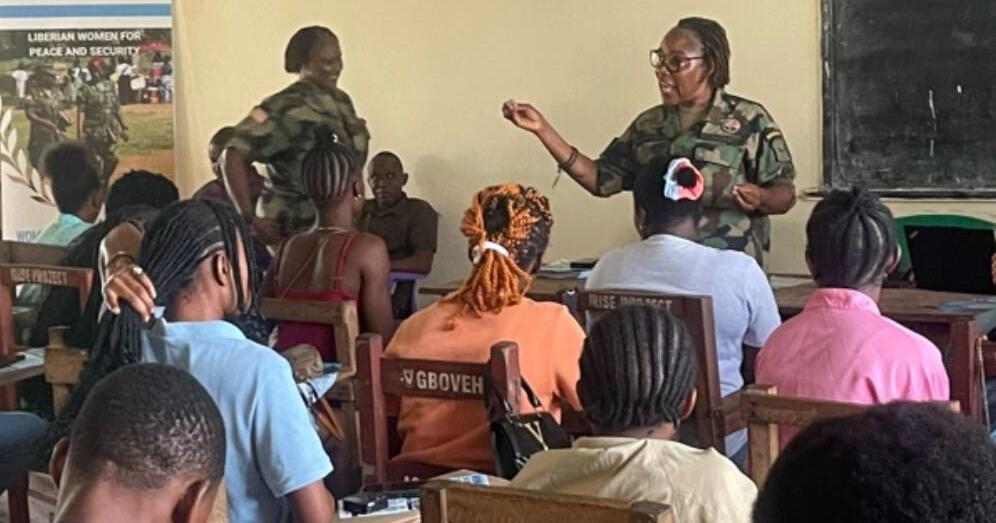
The Ministry of National Defense has launched a nationwide campaign to encourage more young women to enlist in the Armed Forces of Liberia (AFL), signaling a renewed effort to address one of the country’s most persistent gender gaps in the security sector while strengthening Liberia’s capacity to meet international standards on women’s participation in peacekeeping and defense.
The awareness campaign, which commenced in Gbarnga, Bong County, is the first phase of a nationwide initiative expected to reach all 15 counties by 2030. It targets high school students, recent graduates, parents, traditional leaders, religious institutions and community organizations in an effort to dismantle long-standing social and cultural barriers that have limited women’s participation in military service.
The initiative comes at a time when governments around the world are increasingly recognizing that modern armed forces require diverse skills extending far beyond combat, including medicine, engineering, intelligence, logistics, information technology, aviation, communications and leadership.
For Liberia, officials say increasing female participation is not merely about meeting numerical targets—it is about building a more professional, inclusive and effective security institution.
According to the Ministry of National Defense, women currently account for only 7.4 percent of personnel within the Armed Forces of Liberia—well below both the government’s aspirations and international expectations for gender representation in security institutions.
Authorities now hope to increase female participation to between 20 and 25 percent by 2030, with a long-term objective of reaching 30 percent.
Speaking during the outreach at Dolokelen Gboveh High School, the Ministry’s Director of Public Affairs, Anthony M.K. Boakai, said the campaign represents a deliberate effort to reverse years of underrepresentation.
“The sole intent for this exercise is to encourage females to join the Armed Forces of Liberia.”
He explained that outreach teams have simultaneously been deployed to Bomi, Grand Cape Mount, Gbarpolu, Bong, Lofa and Nimba Counties as part of the campaign’s first phase.
“We are actually in Bong County, and not just Bong County, but we have dispatched a team to six different counties,” Boakai said.
Beyond the Battlefield
One of the campaign’s central messages seeks to challenge the widespread perception that military service is synonymous only with combat.
Boakai stressed that today’s Armed Forces require professionals across numerous disciplines, creating opportunities for women with diverse educational backgrounds and career aspirations.
“It is not just about joining the army. We want to highlight to our females that the Armed Forces of Liberia is not just limited to guns.”
“While we agree that military service involves weapons, there are many opportunities for females, especially at the level of decision-making in the Armed Forces of Liberia and other security institutions.”
His remarks reflect a broader transformation occurring in military institutions globally, where armed forces increasingly rely on highly skilled professionals in healthcare, engineering, cyber security, transportation, logistics, finance and administration.
The Ministry highlighted examples already serving within the AFL, including a female physician who heads the 14th Military Hospital and women serving in technical and transport roles.
“One of the women serving in the military currently heads the 14th Military Hospital,” Boakai noted.
Security experts have long argued that increasing women’s participation strengthens military effectiveness rather than simply advancing gender equality.
Female personnel often play critical roles in peacekeeping operations, humanitarian missions, community engagement, intelligence gathering and conflict prevention.
Their presence can improve interactions with women and children during security operations, enhance trust between security institutions and communities, and broaden the range of skills available within the armed forces.
For Liberia, which has emerged from years of civil conflict and remains committed to sustaining peace, a more gender-balanced military could also reinforce public confidence in national security institutions by reflecting the diversity of the society they serve.
The initiative is also consistent with the United Nations Women, Peace and Security Agenda, which encourages member states to increase women’s participation in conflict prevention, peacebuilding and security institutions.
Boakai acknowledged that Liberia remains below the benchmark expected of countries contributing to international peacekeeping missions.
“At the level of the United Nations, every contributing country is expected to meet a benchmark in terms of female representation, and Liberia is way below that standard.”
Improving female representation could therefore enhance Liberia’s readiness for future peacekeeping deployments while strengthening its international standing.
Addressing Historical Barriers
The current campaign follows an assessment conducted in 2022, which identified significant barriers discouraging women from pursuing military careers.
According to Boakai, those findings prompted UN Women, through the SA Initiative Fund, to support a long-term program designed not only to recruit women but also to retain and professionally develop them.
“An assessment was carried out in 2022, and it was identified that there were serious barriers that needed to be addressed.”
“Based on those findings, UN Women came in through the SA Initiative Fund to help bridge those gaps.”
The partnership extends beyond awareness campaigns to include mentorship, training and professional development opportunities for female military personnel.
“This awareness is being sponsored by UN Women through the SA Initiative Fund,” he said.
“The fund will also extend to maintaining our females in the army, providing opportunities and training for them so that they can contribute at the level of the United Nations.”
While encouraging greater female participation, Boakai emphasized that recruitment standards remain unchanged.
Applicants—whether male or female—must be Liberian citizens between the ages of 18 and 35, possess a high school diploma and valid WASSCE credentials, and satisfy all existing military entry requirements.
“The standards set by the Armed Forces of Liberia do not change. Whether you are male or female, the requirements remain the same.”
He also dismissed suggestions circulating on social media that the initiative was connected to previous recruitment controversies.
“This has nothing to do with what happened on Facebook during previous recruitment exercises,” he clarified.
“What we are doing is encouraging more women because we believe they are not taking advantage of the opportunities available within the Armed Forces.”
Recognizing that career decisions are often shaped by families and communities, the Ministry extended the outreach beyond students.
Following the school engagement, officials met with chiefs, religious leaders, youth organizations, women’s groups, opinion leaders and county authorities at the Bong County Administrative Building.
Boakai said community involvement is essential to changing perceptions about military careers for women.
“These young women belong to families and communities. Sometimes the decisions they make require the support of their parents and leaders.”
By involving community stakeholders, the Ministry hopes to overcome social stereotypes that have historically discouraged women from pursuing careers in the military.
The campaign reflects broader efforts by Liberia to modernize its security sector while promoting gender equality in public institutions.
Increasing women’s representation is expected to diversify leadership, expand professional opportunities for young women and strengthen institutional decision-making by drawing on a wider range of experiences and perspectives.
The initiative could open pathways to stable employment, professional training, leadership development and international peacekeeping opportunities for the targeted demographic, while it offers an opportunity to recruit talent from a much larger segment of the population at a time when modern security challenges demand specialized expertise alongside traditional military skills.
However, the success of the initiative will ultimately be measured not simply by the number of women recruited, but by whether those women are supported, retained and empowered to rise through the ranks as leaders in the country’s defense institutions.
If sustained, the campaign could help reshape perceptions of military service—from an institution traditionally dominated by men to one where competence, professionalism and service to the country define opportunity, regardless of gender.
