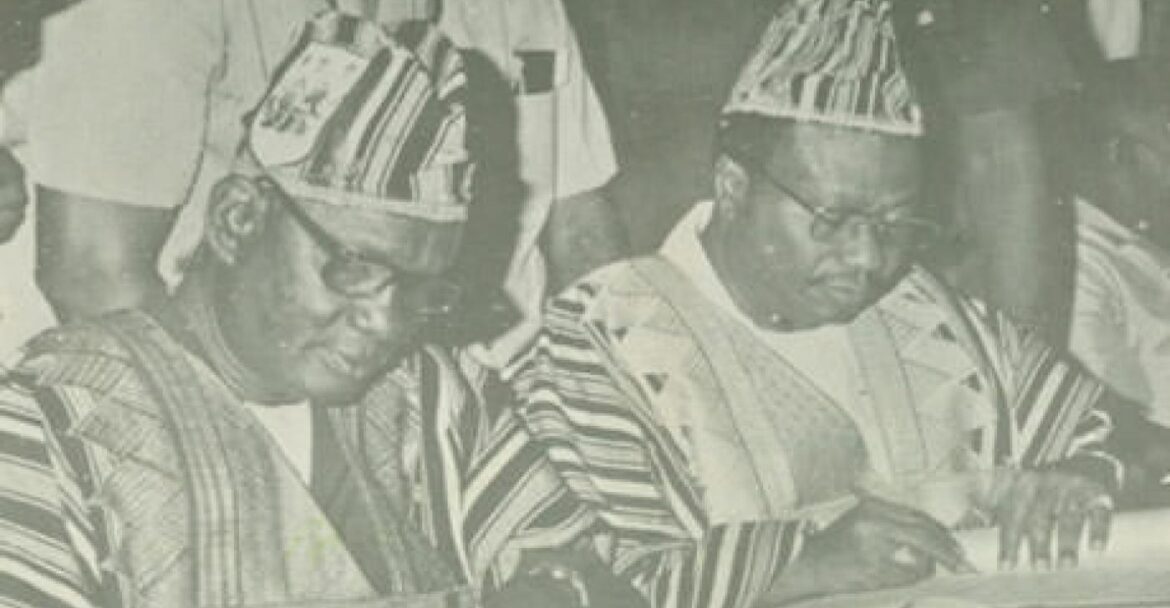
On October 3, 1973, Liberia and Sierra Leone were more than just neighboring countries; they were starting to realize that their futures were intertwined. Over fifty years later, the Mano River Union (MRU) stands as a significant reminder that Liberia’s fate is closely linked to the stability and prosperity of its neighboring nations.
\n
There are moments in history that seem ordinary at the time. They don’t come with the sound of gunfire or the chaos of revolutions. No immediate monuments are built to commemorate them.
Sometimes, history unfolds quietly—two leaders at a table, signing a document whose impact will last long after they are gone.
\n
October 3, 1973, was one of those moments. In Malema, Sierra Leone, Liberian President William R. Tolbert Jr. and Sierra Leonean President Siaka P. Stevens signed the Mano River Declaration, which established the Mano River Union between their nations.
This was not just a regional ambition; it was also a practical decision based on geography. The two countries shared borders, communities, cultures, markets, and generations of social ties. The river that inspired the organization flows from Guinea through the region and along part of the Liberia-Sierra Leone border.
\n
The leaders recognized a truth that is still painfully relevant today: While political borders can divide nations, they do not necessarily divide people, economies, or the challenges they face.
The original vision for the MRU was primarily focused on economic collaboration. Liberia and Sierra Leone aimed to create a customs union, eliminate trade barriers, enhance productive capacity, and strengthen cooperation in agriculture, manufacturing, and other sectors.
\n
The declaration made a clear connection between economic collaboration and enduring peace, friendship, freedom, and social advancement. This last point is crucial.
The founders were not merely looking to facilitate the movement of goods; they were striving to lay the groundwork for neighboring countries to thrive together.
\n
THEN CAME THE WARS
History would ultimately challenge that vision. Guinea became part of the Union in 1980, followed by Côte d’Ivoire in 2008, forming the four-country alliance we see today: Liberia, Sierra Leone, Guinea, and Côte d’Ivoire.
\n
Howbeit, the region soon faced one of its darkest chapters. Civil wars ravaged Liberia and Sierra Leone, leading to consequences that transcended national borders. Refugees fled from one country to another, communities were torn apart, armed groups operated across boundaries, and economies were thrown into disarray. The very regional environment that the MRU aimed to bolster became one of the main casualties of conflict.
According to the MRU Secretariat, the wars from 1991 to 2003 severely hampered the Union’s initial objectives and weakened its institutions. This is where the narrative of October 3 takes a remarkable turn.
\n
The organization, initially focused on economic cooperation, took on a new, perhaps even more pressing, role: that of peacekeeping. The region learned through hardship that economic integration cannot endure in the face of prolonged instability.
A customs union holds little value when roads are in ruins. Trade agreements are meaningless when borders are perilous. Economic strategies are futile when communities are fleeing from war. And development efforts are hollow when security cannot be assured.
\n
Thus, history compelled the MRU to evolve beyond the institution its founders had originally imagined.
LIBERIA’S NEIGHBORS ARE LIBERIA’S CONCERN
\n
October 3 holds significant importance for Liberia today. The country is situated in a region where three of its immediate neighbors—Sierra Leone, Guinea, and Côte d’Ivoire—are also part of the MRU.
This geographical positioning brings both opportunities and responsibilities. Liberia cannot afford to detach itself from the events occurring at its borders.
\n
If trade flourishes throughout the region, Liberian businesses stand to gain. Improvements in regional infrastructure can benefit Liberian communities. Enhanced border security translates to advantages for Liberia.
Moreover, when neighboring countries experience peace and political stability, Liberia’s own security situation becomes more favorable.
\n
However, if instability resurfaces anywhere in the Mano River basin, Liberia cannot take for granted that the repercussions will stay beyond its borders.
Indeed, geography has made regional cooperation essential rather than optional.
\n
THE MRU IS NO LONGER JUST ABOUT TRADE
The organization that arose from the Malema Declaration has undergone significant changes over time. Currently, the MRU focuses on various key areas, including peace and security, good governance, economic integration, social and cultural development, as well as trade, industry, and job creation.
\n
This evolution reflects the broader narrative of West Africa itself, where the challenges faced by the region have become increasingly intertwined.
A dispute over borders can escalate into a security issue, which in turn may lead to a humanitarian crisis. Such a crisis can disrupt trade, and when trade is disrupted, it can exacerbate poverty.
\n
This cycle of poverty can place additional strain on communities that are already vulnerable. Thus, the reasoning is straightforward: what poses a threat to one nation can ultimately impact its neighbors, while what bolsters one nation can also uplift its neighbors. This interconnected logic is the foundation upon which the MRU was established.
FOR LIBERIA, THE BORDER IS THE FRONTLINE
\n
In Liberia, the significance of the MRU is particularly evident at its borders. For generations, Liberians and their neighbors have engaged in trade across these frontiers.
Families and ethnic groups extend beyond national lines, and markets link communities that predate the modern borders drawn on maps.
\n
This underscores that border cooperation is not just a bureaucratic issue; it’s fundamentally about people. It involves the farmer seeking access to a market, the woman transporting goods across the border, and families divided by national lines yet united by shared history.
It encompasses transportation, customs, security, and the flow of legitimate trade, while also aiming to prevent borders from becoming sources of conflict.
\n
The Liberian government has actively engaged in MRU initiatives focused on integrated border governance and peaceful collaboration, including talks regarding Liberia’s borders with Sierra Leone, Guinea, and Côte d’Ivoire.
Liberian officials have articulated a broader goal: to transform borders from potential flashpoints of conflict into areas of cooperation, trade, and development. This is where the essence of October 3 resonates with contemporary Liberia.
\n
THE UNFINISHED PROMISE OF 1973
However, there is another question that Liberia needs to address. Has the region truly embraced the potential of October 3? The answer to this question is complex.
\n
The MRU has endured war, institutional fragility, and political turmoil. Its very existence is noteworthy. Yet, mere survival does not equate to achieving its goals. The initial declaration aimed for enhanced trade, fewer barriers, and greater productive capacity.
More than fifty years later, those aspirations remain unfulfilled. The region still grapples with significant development hurdles. Many young individuals find it difficult to secure meaningful employment. Cross-border trade can still be a challenge. Infrastructure is lacking in numerous areas.
\n
Additionally, the region continues to face security issues that necessitate collaboration rather than isolated national efforts.
Thus, October 3 should not just be a day of celebration; it should prompt critical reflection. What has become of the vision for a genuinely integrated Mano River economy? Why do traders moving from Liberia to Sierra Leone still face obstacles in an era when African nations are discussing continental free trade? Why do communities located just miles apart experience different economic conditions simply because a national border separates them? And how can the MRU become more relevant to the young people of Liberia, Sierra Leone, Guinea, and Ivory Coast who have inherited this organization? These are the pressing questions that should shape the next chapter.
\n
A LESSON FROM TOLBERT AND STEVENS
No matter what history tells us about the politics of that time, the initiative on October 3 highlighted a crucial strategic concept: Neighbors cannot thrive in isolation from each other.
\n
Tolbert and Stevens recognized that working together could open doors to opportunities that neither nation could easily achieve on its own.
Since 1973, the world has undergone significant changes. The Cold War has ended, Liberia has faced devastating civil wars and is being rebuilt, Sierra Leone has also made strides in recovery, Guinea has seen major political shifts, and Côte d’Ivoire has gone through its own cycles of conflict and healing.
\n
Despite these transformations in the global economy, one truth remains unchanged: Liberia is still a neighbor to its neighboring countries. The nation cannot shift its borders, relocate the Mano River, move its citizens, or avoid the impacts—whether positive or negative—of events occurring in its vicinity.
OCTOBER 3 SHOULD BE MORE THAN A DATE
\n
The key takeaway from October 3 is significant. The Mano River Union emerged from a concept that now seems almost self-evident: nations that share geography, history, and economic interests are motivated to work together.
Howbeit, in a region that has faced some of Africa’s most severe conflicts, this straightforward idea turned into a matter of survival.
\n
Today, Liberia has a chance to revitalize the MRU’s purpose—not just through speeches or ceremonial gatherings, but through tangible collaboration. This includes improving infrastructure like roads, facilitating legitimate trade, enhancing border management, coordinating security efforts, fostering agricultural partnerships, creating job opportunities for youth, and developing regional infrastructure.
The MRU’s current agenda focuses on peace, unity, prosperity, and economic integration among its four member countries. This agenda is not obsolete; in fact, it is more pressing than ever.
\n
The challenges Liberia faces today often do not respect national borders. Organized crime, smuggling, disease, climate impacts, migration, and insecurity can all cross borders before diplomats even have a chance to convene.
Thus, the solution must go beyond merely reinforcing national borders; it requires a commitment to stronger regional cooperation.
\n
THE RIVER STILL FLOWS
More than fifty years after October 3, 1973, the Mano River continues to flow. The borders still exist. The people are still here. The shared history endures. And the promise remains intact.
\n
The signatures of William Tolbert and Siaka Stevens forged something that withstood the wars that nearly obliterated it. That alone warrants historical significance.
However, the true measure of the Mano River Union lies not in its survival but in its ability to fulfill the vision its founders had. A vision where a Liberian trader can easily transport goods to neighboring markets. A vision where communities along the borders view those lines as connections rather than obstacles. A vision where regional disputes are resolved through conversation instead of conflict. A vision where the prosperity of Monrovia is linked to the prosperity of Freetown, Conakry, and Abidjan.
\n
Most importantly, a vision where the children of the Mano River basin inherit collaboration instead of strife. This is why October 3 should be commemorated. It marked the day Liberia and Sierra Leone recognized that their futures were too intertwined to be handled separately.
The Mano River Union was established in Malema in 1973, initially aimed at economic cooperation. History turned it political, and war transformed it into a quest for peace.
\n
Today, development necessitates that it becomes more relevant than ever. October 3 was not just the day two presidents endorsed a declaration; it was the day a region began to articulate an idea that remains a work in progress: that Liberia’s future is, in many respects, inextricably linked to that of its neighbors.
See more Liberia News Network stories in Google Search by adding LNN as one of your Preferred Sources.
★ Add LNN as a Preferred Source