
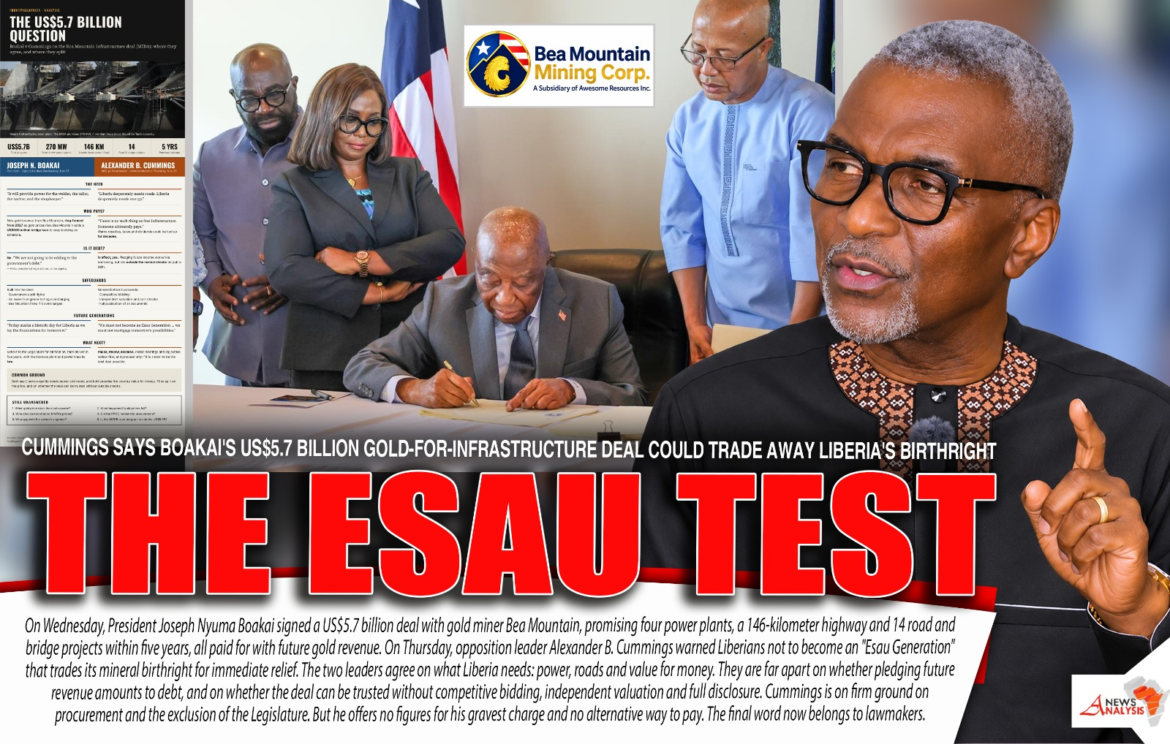
MONROVIA – A day after President Joseph Nyuma Boakai signed what his government calls the largest infrastructure program in Liberia’s history, the opposition’s most prominent economic voice has asked a pointed question: who pays?
Addressing a news conference Thursday, Alternative National Congress (ANC) political leader Alexander B. Cummings compared the deal to the biblical Esau, who sold his birthright for a single meal. “We must not become an Esau Generation,” he said.
What Was Signed
Boakai promised to deliver four new power plants, a national transmission network and 14 major road and bridge projects within five years under the US$5.7 billion agreement he signed Wednesday with Bea Mountain Mining Corporation. Under the Master Infrastructure Development Agreement (MIDA), the deal would add 270 megawatts of electricity through four new power plants, more than three times the capacity of the Mount Coffee hydropower plant, and build a 146-kilometer highway.
The government’s case rests on how the deal is paid for. The President said the government would use higher gold prices to “ring-fence new revenue streams” from BMMC beginning in 2027 to fund the projects, and BMMC also agreed to a US$500 million bridge financing facility to keep construction on schedule. In other words, Liberia pays no cash up front. It pays with gold revenue it expects to collect in the future.
Two Speeches, Two Days
Set side by side, the President’s speech on Wednesday and Cummings’ remarks on Thursday agree on what Liberia needs. They part ways on the price.
Both start with the same hardship. Boakai spoke of ordinary people the deal would reach, saying “It will provide power for the welder, the tailor, the barber, and the shopkeeper,” and pointing to children studying at night and clinics keeping equipment running. Cummings opened on the same ground: roads that cannot be used in the rainy season, millions without reliable electricity, and farmers who cannot get their produce to market. “Liberia desperately needs roads. Liberia desperately needs energy,” he said. On the problem itself, there is no disagreement.
Both reach for a food metaphor. Boakai anticipated his critics in the language of the market: “I know some Liberians will ask, ‘Da What will we Eat?’ That is a legitimate concern.” Cummings answered with Esau’s meal: “His hunger was real. His need was genuine. But the price he paid was far greater than the temporary relief he received.” Boakai’s message is that Liberians will see real benefits from the deal. Cummings’ warning is that satisfying today’s hunger could cost the country something far more valuable.
Both speak for future generations, to opposite ends. Boakai called the signing “a historic day for Liberia as we lay the foundations for tomorrow.” Cummings warned that “in our urgency to solve today’s problems, we must not mortgage tomorrow’s possibilities.” To the President, the deal is a gift to future generations. To Cummings, it is a bill they may be left to pay.
They disagree on whether this is debt. The government insists the deal adds no borrowing. The President’s legal adviser, Keita, said “So we are not going to be adding to the government’s debt, and that is a big deal for all of us.” Cummings rejects the premise: “There is no such thing as free infrastructure. Someone ultimately pays.” His concern is precisely that pledging future revenue lets the government take on a debt-like obligation “outside traditional public debt transparency mechanisms.” The two sides are not arguing about the same numbers. They are arguing about whether committing future income counts as borrowing.
Both claim value for money. Boakai said “We wanted to make sure we got the best for our money and for the future.” Cummings’ closing line uses nearly the same words: infrastructure “at the right price, under the right conditions.” The difference is proof. The government points to safeguards it says are already written into the deal: audit rights and an owner’s engineer to monitor every stage and flag inferior materials or overcharging, and Keita added that “The company even agreed to be fined if they ever overcharge us.” Cummings wants independent valuation, independent certification and full publication of the documents. Both men are addressing the same risk, overcharging. The question is whether the government’s in-house safeguards are enough, or whether the checks must come from outside.
What the President left out. Published accounts of Wednesday’s speech do not mention competitive bidding, the Public Procurement and Concessions Commission, the role of the Legislature, or who will build the projects. Those gaps are exactly where Cummings focused on Thursday.
The Cummings Argument
Cummings went out of his way to say he is not against the deal itself. “We are not opposed to infrastructure development. We are not opposed to investment,” he said. “What we oppose is lack of transparency.”
He listed ten concerns. They include:
• possible breach of the Public Procurement and Concessions Act;
• no competitive bidding;
• no independent valuation or engineering assessment;
• possible overpricing;
• automatic deductions from future government revenue;
• conflict-of-interest risks.
He then set out ten conditions he says must be met before the deal proceeds. Among them: publication of all transaction documents, legislative hearings, an independent debt sustainability analysis, and independent certification of project costs and completed works.
Where the Criticism Lands
On several points, the public record supports him.
No competitive bidding. Reporting on the deal shows that MAPA İnşaat ve Ticaret A.Ş. is identified as the engineering and construction contractor. The Turkish Contractors Association identifies Mehmet Günal as MAPA’s chairman and Murathan Günal as deputy chairman, linking the family to both sides of the deal. In practical terms, the company financing the projects and the company building them appear to share the same family owners. The Liberian Observer found no description of a competitive tender for selecting MAPA, and noted that the government has not publicly released its independent financial due diligence or any comparative assessment of contractors. The paper was careful to add that common ownership is not, by itself, evidence of improper conduct, but it matters when judging how the contracts are priced and supervised.
That is also why the government’s owner’s engineer matters, and why Cummings is right to ask who appoints that engineer and who that engineer answers to. Cummings lists “governance and conflict-of-interest concerns” but never names MAPA or the Günal family. That was the most concrete point available to him, and he left it out.
The Legislature was not at the table. Senator Abe Darius Dillon has said the National Legislature had no role in negotiating or signing the deal. That supports Cummings’ call for legislative review and public hearings before ratification.
The final cost is unclear. Cummings warns that the real bill could be higher than US$5.7 billion. The published project list gives him some support. Alongside the power and road works, the government has announced a further US$1 billion for road networks across all regions, and it is not clear whether that is part of the US$5.7 billion or on top of it. Keita also defended the cost by saying the Via dam is designed to expand to at least 1,000 megawatts. If that expansion is part of the plan, its cost, and who pays for it, has not been disclosed.
Where It Falls Short
Cummings’ case is stronger on principle than on evidence.
His most serious charge is that royalties, income taxes, dividends and other government revenues from Liberia’s natural resources could be “redirected toward repayment — for decades.” But he supports this only with “indications.” He does not cite a clause, a figure or a document.
The government’s position is narrower. It says it will use extra revenue that higher gold prices make possible, while the company will also keep making its regular payments into the Consolidated Account. Who is right depends on how much that “extra” revenue is, how it is calculated, and what happens if gold prices fall. Neither the President on Wednesday nor Cummings on Thursday put those numbers before the public.
The scale is worth noting. LEITI’s FY2023 reconciliation report lists government revenues attributed to Bea Mountain at approximately $33.47 million for that fiscal year. Gold prices have risen sharply since then. Even so, paying off a US$5.7 billion program from one mine’s revenue would require gold earnings far above anything Liberia has recorded. Cummings could have made that point with hard figures. Instead, he leaned on the Esau story.
Nor does he say what he would do instead. He calls on the government to consider “alternative financing models” that could be cheaper, but he names none. For a former Coca-Cola executive who is expected to seek the presidency again in 2029, that is a missed opportunity to show how he would pay for 270 megawatts of electricity without the gold.
His description of the deal as “a human rights issue” may also strike some readers as overreach. His stronger points are the plainer ones: procurement, valuation and disclosure.
The Politics
Cummings insists this “is not a government-versus-opposition issue.” Even so, his remarks position him as the opposition’s guardian of the public purse, a role he has built since 2017.
That leaves two competing messages. The President promises the welder and the barber electricity and roads within five years. Cummings warns that the meal may cost the birthright. With much of the country still without reliable electricity, the President’s message may be the easier one for voters to accept.
What Comes Next
The deal now goes to the Legislature for ratification. That is where the two speeches will be tested against each other.
Dillon has said he wants the agreement scrutinized before any vote but has not said which way he leans. The questions lawmakers can fairly ask are the ones neither the President nor his critic fully answered:
• How much new revenue does the deal assume, and at what gold price?
• What happens to the repayment schedule if gold prices fall?
• Was MAPA’s pricing independently checked, and against what benchmark?
• Who appoints the owner’s engineer, and who does that engineer report to?
• Did the PPCC review the procurement?
• Is the US$1 billion road program inside or outside the US$5.7 billion?
On Wednesday, the President said the deal would lay “the foundations for tomorrow.” On Thursday, Cummings said history will judge the agreement not by “the speeches delivered on signing day,” but by what remains in 20, 30 and 40 years. Both men are appealing to the same future, and only the Legislature’s scrutiny of the deal will show which of them is right about it.
See more Liberia News Network stories in Google Search by adding LNN as one of your Preferred Sources.
★ Add LNN as a Preferred Source