
Published: August 29, 2026
BY NELSON CHEA WLEH
Reg Number 2405000251
A DISSERTATION SUBMITTED TO THE SCHOOL OF GRADUATE STUDIES IN PARTIAL FULFILLMENT OF THE REQUIREMENTS FOR THE AWARD OF MASTER OF BUSINESS ADMINISTRATION IN ACCOUNTING AND FINANCE OF THE UNIVERSITY OF KIGALI
AUG, 2026
This dissertation is my original work and has not been submitted or presented to any other university or institution of higher learning.
Signature………………………… Date…Aug……/…5………/2026
This dissertation has been submitted for examination with the approval of the university supervisor.
Signature………………………… Date……Aug…/……05……/2026
Dr. Tarus Thomas ……………………
Lecturer, University of Kigali
To
I lovingly dedicate this dissertation to my beloved Mother, Nancy Munah Tiklo, who unwavering
love, prayers, sacrifices, and encouragement have been the foundation of my journey. Your
Strength, wisdom and constant belief in me inspired me to preserve through every challenge of
life. This achievement is as much yours as it is mine. Thank you for being my greatest source of
hope and motivation all through the years. I am forever grateful and proud to dedicate this
milestone to you.
Thank you so much Munny and without doubt, you are the hero in this Milestone.
TABLE OF CONTENTS
DECLARATION.. ii
APPROVAL.. iii
DEDICATION.. iv
ACKNOWLEDGEMENTS. v
ABBREVIATIONS AND ACRONYMS. ix
LIST OF TABLES. x
LIST OF FIGURES. xi
OPERATIONAL DEFINITION FOR THE KEY TERMS. xii
ABSTRACT.. xiii
CHAPTER ONE.. 1
GENERAL INTRODUCTION.. 1
1.0. Introduction. 1
1.1 Backgroundof the stud 1
1.2. Statement of the problem.. 3
1.3 Objective of the study. 4
1.3.1 General objective. 4
1.3.2 Specific Objectives. 4
1.4 Research hypotheses 5
1.5 Significance of the Study. 5
1.5.1 To the Researcher 5
1.5.2 To the University. 5
1.5.3 To Policy Makers. 6
1.5.4 To BPR Rwanda Plc. 6
1.6 Scope of the Study. 6
1.6.1 Content Scope. 6
1.6.2 Geographical Scope. 7
1.6.3 Time Scope. 7
CHAPTER TWO: 8
LITERATURE REVIEW… 8
2.1. Introduction. 8
2.2. Conceptual review.. 8
2.2.1. Internal audit in banking Sector 9
2.2.1.1. Audit Independence. 10
2.2.1.3. Audit risk -Based 12
2.2.1.4. Audit Scope Coverage. 13
2.2.1.5. Audit Objectivity. 14
2.2.2. Financial Fraud Prevention. 15
2.3. Theoretical review.. 16
2.3.1. Agency Theory. 17
2.3.2. Fraud Triangle Theory. 18
2.3.3. Resource-Based View (RBV) Theory. 19
2.4. Empirical review.. 21
2.4.1 Audit Independence and Financial Fraud Prevention in Commercial Banks 21
2.4.2 Audit Staff Competency and Financial Fraud Prevention in Commercial Banks. 22
2.4.3 Audit Risk-Based Approach and Financial Fraud Prevention in Commercial Banks 23
2.4.4 Audit Scope Coverage and Financial Fraud Prevention in Commercial Banks. 24
2.4.5 Audit Objectivity and Financial Fraud Prevention in Commercial Banks. 25
2.5. Research gap. 26
2.7. Conceptual framework. 27
CHAPTER THREE: 30
RESEARCH METHODOLOGY.. 30
3.1. Research Design. 30
3.2. The population of the study. 31
3.3. Sample size. 31
3.4. Sampling technique. 31
3.5 Data Collection Instruments. 31
3.5.1 Questionnaire. 32
3.5.2 Document Review.. 32
3.6. Validity and Reliability. 33
3.6.1Validity. 33
3.6.2. Pilot of Instruments 33
3.6.3. Reliability of Instruments. 34
3.7 Processing of Data. 34
3.7.1 Editing. 34
3.7.2 Coding. 35
3.7.3 Transformation. 35
3.8.1 Descriptive Statistics. 35
3.8.2. Inferential statistics. 36
3.9 Research Limitations. 39
3.10 Ethical Considerations 39
REFERENCES. 40
APPENDICES. 44
CVI : Content Validity Index
UK : United Kingdom
RWF : Rwandan Franc
BNR : National Bank of Rwanda
BPR : Banque Populaire du Rwanda
Plc : Public Limited Company
PwC : PricewaterhouseCoopers
RBV : Resource-Based View
KPMG : Klynveld Peat Marwick Goerdeler
IIA : Institute of Internal Auditors
CFE : Certified Fraud Examiner
IT : Information Technology
VIF : Variance Inflation Factor
SPSS : Statistical Package of Social Science
UoK : University of Kigali
Table 3.1. Population of the study. 31
Table 3.2: Evaluation of Mean. 36
Table 3.3: Evaluation of standard deviation. 36
Figure 2.1 Conceptual framework. 29
Internal Audit: Internal audit is an independent and objective assurance function that evaluates and strengthens internal controls, risk management, and governance processes to enhance fraud detection, ensure compliance, and prevent financial losses within an organization (Institute of Internal Auditors, 2020).
Audit Independence and Objectivity: Audit independence and objectivity refer to the ability of internal auditors to perform unbiased assessments without influence from management, thereby improving the credibility of audit findings and enhancing the detection and prevention of fraudulent activities (Arens et al., 2017).
Audit Staff Competency and Fraud Detection: Audit staff competency and fraud detection refer to the auditors’ professional skills, knowledge, and experience that enable them to effectively identify, analyze, and respond to fraud risks, thereby increasing the fraud detection rate within an organization (Singleton & Singleton, 2010).
Compliance with Internal Controls and Risk Mitigation: Compliance with internal controls and risk mitigation refers to the extent to which established control procedures are followed to minimize exposure to fraud risks, enhance operational efficiency, and prevent financial losses (COSO, 2013).
Audit Scope Coverage and Financial Loss Reduction: Audit scope coverage and financial loss reduction refer to the breadth and depth of audit activities across all operational areas to ensure comprehensive evaluation, early identification of irregularities, and reduction of financial losses caused by fraud (Albrecht et al., 2019).
This study examined the effect of internal audit practices on financial fraud prevention in the banking sector, with specific reference to BPR Rwanda Plc. The study adopted a descriptive and explanatory research design and targeted 155 employees, from which a sample of 123 respondents was selected using purposive sampling. Data were collected through questionnaires, interviews, and document review and analyzed using descriptive statistics and multiple regression analysis. The findings revealed positive perceptions of internal audit practices, with overall mean scores of 3.98 for audit independence, 4.08 for audit staff competency, 4.04 for audit risk-based approach, 3.99 for audit scope coverage, and 4.03 for audit objectivity. Financial fraud prevention was also positively assessed with an overall mean score of 3.99. The regression results confirmed that internal audit practices significantly influenced financial fraud prevention, with the model explaining 80.8% of the variation in fraud prevention outcomes (R² = 0.808). The ANOVA results confirmed the significance of the model (F = 50.436, p
Keywords: Internal audit, financial fraud prevention, audit independence, audit staff competency, Audit risk-based, BPR Rwanda Plc.
The chapter presents the general background of the study, problem statement, and objectives of the study, hypotheses of the study, scope of the study and significance of the study.
Banks are financial institutions whose primary function is the mobilization of savings from surplus economic units and the allocation of these funds to deficit units through credit and other financial services. Lim et al. (2020) explain that this intermediation role enhances capital formation and economic efficiency, while Rahmah and Kamilah (2022) emphasize that banking services contribute significantly to improved standards of living through financial inclusion. Similarly, Sidharta and Affandi (2016) argue that banks facilitate payment systems and investment flows, thereby supporting sustainable economic growth. However, the increasing complexity of banking operations has heightened exposure to operational risks, particularly financial fraud, which poses a serious threat to institutional stability and public confidence.
Financial fraud in the banking sector is a persistent global challenge that undermines transparency and financial stability. Behrend and Eulerich (2019) observe that fraud typically emerges from a combination of pressure, opportunity, and rationalization, especially where internal control systems are weak. Kagias et al. (2022) further note that banking fraud often involves misappropriation of assets, manipulation of financial statements, and unauthorized credit issuance. According to Roussy and Perron (2018), the concealed nature of fraud makes early detection difficult, thereby increasing potential losses and reinforcing the need for strong internal governance mechanisms within banks.
Fraud prevention and detection are fundamental components of effective corporate governance in financial institutions. Roussy and Perron (2018) contend that fraud prevention focuses on limiting opportunities for misconduct through sound internal controls, while Albrecht et al. (2021) argue that fraud detection relies on identifying early warning signals through continuous monitoring and auditing. Kagias et al. (2022) emphasize that internal audit plays a central role in both processes by independently assessing risk management systems and compliance with policies. Despite these mechanisms, fraud may still occur intentionally or due to systemic weaknesses, necessitating continuous evaluation of internal audit effectiveness.
Evidence from Europe illustrates the consequences of weak internal audit and governance structures in the banking sector. In the United Kingdom, Behrend and Eulerich (2019) document that repeated cases of financial misconduct were linked to inadequate audit oversight and insufficient independence of internal audit functions. Roussy and Perron (2018) highlight that regulatory sanctions imposed on UK banks following major fraud cases prompted reforms aimed at strengthening internal audit accountability. Kagias et al. (2022) conclude that these reforms underscore the importance of risk-based internal auditing in preventing fraud within advanced financial systems.
A similar situation has been observed in Italy, where banking sector distress revealed weaknesses in internal controls and audit effectiveness. Behrend and Eulerich (2019) note that high levels of non-performing loans were partly associated with fraudulent lending and governance failures in several Italian banks. Albrecht et al. (2021) argue that such failures reflect insufficient internal audit involvement in credit risk assessment processes. Kagias et al. (2022) further observe that European supervisory authorities subsequently emphasized the strengthening of internal audit functions to enhance fraud prevention and financial discipline.
In North Africa, banking systems have also experienced challenges related to financial fraud and weak internal oversight. Kagias et al. (2022) report that in Egypt, internal fraud and credit irregularities account for a substantial proportion of operational losses in commercial banks. Roussy and Perron (2018) attribute these challenges partly to limited internal audit independence and weak control environments. Albrecht et al. (2021) emphasize that regulatory reforms in Egypt have increasingly focused on strengthening internal audit structures as a mechanism for reducing fraud risk.
Similarly, in Morocco, governance weaknesses within banks have contributed to cases of internal collusion and manipulation of financial information. Behrend and Eulerich (2019) explain that deficiencies in internal control systems limited the effectiveness of fraud prevention efforts in several financial institutions. Kagias et al. (2022) highlight that regulatory responses in Morocco have prioritized enhanced internal audit reporting lines and audit committee oversight. According to Albrecht et al. (2021), these measures are consistent with international best practices for strengthening fraud prevention in emerging banking systems.
Within the East African Community, the rapid growth of banking activities has increased exposure to fraud risks, particularly in relation to internal processes and technological innovation. In Kenya, Kagias et al. (2022) note that a significant proportion of reported banking fraud cases involve internal staff participation, reflecting weaknesses in internal controls. Behrend and Eulerich (2019) observe that in Uganda, internal fraud remains a major contributor to operational losses in regulated financial institutions. Roussy and Perron (2018) further indicate that in Tanzania, recurrent credit fraud cases have been linked to inadequate audit oversight and limited risk-based auditing practices.
In Rwanda, the banking sector has expanded considerably following financial sector reforms and increased adoption of digital banking services. Roussy and Perron (2018) argue that while modernization improves efficiency, it also introduces new fraud risks associated with internal systems and operational complexity. Kagias et al. (2022) emphasize that the National Bank of Rwanda has strengthened regulatory requirements on internal controls and internal audit functions to mitigate these risks. Albrecht et al. (2021) maintain that persistent cases of financial irregularities highlight the need for continuous assessment of internal audit effectiveness, thereby justifying the present study entitled “Assessment of the Effect of Internal Audit in the Banking Sector to Prevent Financial Fraud: A Case of BPR Rwanda Plc.”
Financial fraud continues to pose a serious threat to the stability, transparency, and credibility of banking systems, particularly in developing economies where governance and internal control frameworks are still evolving. In the banking sector, fraud commonly occurs through internal collusion, unauthorized credit issuance, manipulation of customer accounts, and falsification of financial records, all of which undermine depositor confidence and weaken financial intermediation (Behrend & Eulerich, 2019). In Rwanda, supervisory reviews have consistently identified fraud and operational irregularities as major risks facing banks, largely attributed to weaknesses in internal controls and audit oversight within financial institutions (Albrecht et al., 2021).
Regulatory and supervisory evidence indicates that fraud-related losses in Rwanda’s banking sector have increased in recent years. According to banking supervision reports issued by the National Bank of Rwanda, fraud and operational risk losses recorded by regulated banks exceeded RWF 25 billion during the period 2020–2024, with internal staff involvement accounting for more than 40 percent of reported cases (BNR, 2023). People’s Banks and microfinance-oriented institutions have been identified as disproportionately affected relative to their asset size, mainly due to decentralized branch operations, limited technological safeguards, and constrained internal audit capacity (Kagias et al., 2022). These patterns suggest that existing fraud prevention and detection mechanisms remain insufficient to effectively address emerging fraud risks within the banking sector.
Despite the existence of formal internal audit structures, BPR Rwanda Plc has continued to experience recurring incidents of financial fraud and internal control failures, as evidenced by repeated supervisory findings and audit observations. Regulatory assessments highlight persistent weaknesses in credit management processes, branch-level transaction authorization, and delayed implementation of internal audit recommendations, resulting in financial losses and reputational risks for the institution (BNR, 2024). Although internal audit is intended to serve as a key mechanism for fraud prevention, there remains limited empirical, institution-specific evidence on its effectiveness in preventing financial fraud at BPR Rwanda Plc (Behrend & Eulerich, 2019). This gap constrains the ability of bank management and regulators to design targeted, evidence-based interventions aimed at reducing fraud-related losses, strengthening governance, and restoring confidence in Rwanda’s banking sector (Albrecht et al., 2021).
The research was guided by the general objective and specific objectives.
The general objective of the study is to assess the effect of internal audit in banking sector on financial fraud prevention. A case of BPR Rwanda Plc.
The specific objectives are:
i. To examine the effect of audit independence on financial fraud prevention in BPR Rwanda Plc,
ii. To assess the effect of audit staff competency on financial fraud prevention in BPR Rwanda Plc,
iii. To examine the effect of audit risk based on financial fraud prevention in BPR Rwanda Plc,
iv. To find out the effect of audit scope coverage on financial fraud prevention in BPR Rwanda Plc,
v. To examine the effect of audit objectivity on financial fraud prevention in BPR Rwanda Plc
The research tested the following hypotheses:
H01: There is no significant effect of effect of Independence of internal audit on financial fraud prevention in BPR Rwanda Plc,
H02: There is no significant effect of audit staff competency on financial fraud prevention in BPR Rwanda Plc,
H03: There is no significant effect of audit risk based on financial fraud prevention in BPR Rwanda Plc,
H04: There is no significant effect of audit scope coverage on financial fraud prevention in BPR Rwanda Plc,
H05: There is no significant effect of audit objectivity on financial fraud prevention in BPR Rwanda Plc.
This study was significant to the researcher, UoK, policymakers, and BPR Rwanda Plc.
The study will enable the researcher to deepen understanding of internal audit practices and their effect on financial fraud prevention in the banking sector. By applying theoretical frameworks to a practical case, the researcher will enhance critical thinking, analytical, and problem-solving skills. The process will contribute to academic growth, will provide a foundation for future research, and will serve as a reference for further studies in internal audit, financial governance, and fraud management.
The findings will enrich UoK’s academic resources by providing empirical evidence on the role of internal audit in preventing financial fraud in Rwandan banks. This contribution will strengthen research in areas such as banking governance, risk management, and auditing. It also will enhance teaching materials and will support collaborations between the university and financial institutions, thereby positioning UoK as a contributor to national capacity-building in financial accountability and corporate governance.
The study will provide policymakers with valuable insights into how internal audit mechanisms operate to prevent, detect, and mitigate financial fraud within banks. The findings will inform the formulation of stronger regulatory frameworks, risk-based audit guidelines, and supervision strategies, thereby will enhance compliance with banking regulations, will reduce financial losses, and will promote accountability and transparency in the financial sector.
The study will directly benefit BPR Rwanda Plc by identifying strengths and weaknesses in its internal audit function and showing how these will impact financial fraud prevention. The findings will help the bank strengthen internal controls, improve audit coverage, implement recommendations effectively, and enhance fraud detection and response systems. Ultimately, this will support better governance, will reduce financial losses, and will increase stakeholder confidence in the bank’s operations.
This section will specify the limits within which the research was carried out. It will describe the study’s coverage in terms of subject matter, geographical area, and time span. These aspects will help establish the study’s focus, contextual setting, and analytical timeframe. A well-defined scope will enhance the study’s relevance, feasibility, and consistency with its stated objectives.
The research will focus on assessing the effect of internal audit on financial fraud prevention, with particular reference to BPR Rwanda Plc. Specifically, it will examine internal audit practices including independence, auditor competence, risk-based auditing, audit scope and coverage, and follow-up on audit recommendations. The study will link these practices to fraud prevention outcomes such as fraud detection, fraud reduction, internal control effectiveness, regulatory compliance, and timely corrective actions. By concentrating on these dimensions, the study will provide a comprehensive understanding of how internal audit mechanisms will influence the prevention of financial fraud in a Rwandan banking context.
Geographically, the study was limited to BPR Rwanda Plc headquarters and selected branches in Kigali City, Rwanda. Kigali, as the administrative and operational hub of the bank, will provide access to internal audit staff, management, and relevant records required for the study. This setting was strategic because BPR Rwanda Plc plays a key role in the financial sector, and its internal audit practices have a direct impact on fraud prevention and operational governance.
The study will cover the period 2020 to 2025, which corresponded to recent operational and audit cycles at BPR Rwanda Plc. This timeframe will allow the researcher to evaluate the evolution of internal audit practices, their implementation, and their effectiveness in preventing financial fraud over the last five years. It also will reflect a period of intensified regulatory oversight and adoption of modern banking governance practices, which will enable a comprehensive analysis of internal audit contributions to fraud mitigation.
The chapter presents the conceptual review of the study, followed by the theoretical review, then the empirical, research gap analysis and ends with the conceptual framework
The conceptual review of this study presents a structured framework explaining the relationship between internal audit practices and financial fraud prevention in the banking sector. The framework identifies audit independence, audit staff competency, risk-based auditing, audit scope coverage, and audit objectivity as key independent variables influencing financial fraud prevention. Financial fraud prevention, the dependent variable, is reflected through indicators such as reduction in fraud incidents, early detection of irregularities, improved internal control systems, and enhanced regulatory compliance. This conceptual structure provides a clear foundation for understanding how internal audit functions contribute to safeguarding financial integrity within banking institutions (Alzeban, 2019).
Audit independence is a fundamental element in ensuring the effectiveness of internal audit functions. Independent auditors are more likely to provide unbiased assessments and report fraudulent activities without interference from management, thereby strengthening transparency and accountability within banks (Eulerich et al., 2019). Similarly, audit staff competency significantly influences fraud prevention, as skilled auditors possess the technical expertise and professional judgment required to identify complex fraud schemes and weaknesses in internal controls (Kabuye et al., 2020). Competency includes continuous professional development, experience, and knowledge of evolving financial risks, which are essential in the dynamic banking environment.
Audit risk based is another critical dimension, as it enables auditors to focus on high-risk areas that are more susceptible to fraud. This approach enhances the efficiency of audit processes by ensuring that resources are allocated strategically to areas with the greatest potential impact on fraud prevention (Drogalas et al., 2020). In addition, audit scope coverage determines the extent to which audit activities encompass all relevant operational and financial processes within the bank. Comprehensive audit coverage reduces the likelihood of undetected fraud by ensuring that all critical areas are subject to examination (Oussii & Taktak, 2018). Audit objectivity further reinforces the credibility of the audit function, as it requires auditors to maintain impartiality and avoid conflicts of interest when evaluating financial activities and reporting findings (Roussy & Brivot, 2020).
The conceptual framework is grounded in Agency Theory, which explains the role of internal audit in reducing information asymmetry and controlling opportunistic behavior by management. It is also supported by the Resource-Based View, which emphasizes the strategic importance of internal audit capabilities in enhancing organizational performance, and Systems Theory, which highlights the interconnectedness of audit processes and internal control systems in preventing fraud (Kabuye et al., 2020). These theoretical perspectives collectively provide a comprehensive explanation of how internal audit practices contribute to effective fraud prevention in banking institutions.
Furthermore, the framework incorporates moderating variables such as regulatory environment, management support, organizational culture, and technological infrastructure. These factors influence the effectiveness of internal audit practices in achieving fraud prevention outcomes. For instance, strong regulatory frameworks and supportive management enhance the ability of internal auditors to perform their duties effectively, while weak governance structures may limit audit effectiveness (PwC, 2022). Technological advancements, such as data analytics tools, also play a significant role in improving fraud detection and prevention capabilities within banks (Deloitte, 2021).
Overall, the conceptual framework provides a coherent and systematic basis for empirical investigation by linking internal audit attributes to measurable fraud prevention outcomes. It guides the study in examining how strengthening audit functions can enhance transparency, accountability, and financial stability in the banking sector (Eulerich et al., 2019).
2.2.1. Internal audit in banking sector
Internal audit practices in the banking sector are central to promoting effective governance, strengthening internal control systems, and mitigating financial and operational risks. In a highly regulated and risk-sensitive environment, banks rely on internal audit functions to provide independent assurance on the adequacy and effectiveness of internal processes. Key dimensions of internal audit practices include audit independence, audit staff competency, risk-based auditing, audit scope coverage, and audit objectivity. Audit independence ensures that internal auditors can perform their duties without undue influence from management, thereby enhancing the credibility and reliability of audit findings (Goodwin, 2018). At the same time, audit staff competency reflected in auditors’ knowledge, skills, and professional experience plays a crucial role in identifying control weaknesses and evaluating complex financial operations within banks (Endaya & Hanefah, 2018).
Furthermore, risk-based auditing enables banks to allocate audit resources strategically by focusing on high-risk areas that are more vulnerable to fraud and mismanagement. This approach enhances audit efficiency and strengthens the overall risk management framework (Abdullatif & Kawuq, 2021). Audit scope coverage is equally important, as it determines the extent to which all relevant departments, processes, and transactions are examined, reducing the likelihood of undetected irregularities (Alqudah et al., 2019). In addition, audit objectivity ensures that auditors maintain impartial judgment and avoid conflicts of interest, thereby improving the quality and trustworthiness of audit reports (Tadesse & Desta, 2020). Collectively, these internal audit components form a comprehensive system that supports transparency, accountability, and financial stability in the banking sector.
Audit independence is a fundamental principle that ensures internal auditors perform their duties without undue influence from management or other stakeholders. It enhances the credibility of audit findings by allowing auditors to objectively assess financial and operational processes. Independence is typically achieved through appropriate organizational positioning, such as reporting lines to the audit committee rather than executive management, and through safeguards that protect auditors from conflicts of interest (Christopher et al., 2021). In the banking sector, where financial decisions carry significant risk implications, independence is essential for identifying irregularities and preventing manipulation of financial information.
Empirical studies emphasize that audit independence significantly improves the effectiveness of internal control systems and fraud detection mechanisms. Independent auditors are more likely to report fraudulent activities and control weaknesses without fear of retaliation or bias. For instance, research has shown that organizations with higher levels of audit independence experience fewer incidences of financial misstatements and fraud-related losses (Abbott et al., 2020). This highlights the role of independence in strengthening transparency and accountability within financial institutions.
Theoretically, audit independence is anchored in Agency Theory, which posits that conflicts of interest between management (agents) and shareholders (principals) can lead to opportunistic behavior. Internal auditors act as monitoring agents who reduce information asymmetry and ensure that management actions align with organizational objectives. Without independence, the effectiveness of this monitoring role is compromised, increasing the likelihood of fraud and financial misconduct (Stewart & Subramaniam, 2019).
In the context of this study on BPR Rwanda Plc, audit independence was assessed in terms of the internal audit function’s reporting structure, freedom from managerial interference, and ability to communicate findings transparently. The study will examine how independence influences financial fraud prevention by enabling auditors to detect, report, and deter fraudulent activities without bias, thereby strengthening internal controls and enhancing financial integrity within the bank.
2.2.1.2. Audit Staff Competency
Audit staff competency refers to the knowledge, skills, experience, and professional qualifications possessed by internal auditors, which enable them to effectively perform audit tasks. Competent auditors are better equipped to understand complex financial systems, identify risks, and evaluate internal control mechanisms. In the banking sector, where transactions are sophisticated and highly regulated, competency is critical for ensuring accurate audit assessments and timely detection of irregularities (Prawitt et al., 2019).
Empirical evidence suggests that higher levels of auditor competency are associated with improved audit quality and enhanced fraud detection capabilities. Skilled auditors are more capable of identifying subtle indicators of fraud, such as unusual transaction patterns or inconsistencies in financial records. Studies have also shown that continuous professional development and training significantly enhance auditors’ ability to respond to emerging risks, including cyber fraud and financial manipulation (Alzeban, 2020). This underscores the importance of investing in human capital within the internal audit function.
From a theoretical perspective, audit staff competency is supported by the Resource-Based View (RBV), which considers human capital as a strategic asset that can provide a competitive advantage. In this context, skilled auditors contribute to organizational effectiveness by improving risk management and control systems. The RBV suggests that organizations with highly competent audit personnel are better positioned to prevent fraud and maintain strong governance structures (Turetken et al., 2020).
In relation to BPR Rwanda Plc, this study will evaluate audit staff competency based on factors such as professional qualifications, years of experience, training programs, and technical expertise. The research will analyze how these competency attributes influence financial fraud prevention by enhancing the auditors’ ability to detect fraud risks, assess control weaknesses, and recommend effective corrective measures within the bank.
Audit risk-based is an approach that prioritizes audit activities based on the level of risk associated with different areas of an organization. Rather than applying uniform audit procedures across all operations, this approach focuses on high-risk areas that are more susceptible to fraud and financial mismanagement. In the banking sector, risk-based auditing is particularly important due to the complexity of financial operations and the increasing sophistication of fraud schemes (Deloitte, 2021).
Empirical studies indicate that risk-based auditing enhances audit efficiency and effectiveness by ensuring that limited audit resources are allocated to areas with the greatest potential impact. Organizations that adopt risk-based audit approaches are better able to detect and prevent fraud, as auditors concentrate on transactions and processes that pose the highest risks. Research has also shown that this approach improves the overall quality of internal audits and strengthens organizational risk management frameworks (KPMG, 2020).
The concept of risk-based auditing is grounded in Systems Theory, which emphasizes the interconnectedness of organizational processes and the need for a holistic approach to risk management. By focusing on high-risk areas, internal auditors can better understand how different components of the organization interact and where vulnerabilities exist. This systemic perspective enables more effective identification and mitigation of fraud risks (Frigo & Anderson, 2018).
For BPR Rwanda Plc, the application of risk-based auditing was examined in terms of how the internal audit function identifies, prioritizes, and evaluates high-risk areas within the bank. The study will assess whether risk-based audit practices contribute to financial fraud prevention by improving the detection of high-risk transactions, enhancing internal controls, and ensuring proactive rather than reactive audit interventions.
Audit scope coverage refers to the extent to which internal audit activities encompass all relevant functions, departments, processes, and transactions within an organization. In the banking sector, comprehensive audit coverage is essential due to the complexity and interconnectivity of financial operations. A broad audit scope ensures that no critical area is excluded from review, thereby reducing the likelihood of undetected fraud or operational weaknesses (Oussii & Taktak, 2018). Effective audit scope coverage also involves periodic reviews and updates to ensure alignment with emerging risks and regulatory requirements.
Empirical studies indicate that organizations with wider audit scope coverage tend to exhibit stronger internal control systems and lower incidences of fraud. When auditors systematically examine all operational areas including lending, treasury, and digital banking platforms they are more likely to identify irregularities and control deficiencies. Research further shows that limited audit scope often creates gaps that can be exploited for fraudulent activities, particularly in high-risk areas that remain unaudited (Alqudah et al., 2019). This highlights the importance of ensuring that audit activities are not only comprehensive but also strategically focused.
From a theoretical perspective, audit scope coverage is supported by Systems Theory, which emphasizes the interconnected nature of organizational processes. According to this theory, weaknesses in one area can affect the entire system, making it necessary for auditors to adopt a holistic approach when evaluating operations. Comprehensive audit coverage allows internal auditors to assess how different components of the bank interact and to identify systemic vulnerabilities that may lead to fraud (Drogalas et al., 2020).
In the context of BPR Rwanda Plc, this study will assess audit scope coverage by examining whether the internal audit function adequately reviews all key operational and financial areas of the bank. The research will evaluate how comprehensive audit coverage contributes to financial fraud prevention by identifying gaps in internal controls, ensuring all risk-prone areas are audited, and strengthening the overall governance framework within the bank.
Audit objectivity refers to the ability of internal auditors to perform their duties with impartiality, fairness, and professional judgment, free from bias or conflicts of interest. It is a critical attribute that ensures the reliability and credibility of audit findings. In the banking sector, where financial decisions and reporting can be influenced by various internal pressures, maintaining objectivity is essential for accurate evaluation of financial activities and detection of fraudulent practices (Roussy & Brivot, 2020).
Empirical evidence suggests that audit objectivity significantly enhances the quality of audit outcomes and the effectiveness of fraud prevention mechanisms. Objective auditors are more likely to provide unbiased assessments and report irregularities without distortion. Studies have shown that when objectivity is compromised due to personal relationships, management pressure, or organizational culture the effectiveness of internal audit in detecting fraud is significantly reduced (Eulerich et al., 2019). This underscores the need for strong ethical standards and safeguards to protect auditor objectivity.
The concept of audit objectivity is grounded in Agency Theory, which highlights the role of auditors as independent monitors who ensure that management acts in the best interests of stakeholders. Objectivity enables auditors to critically evaluate management actions and financial records without being influenced by personal or organizational interests. It also aligns with professional auditing standards that require auditors to maintain integrity and neutrality in all audit engagements (IIA, 2020).
In relation to BPR Rwanda Plc, this study will examine audit objectivity by assessing whether internal auditors maintain impartiality in their evaluations and reporting processes. The research will analyze how objectivity influences financial fraud prevention by ensuring that audit findings are accurate, unbiased, and actionable. This will help determine the extent to which objectivity strengthens internal controls, enhances transparency, and reduces opportunities for fraudulent activities within the bank.
Financial fraud prevention refers to the policies, procedures, and control mechanisms established by organizations to minimize the risk of fraudulent activities and protect financial resources. In the banking sector, fraud prevention is a critical component of operational integrity due to the high volume of transactions, exposure to financial risks, and the increasing sophistication of fraudulent schemes. It encompasses preventive measures such as internal controls, segregation of duties, authorization procedures, and continuous monitoring systems designed to detect and deter fraudulent behavior before it occurs (Wells, 2019). These measures are essential in maintaining trust, ensuring compliance with regulatory requirements, and safeguarding institutional assets.
A key aspect of financial fraud prevention is the establishment of strong internal control systems that limit opportunities for fraud. Effective controls include regular reconciliations, transaction verification processes, and secure information systems that restrict unauthorized access to financial data. In addition, organizations implement fraud risk assessment procedures to identify vulnerable areas and design appropriate mitigation strategies. Preventive mechanisms are further strengthened through employee awareness programs and ethical guidelines that promote a culture of accountability and integrity within the organization (ACFE, 2022).
Financial fraud prevention also involves the use of modern technologies to enhance monitoring and detection capabilities. Banks increasingly rely on automated systems, data analytics, and real-time transaction monitoring tools to identify unusual patterns and flag suspicious activities. These technologies improve the efficiency of fraud prevention efforts by enabling early detection and rapid response to potential threats. Furthermore, regulatory compliance requirements compel banks to adopt standardized reporting and control practices that support transparency and accountability in financial operations (PwC, 2022).
In the context of BPR Rwanda Plc, financial fraud prevention was considered in terms of the effectiveness of internal controls, monitoring systems, and compliance mechanisms in place within the bank. The study will examine how these elements contribute to reducing fraud risks by ensuring proper oversight of financial transactions and timely identification of irregularities. By focusing on the practical application of fraud prevention measures, the research aims to assess how the bank can strengthen its systems to minimize financial losses and enhance overall operational integrity.
The theoretical review section presents the major theories that underpin this study and explain the relationship between internal audit practices and financial fraud prevention in the banking sector, with specific reference to BPR Rwanda Plc. The purpose of this section is to provide a conceptual foundation for understanding how internal audit attributes such as audit independence, audit staff competency, risk-based auditing, audit scope coverage, and audit objectivity contribute to minimizing financial fraud. By examining relevant theories, the study establishes a logical framework that explains how effective internal audit systems enhance transparency, accountability, and control within banking institutions. These theories provide insight into how internal audit functions influence fraud prevention outcomes and strengthen financial integrity (Alzeban, 2019).
This study is grounded in key theoretical perspectives, including Agency Theory, Fraud Triangle Theory, and the Resource-Based View (RBV). Agency Theory explains the relationship between management and stakeholders, emphasizing the role of internal audit in monitoring managerial behavior and reducing information asymmetry that may lead to fraudulent practices (Jensen & Meckling, 1976). Fraud Triangle Theory highlights pressure, opportunity, and rationalization as the main drivers of fraud, suggesting that effective internal audit practices reduce opportunities for fraudulent activities through strong internal controls and oversight mechanisms (Dorminey et al., 2018). Additionally, the Resource-Based View emphasizes the importance of internal audit capabilities, particularly the competency and expertise of audit staff, as strategic resources that enhance the organization’s ability to prevent and detect fraud (Turetken et al., 2020).
Furthermore, Systems Theory is relevant to this study as it explains how different organizational components function as an interconnected system. In banking institutions, internal audit practices operate alongside other control mechanisms to form a comprehensive framework for fraud prevention. Effective audit processes, including risk-based auditing and extensive audit scope coverage, ensure that all operational areas are assessed, thereby minimizing vulnerabilities and strengthening the overall control environment (Drogalas et al., 2020). This interconnected approach is essential in addressing complex fraud risks that may arise across various departments within the bank.
Overall, these theories provide a comprehensive framework for analyzing how internal audit practices influence financial fraud prevention at BPR Rwanda Plc. They collectively explain the importance of independence, objectivity, competency, and systematic auditing approaches in enhancing the effectiveness of internal audit functions. By grounding the study in these theoretical perspectives, the research is better positioned to assess how strengthening internal audit practices can contribute to reducing fraud risks, improving governance, and promoting financial stability within the banking sector (PwC, 2022).
Agency Theory originated in the field of economics and finance, with its foundational development attributed to Michael C. Jensen and William H. Meckling in their seminal 1976 work on the theory of the firm. The theory emerged as a response to the growing separation between ownership and control in modern organizations, where shareholders (principals) delegate decision-making authority to managers (agents). This separation creates a potential conflict of interest, as managers may pursue personal objectives that do not align with the goals of shareholders. Over time, Agency Theory has evolved into a fundamental framework for understanding corporate governance, accountability, and control mechanisms within organizations, particularly in complex and highly regulated sectors such as banking (Jensen & Meckling, 1976; Eisenhardt, 2019).
The central assumptions of Agency Theory are based on the existence of information asymmetry and self-interest among agents. Managers typically possess more information about the organization’s operations than shareholders, creating opportunities for opportunistic behavior such as financial misreporting or fraud. The theory assumes that agents are rational and utility-maximizing, which may lead them to engage in actions that benefit themselves at the expense of the principals unless appropriate monitoring and control mechanisms are established (Eisenhardt, 2019). As a result, organizations incur agency costs, including monitoring costs, bonding costs, and residual losses, in an effort to align the interests of both parties. In the banking sector, these assumptions are particularly relevant due to the high level of financial discretion exercised by management.
One of the key strengths of Agency Theory lies in its ability to explain the need for internal control systems and governance structures within organizations. It provides a clear justification for the establishment of internal audit functions as monitoring mechanisms that help reduce information asymmetry and deter opportunistic behavior. The theory supports the implementation of audit practices such as independence, objectivity, and comprehensive scope coverage, which enhance the effectiveness of oversight and fraud prevention (Alzoubi, 2019). However, the theory has been criticized for its narrow focus on economic self-interest, often overlooking behavioral, ethical, and social factors that may influence managerial decisions. Additionally, it assumes that all agents are inherently opportunistic, which may not always reflect real organizational dynamics.
In the context of this study, Agency Theory provides a strong theoretical foundation for understanding how internal audit practices influence financial fraud prevention at BPR Rwanda Plc. The theory suggests that internal audit functions act as a critical monitoring tool to ensure that management actions align with organizational objectives and regulatory requirements. Practices such as audit independence and objectivity enhance the ability of auditors to report fraud without bias, while audit staff competency and risk-based auditing improve the detection of irregularities. Furthermore, comprehensive audit scope coverage ensures that all areas of the bank are monitored, reducing opportunities for fraud. By applying Agency Theory, this study explains how strengthening internal audit mechanisms can minimize agency conflicts, reduce fraud risks, and promote transparency and accountability within the banking sector.
Fraud Triangle Theory is one of the most widely recognized frameworks for understanding the underlying causes of fraudulent behavior within organizations. The theory was developed by Donald R. Cressey in the 1950s based on his study of occupational fraud offenders. Cressey identified that fraud occurs when three key conditions are present: pressure, opportunity, and rationalization. Over time, the theory has been extensively applied in accounting, auditing, and financial management to explain why individuals engage in fraudulent activities, particularly in environments where financial controls are weak or ineffective (Dorminey et al., 2018). In the banking sector, where financial transactions are complex and continuous, the Fraud Triangle Theory provides a practical lens for analyzing fraud risks and designing preventive mechanisms.
The central assumptions of the Fraud Triangle Theory are that individuals are more likely to commit fraud when they experience financial or personal pressure, perceive an opportunity to exploit system weaknesses, and can rationalize their actions as acceptable. Pressure may arise from personal financial difficulties, performance targets, or organizational expectations, while opportunity is often linked to weak internal controls, lack of oversight, or ineffective audit systems. Rationalization allows individuals to justify their actions, often by believing they are temporarily “borrowing” funds or compensating for perceived unfair treatment (Free, 2019). These three elements interact to create an environment conducive to fraud, making it essential for organizations to address each factor in their control systems.
One of the major strengths of the Fraud Triangle Theory is its simplicity and practical applicability in identifying and mitigating fraud risks. It provides a clear framework for organizations to design control mechanisms that reduce opportunities for fraud, such as strengthening internal audits, improving segregation of duties, and enhancing monitoring systems. The theory also supports the role of internal audit in detecting and preventing fraud by focusing on areas where opportunities are most likely to arise (ACFE, 2022). However, the theory has been criticized for being overly simplistic, as it does not fully account for other factors such as organizational culture, collusion, or technological influences that may contribute to fraud. Despite these limitations, it remains a foundational tool in fraud risk management and auditing practices.
In the context of this study, the Fraud Triangle Theory provides a critical framework for understanding how internal audit practices influence financial fraud prevention at BPR Rwanda Plc. The theory suggests that effective audit practices such as audit independence, objectivity, and comprehensive scope coverage help reduce opportunities for fraud by strengthening internal controls and increasing oversight. Similarly, audit staff competency and risk-based auditing enhance the detection of high-risk areas and potential fraudulent activities. By addressing the “opportunity” element of the fraud triangle, internal audit functions play a central role in preventing fraud within the bank. Therefore, this study applies the Fraud Triangle Theory to explain how strengthening internal audit systems can significantly reduce fraud risks and improve financial accountability.
The Resource-Based View (RBV) theory emerged from the field of strategic management as a response to earlier approaches that focused primarily on external market conditions as determinants of organizational success. The theory was formally articulated by Jay B. Barney, building on earlier contributions by Edith Penrose, who conceptualized the firm as a collection of productive resources. RBV emphasizes that internal resources and capabilities are the primary drivers of sustainable competitive advantage. Over time, the theory has been widely applied in accounting, auditing, and organizational studies to explain how internal competencies influence performance and risk management outcomes (Barney, 2018).
The central assumptions of RBV are that resources are heterogeneous across organizations and not perfectly mobile, meaning that firms possess unique combinations of assets that cannot be easily replicated by competitors. The theory further posits that only resources that are valuable, rare, inimitable, and non-substitutable (VRIN) can provide sustained competitive advantage. These resources may include human capital, organizational processes, technological systems, and institutional knowledge (Wernerfelt, 2019). In the context of banking, internal audit functions—particularly skilled personnel, advanced audit tools, and structured processes—can be viewed as strategic resources that enhance the organization’s ability to manage risks and prevent fraud.
One of the key strengths of RBV lies in its focus on internal capabilities as a source of organizational effectiveness. It provides a strong analytical framework for understanding how investments in human capital, training, and organizational systems can improve performance outcomes. In the context of internal auditing, RBV highlights the importance of audit staff competency, independence, and objectivity as critical resources that strengthen the effectiveness of audit functions (Grant, 2020). However, the theory has been criticized for its inward-looking perspective, often overlooking external factors such as regulatory changes, market competition, and technological disruptions. Additionally, the identification and measurement of VRIN resources can be subjective, making empirical validation challenging.
In relation to this study, the Resource-Based View provides a valuable framework for analyzing how internal audit practices contribute to financial fraud prevention at BPR Rwanda Plc. The theory suggests that internal audit capabilities such as skilled auditors, effective risk-based auditing systems, and comprehensive audit coverage are strategic resources that enhance the bank’s ability to detect and prevent fraud. By leveraging these internal strengths, BPR Rwanda Plc can improve its control environment, reduce financial risks, and enhance overall organizational performance. RBV therefore guides this study in examining how the effective utilization of internal audit resources supports fraud prevention and strengthens financial accountability within the banking sector.
The empirical component of this study is guided by its specific objectives, which include: evaluating the impact of audit independence on financial fraud prevention at BPR Rwanda Plc; assessing how audit staff competency influences fraud prevention; analyzing the effect of risk-based auditing on financial fraud mitigation; determining the role of audit scope coverage in preventing financial fraud; and examining the influence of audit objectivity on enhancing fraud prevention at BPR Rwanda Plc.
Audit independence is considered a fundamental factor in enhancing the effectiveness of internal audit functions in detecting and preventing financial fraud within commercial banks. Independent auditors are able to execute their duties objectively without interference from management, thereby strengthening transparency, accountability, and fraud control systems. Empirical studies have consistently shown that audit independence significantly contributes to reducing financial irregularities and improving organizational governance in the banking sector.
Alzoubi (2019) conducted a study to examine the effect of internal audit independence on financial fraud prevention in Jordanian commercial banks. The objective of the study was to assess whether independent internal audit functions improve fraud detection and prevention in banks. The study adopted a quantitative research design and used structured questionnaires to collect primary data from 120 internal auditors working in commercial banks. Data were analyzed using correlation and regression analysis techniques. The statistical findings revealed a strong positive relationship between audit independence and fraud prevention (r = 0.681, p
Similarly, Okike and Okoye (2020) investigated the influence of audit independence on reducing financial fraud in commercial banks in Nigeria. The main objective of the study was to determine the extent to which auditor independence contributes to minimizing fraudulent practices in banking institutions. The researchers adopted a descriptive survey research design and collected data using structured questionnaires from 150 internal auditors and finance officers in selected commercial banks. Data were analyzed using the Statistical Package for Social Sciences (SPSS), particularly descriptive statistics, correlation, and regression analysis. The findings indicated a statistically significant positive relationship between audit independence and reduction in financial fraud (r = 0.724, p
Hossain et al. (2021) conducted a study to assess the role of audit independence in preventing financial irregularities in the banking sector of Bangladesh. The objective of the study was to evaluate how independent audit systems influence compliance, transparency, and fraud prevention outcomes in commercial banks. The study adopted a mixed-methods research design involving quantitative surveys and qualitative interviews. Data were collected from 200 respondents comprising internal auditors, managers, and audit committee members from different banks. Quantitative data were analyzed using regression and correlation analysis, while qualitative data were analyzed through thematic analysis. The statistical findings revealed that audit independence had a significant positive relationship with fraud prevention and compliance improvement (r = 0.697, p
Almutairi (2022) conducted a study to examine the relationship between internal audit independence and financial fraud control in commercial banks in Saudi Arabia. The objective of the study was to determine the contribution of audit independence toward improving fraud detection and organizational accountability in banks. The study employed a quantitative survey research design and collected data from 180 commercial banks using questionnaires administered to internal auditors and compliance officers. Data analysis was conducted using descriptive statistics and regression analysis. The statistical findings showed that audit independence had a positive and statistically significant effect on financial fraud control (r = 0.741, p
2.4.2 Audit Staff Competency and Financial Fraud Prevention in Commercial Banks
Audit staff competency encompasses the skills, qualifications, and professional experience of internal auditors, directly impacting their ability to detect and prevent fraud. Al-Tamimi (2018) investigated the influence of internal audit competency on fraud detection in UAE commercial banks. Using a quantitative survey design with 130 auditors, the study applied correlation and regression analyses to assess the relationship between staff competency and fraud prevention outcomes. Results indicated that auditors with higher professional qualifications and specialized training were more effective in identifying fraudulent transactions and control weaknesses. For BPR Rwanda Plc, developing the technical and professional competency of audit staff is likely to strengthen its internal audit’s effectiveness in preventing financial fraud.
In Kenya, Njeru and Wanyoike (2019) explored the impact of internal audit staff competency on fraud prevention in commercial banks. Using structured questionnaires with 145 auditors and analyzed via SPSS regression, the study found that staff expertise in risk assessment, financial reporting, and investigative auditing was positively associated with the early detection of fraud. The research highlighted that competency also improved auditors’ judgment and decision-making, which is critical in environments where fraud schemes are sophisticated. For BPR Rwanda Plc, enhancing competency through targeted training and certifications can increase the internal audit’s capacity to identify and mitigate fraud risks.
A study by Al-Shammari (2020) examined 160 commercial banks in Bahrain to assess how audit staff competency affects financial integrity and fraud prevention. The study used a survey method and regression analysis, reporting that competent auditors improved adherence to internal controls and compliance with regulatory standards, which in turn reduced the occurrence of financial irregularities. Limitations included uneven distribution of experienced staff across departments, suggesting the need for capacity-building initiatives. For BPR Rwanda Plc, this implies that investing in human capital development across all audit units will enhance overall fraud prevention effectiveness.
Finally, Idris et al. (2022) studied internal audit competency and fraud prevention in Nigerian commercial banks. Using a cross-sectional survey of 180 auditors, findings indicated a strong positive correlation between competency levels and fraud detection effectiveness. The research recommended continuous professional development and practical exposure to complex financial transactions to maintain high standards of internal audit practice. This is applicable to BPR Rwanda Plc, where structured training programs and skill enhancement can bolster the internal audit function’s contribution to fraud prevention.
A risk-based internal audit approach focuses on prioritizing audit activities based on areas of higher fraud and operational risk, ensuring resources are allocated efficiently to prevent financial misconduct. In Jordan, Alzoubi (2020) examined the effect of risk-based auditing on fraud prevention in commercial banks. The study applied a survey design involving 110 internal auditors and analyzed results using regression analysis. Findings revealed that banks adopting risk-based audit planning identified high-risk transactions earlier, allowing proactive corrective measures and reducing financial losses. For BPR Rwanda Plc, implementing a risk-based audit approach can enhance the bank’s capacity to detect and prevent fraud where it is most likely to occur.
In Malaysia, Tan and Abdullah (2021) investigated the relationship between risk-based internal audit and fraud mitigation in commercial banks. Using a mixed-methods design with 150 auditors, the study found that risk-focused audits improved the identification of vulnerable processes, such as loan approvals and treasury operations, and reduced fraud occurrence by enabling timely interventions. The research highlighted that risk assessment tools and analytical procedures were essential in targeting high-risk areas, a strategy that BPR Rwanda Plc could adopt to optimize audit efficiency and fraud prevention.
A study by Al-Tamimi et al. (2022) on UAE banks assessed the role of risk-based auditing in strengthening financial controls. Data from 140 internal auditors were analyzed using correlation and regression techniques, demonstrating that risk-based approaches improved resource allocation, enhanced monitoring of high-risk transactions, and increased the effectiveness of fraud detection. The study also noted that failure to update risk assessments regularly could limit effectiveness, emphasizing the need for dynamic and continuous risk evaluation. For BPR Rwanda Plc, this indicates that integrating continuous risk assessment into audit planning will reinforce fraud prevention mechanisms.
Finally, Idris and Bello (2023) examined the effect of risk-based internal auditing on fraud prevention in Nigerian commercial banks. The study utilized surveys and regression analysis on 160 auditors and found a significant positive impact of risk-based planning on the detection and prevention of financial fraud. The research highlighted that risk prioritization allowed auditors to focus on areas with the greatest potential for irregularities, improving overall internal control effectiveness. For BPR Rwanda Plc, adopting a systematic risk-based audit methodology can enhance the internal audit function’s ability to proactively address fraud threats.
Audit scope coverage refers to the breadth and comprehensiveness of internal audit activities, including the areas examined, the depth of investigation, and the frequency of reviews. Comprehensive audit coverage ensures that all high-risk processes and financial operations are monitored, reducing the likelihood of undetected fraudulent activities.
Alzoubi (2021) conducted a study on the impact of internal audit scope coverage on fraud prevention in Jordanian commercial banks. Using a survey design with 130 internal auditors and regression analysis, the study found that banks with broader audit coverage—covering all operational, financial, and compliance areas—experienced a significant reduction in fraud incidents. The research emphasized that incomplete or selective auditing left certain departments vulnerable to fraudulent activities. For BPR Rwanda Plc, extending audit coverage to all critical banking operations, including loans, treasury, and cash management, can enhance the effectiveness of fraud prevention mechanisms.
In Kenya, Waweru and Kalunda (2020) investigated the relationship between audit scope and internal control effectiveness in commercial banks. Using structured questionnaires for 150 auditors and analyzed via SPSS regression, the study revealed that wider audit coverage improved the detection of irregularities in high-risk areas such as lending, deposits, and customer transactions. The study also highlighted challenges such as limited staff and time constraints, suggesting the need for risk-based prioritization to complement broad coverage. This finding underscores the need for BPR Rwanda Plc to balance comprehensive audit coverage with efficient resource allocation to maximize fraud prevention outcomes.
A study by Almutairi (2022) in Saudi Arabian banks explored how audit scope affects fraud detection. Surveying 120 auditors and applying regression analysis, results showed that expanding the audit scope across multiple functions improved the identification of both internal and external fraud. However, the study cautioned that overly broad coverage without proper risk assessment may dilute auditor focus. This highlights that BPR Rwanda Plc should ensure that audit scope coverage is comprehensive yet strategically aligned with areas of higher fraud risk.
Similarly, Hossain et al. (2021) examined audit scope coverage in Bangladeshi commercial banks. Using a mixed-methods approach, the study demonstrated that institutions implementing thorough audit procedures across operational, financial, and compliance units reported fewer fraud incidents and higher transparency. Limitations included resource constraints and the need for trained personnel to handle extensive audit areas. For BPR Rwanda Plc, the study suggests that expanding audit scope coverage can significantly strengthen fraud prevention when combined with skilled auditors and targeted monitoring.
Audit objectivity refers to the impartiality and unbiased judgment of auditors when assessing financial records, internal controls, and operational processes. Objectivity ensures that audit findings are credible, reliable, and not influenced by management pressure or personal interests.
Alzoubi (2019) investigated audit objectivity and its effect on fraud prevention in Jordanian banks. Using a quantitative survey with 120 internal auditors, the study applied regression analysis to assess the relationship between objectivity and fraud detection. Findings indicated that auditors who maintained impartiality and resisted managerial influence were more effective in identifying irregularities, misstatements, and fraudulent activities. For BPR Rwanda Plc, ensuring audit objectivity can enhance credibility and reinforce the reliability of fraud prevention processes.
In Nigeria, Okike and Okoye (2020) examined the role of auditor objectivity in preventing financial fraud in commercial banks. The study used structured questionnaires with 150 auditors and regression analysis. Results demonstrated that auditor objectivity significantly improved the detection of both internal and external fraud, as objective auditors were more likely to report discrepancies without bias or fear of retaliation. This insight reinforces the need for BPR Rwanda Plc to institutionalize policies that protect auditor impartiality.
A study by Almutairi (2022) explored audit objectivity in Saudi commercial banks, surveying 120 auditors. Findings revealed that objective auditors contributed to higher transparency, enhanced internal controls, and lower incidences of financial irregularities. The study highlighted challenges where auditor relationships with management could compromise objectivity, emphasizing the importance of formal independence and reporting mechanisms. For BPR Rwanda Plc, this underscores the need for clear protocols to safeguard auditor impartiality while performing fraud detection functions.
Hossain et al. (2021) investigated audit objectivity in Bangladeshi banks using a mixed-method design with 140 internal auditors. The research found a positive correlation between auditor impartiality and effective fraud prevention. Auditors who objectively evaluated risks and transactions were better able to detect anomalies and enforce internal controls. For BPR Rwanda Plc, strengthening audit objectivity through structured oversight, ethics policies, and professional training can significantly enhance the bank’s ability to prevent fraud.
Existing literature on internal audit practices and financial fraud prevention has extensively examined the general role of internal audit functions in commercial banks; however, gaps remain in linking specific audit practices to measurable fraud prevention outcomes. For example, Alzoubi (2019, 2020) and Hossain et al. (2021) explored the effects of audit independence, risk-based auditing, and audit objectivity on fraud detection in banks across Jordan and Bangladesh. While these studies established that audit practices influence fraud prevention, they primarily focused on broad correlations between audit effectiveness and overall fraud reduction, without systematically isolating the impact of individual practices such as audit independence, audit staff competency, audit risk-based approaches, audit scope coverage, and audit objectivity. Consequently, there is a conceptual gap regarding how these distinct internal audit variables specifically contribute to financial fraud prevention in the context of Rwandan commercial banks like BPR Rwanda Plc.
Methodologically, many prior studies employed surveys or secondary data analyses targeting banks in developed or regional contexts (Okike & Okoye, 2020; Tan & Abdullah, 2021), limiting their applicability to banks operating in emerging economies with unique regulatory, technological, and operational environments. Furthermore, while studies such as Almutairi (2022) and Idris et al. (2022, 2023) highlighted the importance of audit independence, staff competency, and risk-based auditing, they rarely examined the combined influence of audit scope coverage and audit objectivity on fraud prevention. This leaves an empirical gap in understanding how a comprehensive and integrated set of audit practices translates into measurable reductions in fraud risk, operational irregularities, and financial losses.
The current study addresses these gaps by focusing on all five critical audit practices audit independence, audit staff competency, risk-based auditing, audit scope coverage, and audit objectivity and assessing their specific contributions to financial fraud prevention at BPR Rwanda Plc. By collecting primary data from internal auditors and applying descriptive and regression analysis, the study provides context-specific insights into how each audit variable influences fraud prevention. This approach not only fills the conceptual void concerning the direct effects of distinct internal audit practices but also offers empirical evidence for banks operating in emerging markets with similar structural and regulatory challenges.
Overall, the study contributes to bridging both the conceptual and empirical gaps by providing a nuanced understanding of how internal audit practices function as strategic tools in mitigating fraud risks, ensuring transparency, and strengthening governance in the banking sector. These insights are particularly relevant for BPR Rwanda Plc, where evidence-based recommendations can enhance audit effectiveness and financial integrity.
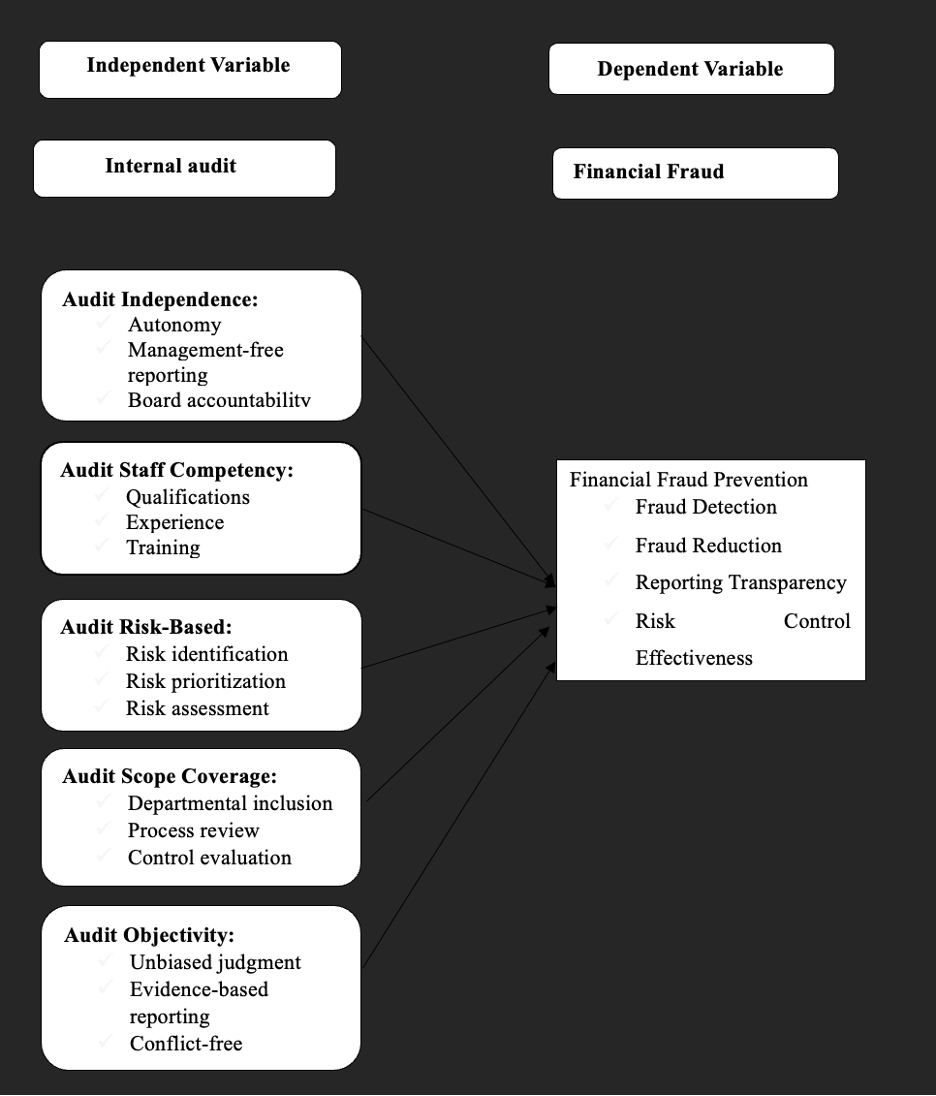
A conceptual framework is a structured representation that illustrates the relationships between variables in a study, showing how independent variables influence a dependent variable and the mechanisms through which these effects occur (Miles & Huberman, 1994). In the context of this study, the framework demonstrates the relationship between internal audit practices and financial fraud prevention in commercial banks, with a focus on BPR Rwanda Plc. It provides a theoretical and visual guide for understanding how specific audit functions contribute to the detection, control, and prevention of fraudulent financial activities.
The independent variables in this study are audit independence, audit staff competency, audit risk-based auditing, audit scope coverage, and audit objectivity, while the dependent variable is financial fraud prevention, measured in terms of reduced incidence of fraud, improved internal control effectiveness, and enhanced financial accountability. The framework posits that stronger internal audit practices directly enhance the bank’s ability to identify irregularities, mitigate fraud risks, and enforce compliance with financial regulations.
By mapping these variables, the framework highlights the pathways through which internal audit functions operate as strategic tools in fraud prevention. For instance, audit independence ensures that auditors can evaluate financial records without undue influence, staff competency enhances auditors’ capacity to detect sophisticated fraud schemes, risk-based auditing prioritizes high-risk areas for scrutiny, scope coverage guarantees that all critical financial processes are examined, and audit objectivity ensures unbiased reporting and decision-making. Collectively, these practices strengthen the internal control environment and reduce opportunities for financial misconduct.
This conceptual framework guides the study’s data collection, analysis, and interpretation by establishing clear relationships between specific audit practices and measurable fraud prevention outcomes. It provides both a theoretical rationale and a practical roadmap for assessing how BPR Rwanda Plc can leverage its internal audit function to enhance financial integrity, improve governance, and minimize exposure to fraudulent activities.
Financial Fraud PreventionFraud DetectionFraud ReductionReporting TransparencyRisk Control Effectiveness
Source: Researcher conceptualization, 2026
Figure 2.1 Conceptual framework
CHAPTER THREE:
The chapter presents the research design of the study, population of the study, sample size, sampling technique, data collection, data analysis, ethical consideration and limitation.
A research design provides a structured framework for collecting, measuring, and analyzing data to achieve the objectives of a study and answer the research questions (Creswell, 2018). This study will adopt an explanatory research design to examine the effect of internal audit practices on financial fraud prevention in commercial banks, with a particular focus on BPR Rwanda Plc. Explanatory research goes beyond describing phenomena; it seeks to determine causal relationships between variables, in this case, how specific internal audit practices such as audit independence, audit staff competency, risk-based auditing, audit scope coverage, and audit objectivity affect financial fraud prevention outcomes.
By using an explanatory design, the study will investigate not only the current state of internal audit practices but also how variations in these practices influence measurable outcomes, including fraud detection rates, compliance with internal controls, reduction in financial losses, reporting transparency, and risk mitigation effectiveness. Structured questionnaires was administered to all employees across relevant departments, ensuring that the study captures detailed and accurate information on audit practices and their impact on fraud prevention.
This approach allows for systematic testing of the relationships between independent variables (audit practices) and the dependent variable (financial fraud prevention), providing insights into the strength, direction, and significance of these effects. The explanatory design is particularly suitable for this study because it links theoretical concepts such as audit independence, staff competency, and risk-based approaches to practical outcomes, enabling a deeper understanding of cause-and-effect relationships within the operational context of BPR Rwanda Plc.
In adopting an explanatory research design ensures that the study produces reliable, evidence-based conclusions about how internal audit practices contribute to preventing financial fraud. The design will generate actionable insights for management, support policy formulation, and strengthen the internal control environment within the bank.
Population is defined as the entire set of individuals, entities, or transactions that are targeted by, or susceptible to, specific fraudulent activities, or the total group of actors committing such fraud. `fvIn this study, the population will comprise all 155 employees of BPR Rwanda Plc, a leading commercial bank in Rwanda. The focus will include employees across all departments, as staff from operations, finance, internal audit, risk management, compliance, customer service, IT, and administrative units all contribute to processes that influence financial fraud prevention. Including all departments ensures a comprehensive understanding of how internal audit interact with broader banking operations to mitigate fraud risks.
PositionNumber of EmployeesSenior Managers7Middle-Level Supervisors9Internal Auditors12Risk and Compliance Officers11Customer Service Staff38Finance and Accounting Officers21IT and Operations Staff25Total Population123
Source: BPR Plc (2025)
Since the total population of BPR Rwanda Plc is relatively small, the study will include all 123employees as the sample size to ensure comprehensive coverage. This population comprises 7 senior managers from operations, finance, audit, and compliance; 9 middle-level supervisors overseeing branch operations, finance, risk, and audit; 12 internal auditors; 11 risk and compliance officers; 38 customer service staff; 21 finance and accounting officers; 25 IT, totaling 123 employees across all departments.
This study will employ a purposive sampling technique to include all 155 employees of BPR Rwanda Plc as respondents. Purposive sampling ensures that every employee who is involved in or influences internal audit and fraud prevention processes is included, covering all departments and hierarchical levels. The participants will consist of senior managers, middle-level supervisors, internal auditors, risk and compliance officers, customer service staff, finance and accounting officers, IT and operations staff, and administrative/support staff. This approach guarantees that the study captures insights from all relevant organizational roles, providing a comprehensive understanding of how internal audit practices contribute to financial fraud prevention at BPR Rwanda Plc.
3.5 Data Collection Instruments
This study will use a combination of questionnaires, interviews, and document review as the primary instruments for collecting data. These instruments will enable the researcher to gather both quantitative and qualitative insights regarding the influence of internal audit practices on financial fraud prevention in commercial banks. By employing multiple instruments, the study will ensure data triangulation, enhancing validity and reliability.
A questionnaire is a structured research instrument consisting of systematically organized questions that will collect data from respondents. For this study, the questionnaire will serve as the principal tool for obtaining quantitative data from BPR Rwanda Plc employees across all relevant departments. It will measure specific variables related to audit independence, audit staff competency, audit risk-based auditing, audit scope coverage, and audit objectivity, as well as the dependent variable, financial fraud prevention, using dimensions such as fraud detection rate, compliance with internal controls, reduction in financial losses, reporting transparency, and risk mitigation effectiveness.
The questionnaire will adopt a five-point Likert scale ranging from 1 (Strongly Disagree) to 5 (Strongly Agree) to quantify respondents’ perceptions and practices. It was organized into sections covering demographic information, independent variables (internal audit practices), and dependent variables (financial fraud prevention outcomes). Section A will capture demographic and professional characteristics, while Sections B to F will assess the five independent audit variables. Section G will evaluate the dependent variables, ensuring that each aspect of financial fraud prevention is systematically measured. Prior to full deployment, the questionnaire was pilot-tested with a small group of bank staff to ensure clarity, relevance, and ease of comprehension, and adjustments was made based on feedback.
Document analysis was utilized to supplement primary data and provide context regarding the bank’s internal control and audit operations. Relevant documents will include internal audit reports, compliance checklists, risk assessment reports, financial statements, and regulatory compliance records. By systematically reviewing these documents, the study will identify patterns, trends, and evidence of the implementation and outcomes of internal audit practices. The documentary data will complement questionnaire and interview findings, enabling triangulation and providing a holistic view of financial fraud prevention at BPR Rwanda Plc.
Through the use of questionnaires, interviews, and document review, this study will gather comprehensive data to inform an evidence-based analysis of how internal audit practices will contribute to preventing financial fraud and enhancing internal control effectiveness in commercial banks.
The section below describes how the validity, pilot testing and reliability of the questionnaire were ensured
3.6. Validity
Validity refers to the extent to which an instrument measures what it is intended to measure (Kumar, Kumar, & Phrommathed, 2015). It focuses on ensuring that the data collected accurately represents the concepts under study and the conclusion drawn from the findings are sound and credible.
An instrument is considered valid when it strictly measures the intended variables without being influenced by irrelevant factors. In the study the validity of the questionnaire was confirmed through expert review, particularly by the research supervisor, who particularly by the research supervisor, who possesses relevant knowledge in the field. Additionally, a pilot study was conducted to identify unclear or ambiguous items. Any issues identified during this process was corrected before the final data collection.
The validity was tested using Content Validity Index (CVI).
If CVI is greater to 0.60 (Sounders, 2000), the questionnaire was considered valid.
A pilot checks whether the study can be undertaken and provide accurate data (Cargan, 2007). Pilot studies pretest the research instrument such as books (2014). A pilot study intends to get rid of in advance for expectation to be faced for the ultimate study (Cooper, 2006). The pilot of 11 respondents was conducted from Bank of Kigali Plc.
To evaluate the reliability of the questionnaire, the study will apply Cronbach’s Alpha. According to Mugenda and Mugenda (2008), Cronbach’s Alpha is an effective measure for determining the consistency and dependability of data obtained through repeated measures. Since the questionnaire contains multiple items measuring the same constructs, this coefficient is suitable for assessing the internal consistency by determining how closely related the items are to one another. A Cronbach’s Alpha value of 0.7 or higher was considered acceptable, indicating that the instrument has good internal consistency.
Cronbach’s Alpha, introduced by Lee Cronbach in 1951, measures how uniformly the items in a scale assess the same concept, with values ranging from 0 to 1, where higher values indicate stronger reliability. Employing this measure in the study helped ensure that the questionnaire yields stable and consistent results, thereby increasing confidence in the accuracy and dependability of the collected data.
Data processing will involve transforming raw data into meaningful and interpretable information that reflects the actual internal audit practices and their impact on financial fraud prevention at BPR Rwanda Plc. To ensure data quality and accuracy, standard checks was conducted through editing, coding, and tabulation. These steps will allow the researcher to organize data systematically, identify inconsistencies, and prepare it for detailed analysis in relation to the study objectives.
Editing will involve carefully examining completed questionnaires to detect and correct errors, omissions, or inconsistencies. This step will ensure that the data collected accurately represents respondents’ views on audit independence, audit staff competency, audit risk-based auditing, audit scope coverage, audit objectivity, and financial fraud prevention. Proper editing will facilitate smoother and more reliable subsequent analysis.
In coding, responses from the questionnaires was categorized and assigned numerical values or symbols to simplify interpretation. For example, Likert scale responses on audit independence or audit staff competency was coded from 1 to 5. Coding will help in systematically summarizing the data and preparing it for statistical analysis using SPSS and Microsoft Excel.
Transformation will involve organizing coded data into tables to display the frequency, percentage, and distribution of responses for each study variable. This will allow the researcher to identify patterns and trends regarding the adoption of internal audit practices and their influence on financial fraud prevention. The tables will present data in a clear format suitable for both descriptive and inferential analysis.
3.8 Data Analysis
Data analysis was conducted using the Statistical Package for the Social Sciences (SPSS) and Microsoft Excel to ensure accurate interpretation of findings related to internal audit practices and financial fraud prevention. Quantitative data was analyzed using descriptive and inferential statistics, while qualitative insights from interviews was examined thematically to complement the numerical findings. Results was presented in tables, charts, and graphs to enhance clarity and comprehension.
For the first objective, which is to examine the effect of audit independence on financial fraud prevention, descriptive statistics such as mean and standard deviation was used to summarize responses and assess the level of implementation and perceived effectiveness. Similarly, for the second objective on audit staff competency, descriptive statistics will provide insights into how the competence of audit personnel influences fraud prevention outcomes. For the third objective, audit risk-based practices, descriptive statistics will help evaluate how risk-oriented auditing contributes to detecting and preventing financial fraud.
Mean – ()
Mean Range——————–Interpretation
1.00 – 2.49————————Very Weak
2.50 – 3.49————————Weak
3.50 – 4.49————————-Strong
4.50 – 5.00————————-Very Strong
Source: Aggresti (2019)
Standard deviation (SD)
Standard deviation measures the amount of variability or dispersion in a set of data values. It shows how far the responses deviate from the mean. A smaller standard deviation indicates values are closer to the mean, while a larger one shows greater variation.
In this study, the Standard Deviation (SD) is used to show how much the participants’ responses differ from the average response. In other words, it measures the extent to which the answers are spread out. A small standard deviation means the responses are closely grouped, while a larger value indicates that the answers vary widely.
Standard Deviation—————————-Interpretation
SD ——————————————-Responses are similar (Homogeneous)
SD > 0.5——————————————-Responses differ noticeably (Heterogeneous)
Source: Aggresti (2009)
Multiple regression analysis was employed to quantify the impact of each internal audit practice on financial fraud prevention. This will allow the study to assess both the combined and individual contributions of the predictors, determining the proportion of variance in financial fraud prevention explained by the audit practices. It will also help identify which audit practices are most significant in reducing fraud risk and strengthening compliance. By integrating correlation and regression analysis, the study will provide a robust framework to understand and predict how effective internal audit practices can mitigate financial fraud, strengthen accountability, and enhance the overall integrity of banking operations at BPR Rwanda Plc. These methods will ensure that both the relationships and the predictive power of the audit variables are systematically evaluated, supporting evidence-based recommendations for improving audit effectiveness and fraud prevention strategies.
Model specification
It is expected that all independent variables audit independence, audit staff competency, audit risk-based auditing, audit scope coverage, and audit objectivity will have a significant and positive effect on financial fraud prevention at BPR Rwanda Plc. Improvements in these internal audit practices are anticipated to enhance the detection, prevention, and mitigation of financial fraud, as independent oversight, staff competence, targeted risk assessment, comprehensive audit coverage, and objective evaluation collectively strengthen the bank’s internal control environment. Overall, the study expects that robust internal audit practices will contribute positively to reducing financial misconduct, supporting a more transparent and secure banking operation (Abdullahi, 2020; Chijoriga & Cassimon, 2018).
Therefore, the research used the following model:
Y = β0+β1 X1 +β2 X2 +β3 X3+β4 X4+β5 X5+ e
Y = Financial Fraud prevention
X1= Audit Independence
X2 = Audit staff compentency
X3 = Audit risk based
X4= Audit scope coverage
X5= Audit objectivity
β0 = Constant
β1- β5= Coefficients of estimâtes
e = Error term
Pre-estimation diagnostic tests was conducted to determine the appropriateness of each model before running the actual regressions. These tests are important because they help the researcher identify whether any adjustments need to be made to the variables in the model prior to estimation. After estimating the models, post-estimation tests were also carried out to assess which estimation technique is most suitable for each model.
To detect multicollinearity, the Variance Inflation Factor (VIF) was applied, while a correlation matrix was used to examine the degree of association among the variables. Additionally, the significance of model coefficients was interpreted using t-statistics or z-statistics, and the overall model significance was evaluated using F-statistics, all compared against the critical (tabulated) values and probability levels at the 5% threshold.
The R-squared statistic was employed to measure the goodness of fit of the regression model. It indicates how well the independent variables collectively explain variations in the dependent variable. The benchmark for comparison is the baseline model, which does not include any independent variables. This baseline model simply uses the average value of the dependent variable as the predicted outcome, serving as the poorest-performing model.
The coefficient of determination, R2, is used to analyze how differences in one variable can be explained by a difference in a second variable. For example, when a person gets pregnant has a direct relation to when they give birth. More specifically, R-squared gives you the percentage the proportion of the variation in the dependent variable (y) that can be explained by the independent variable(s) (x). Its value ranges from 0 to 1, meaning that 0% to 100% of the variation in y is accounted for by the model. The R-squared value is related to the correlation coefficient (r), which measures the strength of the linear relationship between two variables. In fact, R-squared is simply the square of the correlation coefficient (r), which is why it is referred to as r-squared.
In addition, the t-test is used to test the significance of the regression coefficients in simple linear regression. Specifically, a t-statistic, which follows a t-distribution, is used to test a two-sided hypothesis about the true value of the slope coefficient β₁.
The study on the effect of internal audit practices on financial fraud prevention at BPR Rwanda Plc may face several limitations. First, data availability and accuracy may pose a challenge, as detailed records on audit activities, compliance reports, and financial fraud incidents might be incomplete, inconsistently documented, or restricted due to confidentiality concerns. This limitation could affect the precision of information gathered regarding the effectiveness of audit practices. Second, response bias may occur, as employees and managers might overstate the effectiveness of certain audit practices or underreport instances of financial irregularities. Third, the findings may have limited generalizability, as the study focuses specifically on BPR Rwanda Plc, making it difficult to extrapolate results to other commercial banks in Rwanda or in similar contexts. Additionally, external factors, such as regulatory changes, technological disruptions, or economic fluctuations, may influence audit effectiveness and fraud outcomes, complicating the direct assessment of internal audit practices. Finally, the cross-sectional design of the study may limit insights into long-term impacts, as it will capture audit practices and fraud prevention measures at a single point in time rather than over an extended period. Recognizing these limitations will guide careful interpretation of findings and inform recommendations for future research.
In conducting this study on internal audit practices and financial fraud prevention at BPR Rwanda Plc, the researcher will adhere to strict ethical standards to protect the rights and well-being of all participants. Participation was voluntary, ensuring that no employee is coerced or pressured to provide information. Respondents was informed of their right to withdraw from the study at any point without facing negative consequences.
Confidentiality was maintained throughout the research process. Information provided by participants will not be disclosed to unauthorized persons, colleagues, or the public, and personal identifiers was removed from collected data. All responses was treated with the utmost confidentiality and used solely for academic purposes. Additionally, a formal letter of consent was provided to assure participants that their contributions will remain anonymous and that the research findings was reported in a manner that protects their privacy and professional integrity.
This chapter presents and analyses the data collected from respondents to address the research objectives of the study. It provides a systematic presentation of the findings using both descriptive and inferential statistics to ensure clarity and accuracy in interpretation. Tables, figures, and charts are employed to illustrate the key patterns, relationships, and trends emerging from the data. The analysis further incorporates relevant statistical tests to validate the consistency and reliability of the findings in alignment with the research design.
4.1. Demographic information
4.1.1. Distribution of respondent by gender
This part outlines the gender composition of the respondents, illustrating the proportion of male and female participants involved in the study.
GenderFrequencyPercentageFemale6653.7Male5746.3Total123100
Source: Primary Data, 2026
Table 4.1 presents the gender distribution of respondents who participated in the study on the effect of internal audit in the banking sector on financial fraud prevention, with reference to BPR Rwanda Plc. Out of the total sample of 123 respondents, 66 (53.7%) were female while 57 (46.3%) were male. The findings indicate a slightly higher representation of female respondents compared to male respondents; however, the difference between the two categories is relatively small, demonstrating a balanced gender representation among the study participants. This implies that the study captured perspectives from both male and female employees involved in various banking functions, including internal audit, risk management, compliance, finance, and operations, thereby enhancing the comprehensiveness of the findings.
The balanced gender distribution observed in this study is supported by recent literature emphasizing the importance of diversity and inclusiveness in organizational research. Müller-Horn et al. (2024) argue that gender diversity within organizations improves the quality of decision-making by integrating different experiences, viewpoints, and approaches to problem-solving. In the context of banking institutions, where effective internal audit systems require collaboration, ethical awareness, and strong internal control practices, the involvement of both male and female employees provides a broader understanding of fraud prevention mechanisms. Therefore, the findings suggest that the assessment of internal audit effectiveness at BPR Rwanda Plc was not influenced by the views of a single gender group, which strengthens the reliability of the study outcomes.
Furthermore, the findings align with Lacerenza (2024), who emphasizes that inclusive organizational environments enhance employee engagement and contribute to improved organizational effectiveness. The representation of both genders in this study indicates that internal audit activities and financial fraud prevention responsibilities are shared across different employees and departments rather than being associated with a particular gender. Consequently, the gender composition of respondents provides a strong foundation for analyzing the effect of internal audit practices on financial fraud prevention in the banking sector, as the findings reflect diverse experiences and perceptions within BPR Rwanda Plc.
4.1.2. Distribution of respondents by marital status
This part presents the marital status of respondents, showing how categories such as single, married, divorced, or widowed are represented within the sample.
GenderFrequencyPercentageSingle5544.7Married6855.3Total123100
Source: Primary Data, 2026
Table 4.2 presents the marital status distribution of respondents who participated in the study on the effect of internal audit in the banking sector on financial fraud prevention, with reference to BPR Rwanda Plc. Out of the total sample of 123 respondents, 68 (55.3%) were married while 55 (44.7%) were single. The findings indicate that married respondents constituted the majority of participants, although the difference between married and single respondents was relatively small. This demonstrates that the study incorporated respondents with diverse personal backgrounds, enabling the collection of varied perspectives regarding internal audit practices, ethical conduct, compliance with organizational procedures, and fraud prevention mechanisms within BPR Rwanda Plc.
The higher proportion of married respondents may imply that a significant number of employees participating in the study have family responsibilities, which may influence their perceptions of professional accountability, commitment, and adherence to institutional policies. In the banking sector, where employees are expected to maintain high levels of integrity and compliance with internal control systems, individual characteristics may influence attitudes toward ethical behavior and participation in fraud prevention initiatives. The inclusion of both married and single respondents therefore provided a broader understanding of how internal audit practices contribute to preventing financial fraud from employees with different personal circumstances.
The findings are supported by recent studies emphasizing the influence of demographic characteristics on employees’ workplace attitudes and organizational behavior. Alshaabani et al. (2022) noted that employees’ personal characteristics may affect their level of organizational commitment and engagement with institutional practices. Similarly, Memon et al. (2023) highlighted that demographic factors contribute to variations in employees’ perceptions and behavioral responses within organizational settings. Therefore, the representation of both married and single respondents enhances the credibility of this study by ensuring that the assessment of internal audit effectiveness and financial fraud prevention at BPR Rwanda Plc reflects diverse employee experiences and perspectives.
4.1.3. Distribution of respondents by age
This part analyses the age distribution of respondents, highlighting the age brackets most represented in the study and their relevance to the research context.
Age GroupFrequencyPercentageLess than 251814.626–353427.636–454032.546–552419.556 and above75.7Total123100
Source: Primary Data, 2026
Table 4.3 presents the age distribution of respondents who participated in the study on the effect of internal audit in the banking sector on financial fraud prevention, with reference to BPR Rwanda Plc. The findings indicate that respondents aged between 36 and 45 years constituted the largest proportion, with 40 respondents (32.5%), followed by those aged between 26 and 35 years, representing 34 respondents (27.6%). Respondents aged between 46 and 55 years accounted for 24 respondents (19.5%), while those below 25 years represented 18 respondents (14.6%). The least represented category was respondents aged 56 years and above, with 7 respondents (5.7%). The distribution demonstrates that the study involved employees from different age categories, providing diverse perspectives based on varying levels of professional experience within the banking sector.
The predominance of respondents aged between 26 and 45 years suggests that most participants were within the active working-age population and likely possessed considerable exposure to banking operations, internal control systems, and audit procedures. Employees within this age range are often involved in key institutional activities, including financial management, risk assessment, compliance monitoring, and implementation of internal controls, making their views valuable in assessing the role of internal audit in preventing financial fraud at BPR Rwanda Plc. The inclusion of younger and older respondents also contributed to capturing perspectives from employees with different levels of experience and familiarity with fraud prevention practices.
The findings are consistent with recent studies emphasizing the importance of employee experience and demographic diversity in organizational research. Memon et al. (2023) noted that demographic characteristics, including age, may influence employees’ perceptions, workplace behaviors, and responses to organizational systems and policies. Similarly, Alshaabani et al. (2022) emphasized that employees at different career stages may demonstrate varying levels of organizational commitment and engagement with institutional practices. Therefore, the age diversity observed among respondents strengthens the reliability of this study by ensuring that the assessment of internal audit effectiveness and financial fraud prevention at BPR Rwanda Plc reflects insights from employees with different levels of professional maturity and experience.
4.1.4. Distribution of respondents by education
This part examines the educational background of the respondents, providing insight into their academic qualifications and how these may influence their understanding and responses within the study.
Education LevelFrequencyPercentage (%)Bachelor’s Degree9778.8Master’s Degree2621.1Total123100
Source: Primary Data, 2026
Table 4.4 presents the education level distribution of respondents who participated in the study on the effect of internal audit in the banking sector on financial fraud prevention, with reference to BPR Rwanda Plc. The findings indicate that out of the 123 respondents, 97 (78.9%) held a Bachelor’s Degree, while 26 (21.1%) possessed a Master’s Degree. The results show that the majority of respondents had attained at least a Bachelor’s Degree, indicating that participants possessed a relatively high level of academic qualification. This suggests that respondents were likely to have adequate knowledge and professional understanding of banking operations, internal control systems, audit procedures, and financial fraud prevention practices.
The predominance of respondents with Bachelor’s Degree qualifications may be attributed to the professional requirements of the banking sector, where many positions related to finance, accounting, audit, risk management, and compliance require university-level education. The participation of respondents with Master’s Degree qualifications further strengthened the study by incorporating views from individuals with advanced academic and professional exposure. Their perspectives were important in assessing the effectiveness of internal audit functions, particularly in areas related to risk assessment, governance, compliance monitoring, and fraud prevention strategies at BPR Rwanda Plc.
The findings are consistent with recent studies emphasizing the role of employees’ educational background in understanding and implementing organizational control mechanisms. Alshaabani et al. (2022) noted that higher educational attainment enhances employees’ capacity to understand organizational policies, procedures, and professional responsibilities. Similarly, Memon et al. (2023) highlighted that education influences employees’ perceptions, decision-making abilities, and responses to organizational practices. Therefore, the high level of educational attainment among respondents increases the reliability of this study, as participants were considered capable of providing informed opinions regarding the effect of internal audit on financial fraud prevention in the banking sector.
4.2. Analysis of internal audit practices
This section presents the descriptive analysis of respondents’ perceptions regarding internal audit practices at BPR Rwanda Plc. The analysis focuses on the five dimensions of internal audit examined in this study, namely audit independence, audit staff competency, audit risk-based approach, audit scope coverage, and audit objectivity. Descriptive statistics, including frequencies, means, and standard deviations, are used to assess respondents’ level of agreement with statements measuring each dimension. The findings provide insights into the effectiveness of the internal audit function in supporting sound governance, strengthening internal controls, and enhancing the bank’s capacity to prevent financial fraud.
4.2.1. Audit intendance
Researcher asked the respondents to indicate their level of agreement with the statements relate to audit independenceand the results are presented in table 4.5. below.
Audit IndependenceNMeanCommentsStd. DeviationCommentsThe internal audit function operates independently from management influence in the bank.1234.44Strong.34HomogeneityInternal auditors report directly to the audit committee or board rather than executive management.1233.98Strong.75HeterogeneityInternal auditors are free from interference when selecting audit areas and procedures.1233.79Strong.73HeterogeneityThe organizational structure of the bank supports the independence of internal auditors.1234.41Strong.41HomogeneityInternal audit recommendations are made without pressure or bias from management.1233.32Weak.80HeterogeneityOverall mean 3.98
Source: Primary Data, 2026
Table 4.5 presents respondents’ perceptions regarding audit independence in relation to the role of internal audit in financial fraud prevention at BPR Rwanda Plc. The overall mean score of 3.98 indicates that respondents generally perceive the level of audit independence within the bank as strong. This suggests that internal auditors are generally able to perform their responsibilities with a considerable level of objectivity, autonomy, and professional judgment, which are essential elements for effective fraud detection and prevention. However, variations in mean scores and standard deviations across the indicators reveal that while some aspects of audit independence are strongly established, concerns remain regarding the extent to which management influence may affect audit recommendations and decisions.
The statement “The internal audit function operates independently from management influence in the bank” recorded the highest mean score of 4.44 (SD = 0.34), indicating strong agreement and a high level of consensus among respondents. This finding suggests that employees perceive internal audit activities at BPR Rwanda Plc as being conducted without significant interference from management. The low standard deviation further indicates that respondents had similar views regarding the independence of the internal audit function. This finding is supported by Alzeban (2022), who emphasized that internal audit independence is a fundamental requirement for ensuring objective evaluations of internal controls and improving organizational governance. The author noted that auditors who operate without undue influence are more capable of identifying weaknesses and reporting irregularities effectively. However, the finding contrasts with Yassin and Nelson (2023), who argued that in some financial institutions, internal auditors may experience informal pressures from senior management, which can limit their ability to provide fully independent assessments.
Similarly, the statement “The organizational structure of the bank supports the independence of internal auditors” obtained a mean score of 4.41 (SD = 0.41), indicating strong agreement with relatively homogeneous responses. This finding demonstrates that respondents recognize the existence of organizational arrangements that promote internal audit independence, such as clear reporting structures, defined responsibilities, and institutional support. This finding is supported by Abdelrahim and Al-Malkawi (2023), who found that an appropriate organizational structure strengthens internal audit effectiveness by providing auditors with the authority and resources required to perform their duties independently. Nevertheless, the finding contradicts Prawitt et al. (2022), who highlighted that even where formal structures supporting independence exist, internal audit effectiveness may still be weakened if organizational culture does not encourage unrestricted communication and reporting.
The statement “Internal auditors report directly to the audit committee or board rather than executive management” recorded a mean score of 3.98 (SD = 0.75), indicating strong agreement but with noticeable variation among respondents. This suggests that although respondents generally believe that internal auditors have access to independent oversight mechanisms, perceptions differ regarding the practical effectiveness of these reporting arrangements. The finding is supported by Betti et al. (2022), who emphasized that direct reporting relationships between internal audit functions and audit committees enhance auditor independence by reducing potential conflicts arising from reporting to operational management. However, this finding contradicts Mihret and Woldeyohannis (2023), who observed that in some organizations, audit committees may not always exercise sufficient authority over internal audit functions, resulting in continued dependence on executive management.
Regarding the statement “Internal auditors are free from interference when selecting audit areas and procedures,” respondents recorded a mean score of 3.79 (SD = 0.73), indicating strong agreement but heterogeneous perceptions. The result suggests that internal auditors generally have the freedom to determine audit scope and procedures, although some respondents may perceive limitations arising from operational priorities or management expectations. This finding supports Kabuye et al. (2022), who found that auditor autonomy in planning and executing audit assignments enhances the ability of internal audit departments to identify fraud risks and strengthen internal controls. However, the finding contradicts Eulerich et al. (2023), who noted that internal auditors in some organizations face restrictions when selecting audit areas due to resource limitations, management preferences, or strategic considerations.
The statement “Internal audit recommendations are made without pressure or bias from management” recorded the lowest mean score of 3.32 (SD = 0.80), indicating weak agreement and the highest level of variation among respondents. This finding suggests that although internal audit independence is generally perceived positively, some respondents believe that management influence may still affect the objectivity and implementation of audit recommendations. The relatively high standard deviation indicates differences in employees’ experiences and perceptions regarding the extent of management pressure on audit outcomes. This finding is supported by Abdelrahim and Al-Malkawi (2023), who emphasized that management interference can reduce the credibility of audit findings and weaken the contribution of internal audit to fraud prevention. Conversely, the finding contradicts Alzeban (2022), who argued that strong governance frameworks and professional internal audit practices can ensure that audit recommendations remain objective and free from managerial influence.
Overall, the findings indicate that audit independence at BPR Rwanda Plc is generally strong, particularly in terms of organizational support, operational autonomy, and reduced direct interference from management. The high overall mean demonstrates that internal audit is perceived as an effective mechanism for strengthening financial fraud prevention. However, the lower rating concerning pressure and bias in audit recommendations highlights an area requiring further improvement. Strengthening the authority of the audit committee, protecting auditors from potential managerial influence, and promoting a culture of unrestricted reporting would further enhance internal audit independence and its contribution to preventing financial fraud in the banking sector.
4.2.2. Audit staff competency
Researcher askes the respondents to indicate their level of agreement with the statements relate to audit staff competency and the results are presented in table 4.6. below.
Audit Staff CompetencyNMeanCommentsStd. DeviationCommentsInternal auditors possess adequate professional qualifications relevant to banking operations.1233.98Strong0.75HeterogeneityInternal audit staff receive regular training on fraud detection and prevention techniques.1233.91Strong0.65HeterogeneityInternal auditors have sufficient experience to identify complex financial fraud schemes.1234.08Strong0.43HomogeneityThe internal audit team demonstrates strong analytical and investigative skills.1234.32Strong0.41HomogeneityThe bank ensures continuous professional development of internal audit staff.1234.11Strong0.40HomogeneityOverall mean1234.08
Source: Primary Data, 2026
Table 4.6 presents respondents’ perceptions regarding audit staff competency in relation to the effectiveness of internal audit in preventing financial fraud at BPR Rwanda Plc. The overall mean score of 4.08 indicates that respondents generally perceive the competency of internal audit staff as strong. This suggests that internal auditors possess the knowledge, skills, experience, and professional capabilities required to perform audit assignments effectively and contribute to the prevention of financial fraud. The relatively low standard deviations for most indicators further imply that respondents shared similar perceptions regarding the competency of the internal audit staff.
The statement “The internal audit team demonstrates strong analytical and investigative skills” recorded the highest mean score of 4.32 (SD = 0.41), indicating strong agreement and a high level of consensus among respondents. This finding suggests that employees perceive internal auditors as having the analytical ability to identify irregular transactions, investigate suspicious activities, and evaluate weaknesses in internal control systems. The finding is supported by Alqudah et al. (2023), who found that analytical and investigative competencies significantly improve the effectiveness of internal auditors in detecting fraud and strengthening organizational governance. However, the finding contradicts Eulerich et al. (2022), who argued that despite possessing technical knowledge, many internal auditors continue to face challenges in investigating increasingly sophisticated financial fraud schemes due to technological complexities and evolving fraud techniques.
Similarly, the statement “The bank ensures continuous professional development of internal audit staff” obtained a mean score of 4.11 (SD = 0.40), indicating strong agreement with highly homogeneous responses. This implies that respondents believe BPR Rwanda Plc invests in enhancing the knowledge and competencies of its internal auditors through continuous professional development initiatives. This finding is supported by The Institute of Internal Auditors (IIA, 2024), which emphasizes that continuous professional education enables auditors to remain competent in emerging audit methodologies, regulatory requirements, and fraud risk management practices. Conversely, the finding contrasts with Mihret and Woldeyohannis (2023), who reported that limited training opportunities remain a significant challenge affecting the effectiveness of internal audit functions in some organizations, particularly in developing economies.
The statement “Internal auditors have sufficient experience to identify complex financial fraud schemes” recorded a mean score of 4.08 (SD = 0.43), reflecting strong agreement and relatively homogeneous perceptions. This finding indicates that respondents consider the internal audit staff to possess adequate practical experience to detect sophisticated fraud schemes within the banking environment. The finding supports Abdelrahim and Al-Malkawi (2023), who concluded that experienced internal auditors are more effective in recognizing fraud indicators, evaluating internal control weaknesses, and recommending appropriate corrective measures. However, the finding contradicts Kabuye et al. (2022), who argued that experience alone may not guarantee effective fraud detection unless it is complemented by specialized technological skills and continuous exposure to emerging financial crimes.
The statement “Internal auditors possess adequate professional qualifications relevant to banking operations” achieved a mean score of 3.98 (SD = 0.75), indicating strong agreement but with noticeable variation among respondents. This suggests that while respondents generally acknowledge the qualifications of internal auditors, some perceive differences in professional competence across the audit team. The finding is supported by Alzeban (2022), who emphasized that professional qualifications such as Certified Internal Auditor (CIA), Certified Public Accountant (CPA), and other relevant certifications enhance auditors’ ability to perform effective audits and strengthen fraud prevention. Nevertheless, the finding contradicts Betti et al. (2022), who argued that professional qualifications alone do not necessarily translate into audit effectiveness without practical experience and organizational support.
The statement “Internal audit staff receive regular training on fraud detection and prevention techniques” recorded the lowest mean score of 3.91 (SD = 0.65), although it remained within the strong agreement category. The finding suggests that respondents generally believe training opportunities are available, but some variability in responses indicates that not all employees perceive training to be regular or sufficient. This finding supports The Institute of Internal Auditors (IIA, 2024), which emphasizes that continuous fraud-related training is essential for enabling internal auditors to respond effectively to evolving fraud risks. However, it contradicts Eulerich et al. (2023), who found that many organizations still provide insufficient specialized fraud investigation training, limiting auditors’ preparedness to address increasingly complex financial fraud.
Overall, the findings indicate that respondents have a strong perception of the competency of internal audit staff at BPR Rwanda Plc. Internal auditors are perceived to possess appropriate qualifications, analytical capabilities, professional experience, and opportunities for continuous professional development, all of which contribute positively to financial fraud prevention. However, the relatively lower rating for regular fraud detection training suggests that the bank could further strengthen audit effectiveness by increasing the frequency and specialization of training programs to ensure auditors remain equipped to address emerging fraud risks in the banking sector.
4.2.3. Audit risk based
The researcher asked the respondents to indicate their level of agreement with the statements relate to audit risk based and the results are presented in table 4.7 below
Audit Risk BasedNMeanCommentsStd. DevCommentsInternal audit activities are guided by a formal risk assessment framework.1234.13Strong.39HomogeneityHigh-risk areas are prioritized during audit planning and execution.1233.56Strong.63HeterogeneityInternal auditors regularly update risk assessments to reflect emerging fraud risks.1234.21Strong.42HomogeneityAudit procedures are designed based on the level of risk exposure.1233.74Strong.60HeterogeneityRisk-based auditing enhances the effectiveness of fraud detection in the bank.1234.56Very strong.43HomogeneityOverall mean 4.04
Source: Primary Data, 2026
Table 4.7 presents respondents’ perceptions regarding the adoption of a risk-based audit approach and its contribution to financial fraud prevention at BPR Rwanda Plc. The overall mean score of 4.04 indicates that respondents generally perceive the bank’s internal audit function as applying a strong risk-based auditing approach. This suggests that audit activities are largely focused on areas with greater exposure to financial and operational risks, thereby enhancing the effectiveness of fraud prevention. The variation in standard deviations across the indicators further demonstrates that while respondents strongly agreed on most aspects of risk-based auditing, differences of opinion exist regarding audit planning and the design of audit procedures.
The statement “Risk-based auditing enhances the effectiveness of fraud detection in the bank” recorded the highest mean score of 4.56 (SD = 0.43), indicating very strong agreement and a high level of consensus among respondents. This finding suggests that employees perceive the risk-based audit approach as an effective tool for identifying fraud risks and strengthening internal controls within BPR Rwanda Plc. The finding is supported by The Institute of Internal Auditors (IIA, 2024), which emphasizes that risk-based auditing enables internal auditors to allocate audit resources to areas with the highest fraud exposure, thereby improving audit effectiveness and organizational governance. However, the finding contradicts Eulerich et al. (2023), who argued that although risk-based auditing improves audit efficiency, its effectiveness may be constrained by limited audit resources, inadequate risk data, and rapidly evolving fraud techniques.
Similarly, the statement “Internal auditors regularly update risk assessments to reflect emerging fraud risks” obtained a mean score of 4.21 (SD = 0.42), indicating strong agreement and homogeneous responses. This implies that respondents believe the internal audit function continuously reviews and updates risk assessments to address new and emerging fraud threats. Such a practice enhances the ability of the bank to respond proactively to changing operational and financial risks. This finding is consistent with Abdelrahim and Al-Malkawi (2023), who found that continuous risk assessment strengthens internal audit effectiveness by enabling organizations to respond promptly to emerging fraud risks and changing business environments. Conversely, the finding contrasts with Kabuye et al. (2022), who reported that many organizations still rely on periodic rather than continuous risk assessments, reducing their ability to respond effectively to dynamic fraud risks.
The statement “Internal audit activities are guided by a formal risk assessment framework” recorded a mean score of 4.13 (SD = 0.39), reflecting strong agreement and a high degree of consensus among respondents. This finding indicates that respondents recognize the existence of structured risk assessment procedures guiding audit planning and execution at BPR Rwanda Plc. The finding supports Alzeban (2022), who argued that a formal risk assessment framework improves audit quality by ensuring that audit activities are aligned with organizational objectives and key risk areas. However, this finding contradicts Betti et al. (2022), who observed that the existence of formal risk assessment frameworks does not always guarantee effective implementation if management commitment and organizational resources are inadequate.
The statement “Audit procedures are designed based on the level of risk exposure” achieved a mean score of 3.74 (SD = 0.60), indicating strong agreement but with heterogeneous responses. This suggests that although respondents generally believe audit procedures are risk-oriented, perceptions differ regarding the consistency with which risk levels influence audit methodologies. The finding supports The Institute of Internal Auditors (IIA, 2024), which recommends tailoring audit procedures according to the significance of identified risks to improve fraud detection and resource utilization. Nevertheless, the finding contradicts Mihret and Woldeyohannis (2023), who found that some organizations continue to apply standardized audit procedures irrespective of varying levels of risk exposure, thereby limiting the effectiveness of risk-based auditing.
The statement “High-risk areas are prioritized during audit planning and execution” recorded the lowest mean score of 3.56 (SD = 0.63), although respondents still expressed strong agreement. The relatively higher standard deviation indicates noticeable differences in respondents’ perceptions regarding the extent to which audit planning consistently focuses on high-risk areas. This finding suggests that while the bank generally adopts risk-based audit planning, opportunities exist to further strengthen the prioritization of high-risk activities during audit engagements. The finding is supported by Alqudah et al. (2023), who noted that prioritizing high-risk areas enables internal auditors to detect significant control weaknesses and prevent financial fraud more effectively. However, the finding contradicts Eulerich et al. (2022), who argued that practical constraints such as limited audit staff, budgetary restrictions, and regulatory demands may prevent internal auditors from consistently focusing on the highest-risk areas.
Overall, the findings indicate that BPR Rwanda Plc has largely embraced a risk-based internal audit approach characterized by formal risk assessment, continuous monitoring of emerging risks, and the application of audit procedures based on risk exposure. The particularly high perception that risk-based auditing enhances fraud detection demonstrates respondents’ confidence in this approach as a key mechanism for preventing financial fraud. Nevertheless, the comparatively lower ratings for prioritizing high-risk areas and designing audit procedures according to risk exposure suggest that the bank could further strengthen the consistency of its risk-based audit planning to maximize the effectiveness of internal audit in combating financial fraud.
4.2.4. Audit scope coverage
The researcher asked the respondents to indicate their level of agreement with the statements relate to audit scope coverage and the results are presented in table 4.8 below
Table 4.8. Audit scope coverage
Audit Scope CoverageNMeanCommentsStd. DevCommentsInternal audits cover all key departments and operational areas of the bank.1234.35Strong.39HomogeneityThe scope of internal audit includes both financial and non-financial processes.1233.48Strong.63HeterogeneityInternal audit reviews extend to digital banking systems and electronic transactions.1234.21Strong.42HomogeneityThe audit scope is sufficient to detect potential fraud across all banking operations.1233.79Strong.69HeterogeneityInternal auditors periodically expand audit coverage to address new risks.1234.14Very strong.41HomogeneityOverall mean 3.99
Source: Primary Data, 2026
Table 4.8 presents respondents’ perceptions regarding audit scope coverage and its contribution to financial fraud prevention at BPR Rwanda Plc. The overall mean score of 3.99 indicates that respondents generally perceived the scope of internal audit as strong. This suggests that the internal audit function covers most of the critical operational and financial activities of the bank, thereby enhancing its capacity to identify control weaknesses and prevent financial fraud. Nevertheless, the differences in mean scores and standard deviations across the indicators imply that while respondents strongly acknowledged broad audit coverage, some aspects of audit scope require further enhancement to ensure comprehensive fraud prevention.
The statement “Internal audits cover all key departments and operational areas of the bank” recorded the highest mean score of 4.35 (SD = 0.39), indicating strong agreement and a high level of consensus among respondents. This finding suggests that employees perceive the internal audit function as providing comprehensive coverage of the bank’s core operations, thereby minimizing the likelihood of significant areas remaining unaudited. The finding is supported by The Institute of Internal Auditors (IIA, 2024), which emphasizes that comprehensive audit coverage enables organizations to identify operational weaknesses, strengthen internal controls, and improve fraud prevention. However, the finding contradicts Eulerich et al. (2023), who argued that internal audit departments in many organizations are often constrained by limited resources, making it difficult to audit every operational area comprehensively.
Similarly, the statement “Internal audit reviews extend to digital banking systems and electronic transactions” obtained a mean score of 4.21 (SD = 0.42), indicating strong agreement with homogeneous responses. This finding implies that respondents recognize the growing role of internal audit in reviewing technology-driven banking operations and electronic financial transactions. Given the increasing use of digital banking services, effective audit coverage of information systems is essential for detecting cyber-enabled fraud and safeguarding financial assets. This finding is supported by IIA (2024), which highlights that internal audit functions should continuously assess digital systems and technology-related risks as financial institutions increasingly rely on electronic banking platforms. Conversely, the finding contradicts Alqudah et al. (2023), who observed that many financial institutions still face challenges in effectively auditing digital banking environments due to shortages of specialized information technology audit skills.
The statement “Internal auditors periodically expand audit coverage to address new risks” recorded a mean score of 4.14 (SD = 0.41), reflecting very strong agreement and a high degree of consensus among respondents. This suggests that the internal audit function at BPR Rwanda Plc responds proactively to emerging risks by broadening audit coverage whenever necessary. Such flexibility enables the bank to strengthen fraud prevention by addressing newly identified operational, technological, and regulatory risks. This finding supports Abdelrahim and Al-Malkawi (2023), who found that expanding audit coverage in response to emerging risks improves organizational resilience and enhances the effectiveness of internal audit in managing fraud risks. However, the finding contrasts with Mihret and Woldeyohannis (2023), who reported that some organizations continue to maintain static audit plans that fail to adequately address rapidly changing business risks.
The statement “The audit scope is sufficient to detect potential fraud across all banking operations” achieved a mean score of 3.79 (SD = 0.69), indicating strong agreement but with heterogeneous responses. This finding suggests that although respondents generally believe the audit scope is adequate for fraud detection, opinions differ regarding its comprehensiveness across all operational areas. The relatively higher standard deviation may reflect varying experiences among employees in different departments concerning the frequency and effectiveness of audit activities. This finding is supported by Betti et al. (2022), who argued that broad audit scope enhances the likelihood of identifying fraud risks before they result in financial losses. However, it contradicts Eulerich et al. (2022), who maintained that even comprehensive audit coverage cannot eliminate all fraud risks because fraud schemes continue to evolve and may occur outside planned audit engagements.
The statement “The scope of internal audit includes both financial and non-financial processes” recorded the lowest mean score of 3.48 (SD = 0.63), although respondents still expressed strong agreement. The finding indicates that respondents generally acknowledge that internal audit extends beyond traditional financial audits to include operational, compliance, and administrative processes; however, the relatively lower mean and heterogeneous responses suggest that such coverage may not be consistently experienced across all departments. This finding supports Alzeban (2022), who emphasized that modern internal auditing should encompass financial, operational, compliance, and governance processes to effectively strengthen organizational performance and fraud prevention. Nevertheless, the finding contradicts Kabuye et al. (2022), who found that internal audit functions in some institutions continue to concentrate primarily on financial controls while giving insufficient attention to operational and non-financial risk areas.
Overall, the findings indicate that BPR Rwanda Plc has established a broad internal audit scope that covers key operational areas, digital banking activities, and emerging organizational risks, thereby contributing positively to financial fraud prevention. However, the comparatively lower perceptions regarding the inclusion of non-financial processes and the adequacy of audit coverage for detecting fraud across all operations suggest that the bank should continue expanding audit activities to ensure that all significant financial and operational risks receive sufficient audit attention. Such improvements would further strengthen the effectiveness of internal audit in preventing financial fraud within the banking sector.
4.2.5. Audit objectivity
The researcher asked the respondents to indicate their level of agreement with the statements relate to audit objectivity and the results are presented in table 4.9 below
Table 4.9. Audit objectivity
Audit ObjectivityNMeanCommentsStd. DevCommentsInternal auditors perform their duties without personal or professional bias.1234.32Strong.41HomogeneityAudit findings are based solely on evidence and factual analysis.1233.87Strong.62HeterogeneityInternal auditors maintain impartiality when evaluating internal controls.1234.42Strong.38HomogeneityPersonal relationships do not influence internal audit judgments.1233.74Strong.60HeterogeneityInternal auditors adhere strictly to ethical standards in their work.1234.42Very strong.45HomogeneityOverall mean 4.03
Source: Primary Data, 2026
Table 4.9 presents respondents’ perceptions regarding audit objectivity and its contribution to financial fraud prevention at BPR Rwanda Plc. The overall mean score of 4.03 indicates that respondents generally perceived the objectivity of the internal audit function as strong. This suggests that internal auditors perform their responsibilities with a high degree of impartiality, professionalism, and ethical conduct, which enhances the credibility of audit findings and strengthens financial fraud prevention. Nevertheless, the variation in the mean scores and standard deviations across the indicators suggests that while objectivity is well established in most audit activities, certain factors, particularly those related to personal relationships and evidence-based reporting, may require further reinforcement.
The statements “Internal auditors maintain impartiality when evaluating internal controls” and “Internal auditors adhere strictly to ethical standards in their work” recorded the highest mean scores of 4.42, with standard deviations of 0.38 and 0.45, respectively. These findings indicate strong to very strong agreement and a high level of consensus among respondents. The results suggest that respondents have confidence in the ethical conduct and impartiality of internal auditors when assessing internal control systems and carrying out their professional responsibilities. This finding is supported by The Institute of Internal Auditors (IIA, 2024), which identifies integrity, objectivity, and adherence to ethical standards as the core principles that enable internal auditors to provide reliable assurance and enhance organizational governance. However, the finding contradicts Eulerich et al. (2023), who argued that internal auditors may occasionally encounter ethical dilemmas and organizational pressures that can compromise complete objectivity, particularly in complex organizational environments.
Similarly, the statement “Internal auditors perform their duties without personal or professional bias” recorded a mean score of 4.32 (SD = 0.41), indicating strong agreement with homogeneous responses. This implies that respondents generally perceive internal auditors as making professional judgments based on objective assessments rather than personal interests or external influences. The finding supports Alzeban (2022), who found that unbiased internal auditors are more effective in identifying control deficiencies, evaluating fraud risks, and improving organizational accountability. Conversely, the finding contrasts with Mihret and Woldeyohannis (2023), who observed that personal interests, organizational culture, and management expectations may sometimes influence auditors’ professional judgments despite the existence of formal ethical standards.
The statement “Audit findings are based solely on evidence and factual analysis” achieved a mean score of 3.87 (SD = 0.62), indicating strong agreement but with heterogeneous responses. This finding suggests that respondents generally believe audit conclusions are supported by sufficient evidence; however, differences in perceptions indicate that some employees may question the consistency with which evidence-based auditing is applied across all audit engagements. The finding is supported by Abdelrahim and Al-Malkawi (2023), who emphasized that evidence-based auditing enhances the credibility of audit reports and improves the effectiveness of fraud detection. However, the finding contradicts Betti et al. (2022), who argued that the quality of audit evidence may sometimes be affected by limited access to information, time constraints, and operational complexities, thereby influencing the reliability of audit conclusions.
The statement “Personal relationships do not influence internal audit judgments” recorded the lowest mean score of 3.74 (SD = 0.60), although respondents still expressed strong agreement. The relatively lower mean and higher standard deviation indicate that respondents held differing views regarding the extent to which personal relationships may affect audit decisions. This suggests that while internal auditors are generally perceived as objective, there remain concerns that interpersonal relationships within the organization could occasionally influence professional judgments. The finding is supported by Kabuye et al. (2022), who found that organizational relationships and familiarity among employees may create challenges for maintaining complete audit independence and objectivity. In contrast, the finding contradicts IIA (2024), which maintains that strict adherence to professional ethics and quality assurance standards enables internal auditors to make impartial judgments regardless of personal or professional relationships.
Overall, the findings indicate that audit objectivity at BPR Rwanda Plc is perceived to be strong, particularly with respect to ethical conduct, impartial evaluation of internal controls, and freedom from personal or professional bias. These attributes enhance the credibility of internal audit activities and strengthen the bank’s ability to prevent financial fraud. However, the relatively lower perceptions regarding the influence of personal relationships and the consistency of evidence-based reporting suggest that continuous reinforcement of ethical standards, professional skepticism, and quality assurance mechanisms would further improve the objectivity and effectiveness of the internal audit function in safeguarding the bank against financial fraud.
4.3. Analysis of financial fraud prevention
This section presents the descriptive analysis of respondents’ perceptions regarding financial fraud prevention at BPR Rwanda Plc. The analysis focuses on four key indicators of financial fraud prevention, namely fraud detection, compliance with internal controls, reduction in financial losses, reporting transparency, and risk mitigation effectiveness. Mean scores and standard deviations are used to evaluate respondents’ level of agreement with statements related to each indicator. The findings provide an assessment of the effectiveness of the bank’s fraud prevention mechanisms and the extent to which they contribute to safeguarding financial resources, strengthening accountability, and minimizing fraud risks.
4.3.1. Financial fraud prevention
Researcher asked the respondents to indicate their level of agreement with the statements relate to financial fraud prevention and the results are presented in table 4.10 below.
Financial fraud PreventionNMeanCommentsStd. DeviationcommentsAt BPR Rwanda Plc, fraudulent activities are usually detected at an early stage.1234.09Strong0.45HomogeneityThe current systems in the bank allow for timely identification of suspicious transactions.1234.11Strong0.48HomogeneityMost fraud cases within the bank are identified before escalating into major issues.1233.89Weak0.76HeterogeneityThere are minimal cases of fraud that go undetected in the bank.1233.87Strong0.65HeterogeneityThe bank’s fraud detection mechanisms are effective in identifying emerging fraud risks.1234.03Strong0.43HomogeneityOverall mean 3.99
Source: Primary Data, 2026
Table 4.10 presents respondents’ perceptions regarding financial fraud prevention at BPR Rwanda Plc. The overall mean score of 3.99 indicates that respondents generally perceive the bank’s fraud prevention mechanisms as strong. This implies that the bank has established effective systems, controls, and monitoring procedures that contribute to reducing exposure to fraudulent activities. The results demonstrate that respondents have confidence in the ability of BPR Rwanda Plc to identify suspicious activities, respond to fraud risks, and minimize potential financial losses. However, differences in the standard deviations across indicators suggest that while some fraud prevention practices are consistently experienced by employees, other areas still generate varying perceptions.
The effectiveness of fraud prevention at BPR Rwanda Plc is particularly reflected in the statement “The current systems in the bank allow for timely identification of suspicious transactions,” which recorded a mean score of 4.11 (SD = 0.48). This indicates strong agreement with a high level of consensus among respondents. The finding suggests that the bank’s transaction monitoring systems, internal controls, and review mechanisms are perceived to support early identification of potentially fraudulent activities. This finding is consistent with Alqudah et al. (2023), who emphasized that effective fraud detection systems based on continuous monitoring and advanced control mechanisms enhance the ability of financial institutions to identify suspicious transactions promptly. However, it contrasts with Kabuye et al. (2022), who found that weaknesses in technological infrastructure and limited fraud monitoring capabilities may delay the identification of fraudulent activities in some financial institutions.
The statement “At BPR Rwanda Plc, fraudulent activities are usually detected at an early stage” also recorded a high mean score of 4.09 (SD = 0.45) with homogeneous responses. This demonstrates that respondents believe the bank’s internal audit activities, control procedures, and fraud monitoring practices contribute to early fraud detection. Early identification is essential because it allows management to take corrective action before fraudulent activities result in significant financial and reputational damage. The finding supports Abdelrahim and Al-Malkawi (2023), who argued that strong governance structures and effective internal audit functions improve organizations’ ability to detect irregularities at an early stage. Nevertheless, the finding contradicts Eulerich et al. (2023), who noted that the increasing sophistication of financial fraud schemes continues to challenge institutions’ ability to identify fraud before substantial losses occur.
Beyond early detection, respondents also expressed confidence in the bank’s ability to address emerging fraud threats. The statement “The bank’s fraud detection mechanisms are effective in identifying emerging fraud risks” achieved a mean score of 4.03 (SD = 0.43), indicating strong agreement and homogeneous perceptions. This suggests that employees perceive BPR Rwanda Plc as having adaptable fraud control mechanisms capable of responding to changing fraud patterns, particularly those associated with technological advancement and digital banking. This finding aligns with The Institute of Internal Auditors (IIA, 2024), which emphasizes that organizations should continuously strengthen fraud risk assessment and detection approaches to address evolving threats. However, the finding differs from Betti et al. (2022), who highlighted that emerging fraud risks often require continuous investment in technology, skills development, and control improvement to maintain effective detection capacity.
Despite the generally positive perception of fraud prevention practices, some indicators reveal areas where improvement may still be required. The statement “Most fraud cases within the bank are identified before escalating into major issues” recorded a mean score of 3.89 (SD = 0.76), while “There are minimal cases of fraud that go undetected in the bank” recorded a mean score of 3.87 (SD = 0.65). Although both statements indicate agreement, the relatively higher standard deviations show greater differences in respondents’ opinions. This may suggest that while employees recognize the effectiveness of existing controls, they also acknowledge that certain fraud incidents may remain difficult to detect or may not always be addressed before causing significant impacts. These findings are supported by Alzeban (2022), who emphasized that even strong internal control systems cannot completely eliminate fraud risks due to human factors and increasingly sophisticated fraudulent practices. Conversely, Mihret and Woldeyohannis (2023) argued that continuous improvement of internal audit coverage, reporting mechanisms, and organizational accountability can further reduce the likelihood of undetected fraud.
Overall, the findings indicate that BPR Rwanda Plc has a strong financial fraud prevention framework supported by effective monitoring systems, early detection mechanisms, and responsive fraud risk management practices. The positive perceptions regarding suspicious transaction identification and emerging fraud risk detection demonstrate the important role of internal audit and internal controls in protecting the bank’s financial resources. However, the variations observed regarding fraud escalation and undetected cases indicate the need for continuous enhancement of fraud monitoring technologies, employee awareness, and audit procedures to further strengthen the prevention of financial fraud in the banking sector.
4.3.2. Compliance with internal controls
Researcher asked the respondents to indicate their level of agreement with the statements relate to compliance with internal controls and the results are presented in table 4.11. below.
Compliance with Internal ControlsNMeancommentsStd. DeviationCommentsEmployees at BPR Rwanda Plc consistently follow established internal control procedures.1233.42Strong0.87HeterogeneityThere is a high level of adherence to financial policies and regulations within the bank.1233.50Strong0.62HeterogeneityInstances of non-compliance with internal controls are uncommon in the bank.1233.58Strong0.87HeterogeneityInternal controls are effectively implemented across all departments of the bank.1234.28Strong0.39HomogeneityThe current level of compliance contributes significantly to preventing fraud in the bank.1233.32Strong0.75HomogeneityOverall mean 3.62
Source: Primary Data, 2026
Table 4.11 presents respondents’ perceptions regarding compliance with internal controls and its contribution to financial fraud prevention at BPR Rwanda Plc. The overall mean score of 3.62 indicates that respondents generally perceive compliance with internal controls within the bank as strong. This suggests that internal control procedures, policies, and regulatory requirements are generally implemented and followed, contributing to the reduction of fraud risks. However, compared with other dimensions of internal audit effectiveness, the relatively lower overall mean indicates that compliance with internal controls remains an area requiring further strengthening. The variations in standard deviations across the indicators further demonstrate differences in employees’ experiences regarding the consistency of control implementation and adherence within different departments.
The strongest perception was observed in the statement “Internal controls are effectively implemented across all departments of the bank,” which recorded a mean score of 4.28 (SD = 0.39), indicating strong agreement with a high level of consensus among respondents. This finding suggests that employees recognize the existence of structured internal control mechanisms that are applied across different operational areas of BPR Rwanda Plc. Effective implementation of internal controls across departments is essential because it creates a consistent framework for safeguarding assets, ensuring compliance, and reducing opportunities for fraudulent activities. The finding is supported by Alzeban (2022), who emphasized that well-designed and properly implemented internal controls enhance organizational governance and reduce exposure to financial misconduct. However, the finding contrasts with Mihret and Woldeyohannis (2023), who observed that formal internal control systems may exist within organizations but their effectiveness can be limited when implementation differs across departments.
Regarding adherence to institutional requirements, the statement “There is a high level of adherence to financial policies and regulations within the bank” recorded a mean score of 3.50 (SD = 0.62), indicating strong agreement but with heterogeneous responses. This implies that while respondents generally believe employees comply with financial policies and regulatory requirements, there are differences in perceptions regarding the consistency of compliance practices. The finding supports Betti et al. (2022), who highlighted that employee compliance with financial policies is a critical component of effective fraud prevention because it reduces opportunities for control breaches. Nevertheless, the variation in responses suggests that continuous monitoring and reinforcement of compliance requirements remain necessary to ensure uniform adherence throughout the institution.
The statement “Instances of non-compliance with internal controls are uncommon in the bank” achieved a mean score of 3.58 (SD = 0.87), indicating agreement but with a relatively high level of variation among respondents. This finding suggests that although employees generally perceive non-compliance as limited, experiences may differ across departments or operational areas. The relatively high standard deviation indicates that some respondents may have encountered situations where internal controls were not fully followed. This finding is consistent with Kabuye et al. (2022), who found that employee behavior and organizational culture significantly influence the effectiveness of internal control systems. However, it contradicts The Institute of Internal Auditors (IIA, 2024), which emphasizes that strong control environments supported by continuous monitoring and accountability mechanisms can significantly minimize deviations from established procedures.
The statement “Employees at BPR Rwanda Plc consistently follow established internal control procedures” recorded a mean score of 3.42 (SD = 0.87), indicating strong agreement but with considerable variation among respondents. The result suggests that although employees generally comply with established procedures, consistency in applying internal controls may differ depending on departmental practices, workload pressures, or individual commitment to compliance requirements. This finding supports Alqudah et al. (2023), who argued that employee awareness and commitment to internal control procedures are essential for preventing fraud. However, the finding contradicts Eulerich et al. (2023), who noted that even where employees understand internal controls, operational pressures and process complexities may lead to occasional deviations from prescribed procedures.
The statement “The current level of compliance contributes significantly to preventing fraud in the bank” recorded the lowest mean score of 3.32 (SD = 0.75), although it remained within the agreement category. This indicates that respondents recognize the contribution of internal control compliance to fraud prevention, but they may have reservations regarding the extent of its effectiveness. The result suggests that compliance alone may not be sufficient to eliminate fraud risks unless supported by strong monitoring, internal audit activities, and management commitment. This finding is supported by Abdelrahim and Al-Malkawi (2023), who emphasized that internal controls contribute effectively to fraud prevention when combined with independent oversight and continuous evaluation. Conversely, it contrasts with Alzeban (2022), who argued that high levels of compliance with internal controls significantly enhance fraud prevention by reducing opportunities for fraudulent behavior.
Overall, the findings indicate that compliance with internal controls at BPR Rwanda Plc is generally strong, particularly in terms of the implementation of controls across departments. However, the lower mean scores related to employee adherence and the contribution of compliance to fraud prevention suggest that strengthening the control culture remains important. Enhancing employee awareness, continuous monitoring, and accountability mechanisms would improve consistency in internal control compliance and further strengthen the role of internal audit in preventing financial fraud within the banking sector.
4.3.3. Reduction in financial losses
Researcher asked the respondents to indicate their level of agreement with the statements relate to reduction in financial losses and the results are presented in table 4.12. below.
Reduction in Financial LossesNMeanCommentsStd. DeviationCommentsBPR Rwanda Plc has experienced a noticeable reduction in fraud-related financial losses.1234.21Strong0.34HomogeneityLosses resulting from fraudulent activities are currently well controlled in the bank.1234.45Strong0.40HomogeneityFraud incidents rarely lead to significant financial damage in the bank.1234.42Strong0.36HomogeneityMeasures in place have helped to minimize the financial impact of fraud cases.1234.19Strong0.37HomogeneityThe overall trend of fraud-related losses in the bank is decreasing.1234.32Strong0.47HomogeneityOverall mean 4.31
Source: Primary Data, 2026
Table 4.12 presents respondents’ perceptions regarding the reduction of financial losses resulting from fraudulent activities at BPR Rwanda Plc. The overall mean score of 4.31 indicates that respondents strongly perceive that the bank has achieved a significant reduction in fraud-related financial losses. This suggests that the internal audit function, together with other control mechanisms, has contributed positively to minimizing the financial consequences associated with fraudulent activities. The low standard deviations across all indicators demonstrate a high level of agreement among respondents, indicating that employees have relatively similar experiences and perceptions regarding the effectiveness of fraud loss reduction measures.
The statement “Losses resulting from fraudulent activities are currently well controlled in the bank” recorded the highest mean score of 4.45 (SD = 0.40), indicating strong agreement and homogeneous responses. This finding suggests that respondents believe BPR Rwanda Plc has effective mechanisms for controlling the financial consequences of fraud through preventive controls, monitoring systems, and corrective actions. The finding is supported by Abdelrahim and Al-Malkawi (2023), who emphasized that effective internal governance and strong internal audit functions contribute to reducing the financial impact of fraud by identifying weaknesses and ensuring timely corrective measures. However, the finding contrasts with Eulerich et al. (2023), who noted that financial institutions continue to face significant fraud-related losses due to increasingly complex fraud schemes, particularly those involving digital transactions.
Closely related to this, the statement “Fraud incidents rarely lead to significant financial damage in the bank” achieved a mean score of 4.42 (SD = 0.36), reflecting strong agreement with a high level of consensus among respondents. This indicates that employees perceive fraud incidents at BPR Rwanda Plc as being effectively managed before causing substantial financial harm. The finding demonstrates confidence in the bank’s ability to limit the severity of fraud through early detection, internal controls, and effective response mechanisms. This supports The Institute of Internal Auditors (IIA, 2024), which highlights that effective internal audit activities reduce organizational vulnerability by ensuring timely identification and management of fraud risks. Nevertheless, the finding contradicts Betti et al. (2022), who argued that even institutions with strong control systems remain exposed to potential financial losses because fraudsters continuously develop new techniques to bypass existing safeguards.
The statement “The overall trend of fraud-related losses in the bank is decreasing” recorded a mean score of 4.32 (SD = 0.47), indicating strong agreement and homogeneous perceptions. This suggests that respondents have observed positive progress in controlling fraud-related financial losses over time. The finding implies that improvements in internal audit practices, risk management, and fraud monitoring mechanisms may have contributed to strengthening the bank’s ability to protect financial resources. This finding aligns with Alqudah et al. (2023), who found that organizations with effective internal audit functions experience improved fraud risk management and reduced financial exposure. However, it differs from Kabuye et al. (2022), who emphasized that sustaining reductions in fraud losses remains challenging because changes in technology and business processes create new vulnerabilities.
Furthermore, the statement “BPR Rwanda Plc has experienced a noticeable reduction in fraud-related financial losses” recorded a mean score of 4.21 (SD = 0.34), showing strong agreement with very consistent responses among participants. This finding indicates that respondents recognize a positive relationship between the bank’s fraud prevention strategies and reduced financial losses. The result supports Alzeban (2022), who found that effective internal audit practices improve organizational control environments and reduce the likelihood and impact of fraudulent activities. However, the finding partially contradicts Mihret and Woldeyohannis (2023), who argued that measuring fraud reduction can be challenging because some fraud incidents may remain undiscovered, making the actual financial impact difficult to determine.
The statement “Measures in place have helped to minimize the financial impact of fraud cases” obtained a mean score of 4.19 (SD = 0.37), indicating strong agreement and homogeneous perceptions. This suggests that respondents believe existing fraud prevention measures, including internal audits, control procedures, and monitoring mechanisms, have been effective in limiting the consequences of fraud. The finding supports IIA (2024), which emphasizes that proactive internal audit practices help organizations identify weaknesses, strengthen controls, and reduce the impact of fraudulent activities. However, the finding contrasts with Eulerich et al. (2022), who noted that fraud mitigation measures require continuous improvement because existing controls may become less effective as fraud methods evolve.
Overall, the findings demonstrate that BPR Rwanda Plc has achieved a strong level of control over fraud-related financial losses. Respondents highly recognize the effectiveness of existing measures in reducing the occurrence, severity, and financial impact of fraudulent activities. The consistency of responses across all indicators suggests confidence in the bank’s fraud prevention framework. However, maintaining this positive trend requires continuous improvement of internal audit practices, investment in fraud detection technologies, and regular assessment of emerging risks to ensure that financial losses associated with fraud remain minimized.
4.3.4. Improvement in reporting transparency
Researcher asked the respondents to indicate their level of agreement with the statements relate to improvement in reporting transparency and the results are presented in table 4.13. below.
Table 4.13. Perception of respondents on improvement in reporting transparency
Improvement in Reporting TransparencyNMeanCommentsStd. DeviationCommentsFinancial reporting at BPR Rwanda Plc is currently clear and transparent.1234.34Strong0.34HomogeneityThere are minimal cases of manipulation or misrepresentation of financial information.1233.82Weak0.65HeterogeneityThe bank provides accurate and reliable financial reports to stakeholders.1234.21Strong0.39HomogeneityInternal reporting systems promote accountability and openness within the bank.1234.19Strong0.37HomogeneityThe current level of transparency helps in reducing opportunities for fraud.1234.43Strong0.33HomogeneityOverall mean 4.19
Source: Primary Data, 2026
Table 4.13 presents respondents’ perceptions regarding improvement in reporting transparency at BPR Rwanda Plc and its contribution to financial fraud prevention. The overall mean score of 4.19 indicates that respondents strongly perceive reporting transparency within the bank as high. This suggests that the bank has established reporting practices that promote clarity, reliability, accountability, and openness in the communication of financial information. The findings demonstrate that transparent reporting systems are perceived as an important mechanism for strengthening governance and reducing opportunities for fraudulent activities. However, the differences in mean scores and standard deviations indicate that while respondents generally have confidence in the bank’s reporting framework, some concerns remain regarding the possibility of manipulation or misrepresentation of financial information.
The statement “The current level of transparency helps in reducing opportunities for fraud” recorded the highest mean score of 4.43 (SD = 0.33), indicating strong agreement and a high level of consensus among respondents. This finding suggests that employees strongly believe transparency in reporting processes plays a significant role in limiting fraudulent practices by increasing accountability and making irregularities easier to identify. The finding is supported by Abdelrahim and Al-Malkawi (2023), who emphasized that transparent financial reporting strengthens governance mechanisms by reducing information asymmetry and limiting opportunities for financial misconduct. However, the finding contrasts with Eulerich et al. (2023), who argued that transparency alone may not completely prevent fraud unless it is supported by strong internal controls, independent oversight, and effective enforcement mechanisms.
Similarly, the statement “Financial reporting at BPR Rwanda Plc is currently clear and transparent” achieved a mean score of 4.34 (SD = 0.34), showing strong agreement with homogeneous responses. This indicates that respondents perceive the bank’s financial reports as understandable, accessible, and appropriately presented. Clear financial reporting enhances stakeholder confidence and supports effective decision-making by providing reliable information regarding the bank’s financial position and performance. The finding aligns with Alzeban (2022), who found that effective internal audit functions improve the quality and transparency of financial reporting by strengthening review processes and ensuring compliance with reporting standards. Nevertheless, this finding differs from Betti et al. (2022), who highlighted that financial institutions may still experience challenges in achieving complete transparency due to complex transactions and the increasing sophistication of financial operations.
The statement “The bank provides accurate and reliable financial reports to stakeholders” recorded a mean score of 4.21 (SD = 0.39), indicating strong agreement and a high level of consistency among respondents. This finding implies that stakeholders are perceived to receive dependable financial information, which enhances trust and supports accountability within the institution. Reliable reporting is particularly important in the banking sector because inaccurate information can conceal financial irregularities and weaken fraud prevention efforts. This finding supports The Institute of Internal Auditors (IIA, 2024), which emphasizes that internal audit contributes to reporting reliability by evaluating the effectiveness of financial controls and ensuring the accuracy of organizational information. However, it contradicts Mihret and Woldeyohannis (2023), who noted that weaknesses in reporting systems and organizational pressures may affect the reliability of financial information in some institutions.
The statement “Internal reporting systems promote accountability and openness within the bank” obtained a mean score of 4.19 (SD = 0.37), indicating strong agreement and homogeneous perceptions. This suggests that respondents believe internal reporting mechanisms encourage responsibility among employees and promote a culture where financial issues can be identified and addressed. The finding supports Kabuye et al. (2022), who found that effective internal reporting structures enhance accountability by enabling timely communication of control weaknesses and suspicious activities. However, the finding contrasts with Alqudah et al. (2023), who argued that reporting systems may have limited impact if employees lack confidence in reporting channels or fear negative consequences for disclosing irregularities.
The statement “There are minimal cases of manipulation or misrepresentation of financial information” recorded the lowest mean score of 3.82 (SD = 0.65), indicating a generally positive perception but with heterogeneous responses. This suggests that although respondents believe financial misrepresentation is limited, some uncertainty exists regarding the complete elimination of reporting irregularities. The variation in responses may reflect differences in employees’ exposure to reporting processes across departments. This finding is supported by IIA (2024), which recognizes that strong audit oversight and internal controls reduce the likelihood of financial reporting manipulation. However, it contradicts Eulerich et al. (2022), who emphasized that financial institutions remain vulnerable to reporting-related fraud due to management incentives, complexity of financial transactions, and limitations in control systems.
Overall, the findings indicate that BPR Rwanda Plc has achieved a strong level of reporting transparency, characterized by clear financial reporting, reliable information disclosure, and improved accountability mechanisms. The high overall mean demonstrates that respondents view transparency as an important outcome of effective internal audit practices and a key factor in reducing fraud opportunities. Nevertheless, the comparatively lower perception regarding manipulation or misrepresentation of financial information highlights the need for continuous strengthening of reporting controls, independent verification processes, and ethical reporting culture to sustain transparency and enhance financial fraud prevention.
4.3.5. Risk mitigation effectiveness
Researcher asked the respondents to indicate their level of agreement with the statements relate to risk mitigation effectiveness and the results are presented in table 4.14. below.
Table 4.14. Perception of respondents on risk mitigation effectiveness
Risk Mitigation EffectivenessNMeanCommentsStd. DeviationCommentsBPR Rwanda Plc effectively identifies potential fraud risks in its operations.1234.34Strong0.34HomogeneityThe bank has adequate measures in place to mitigate identified fraud risks.1233.82Weak0.65HeterogeneityFraud risks are regularly monitored and addressed in a timely manner.1234.21Strong0.39HomogeneityExisting controls are effective in preventing the occurrence of fraud.1234.19Strong0.37HomogeneityThe bank responds efficiently to incidents or threats of fraud when they arise.1234.43Strong0.33HomogeneityOverall mean 4.21
Source: Primary Data, 2026
Table 4.14 presents respondents’ perceptions regarding risk mitigation effectiveness at BPR Rwanda Plc in relation to financial fraud prevention. The overall mean score of 4.21 indicates that respondents generally perceive the bank’s fraud risk mitigation mechanisms as highly effective. This suggests that BPR Rwanda Plc has established strong processes for identifying, monitoring, controlling, and responding to fraud risks. The findings demonstrate that internal audit activities and other control mechanisms contribute significantly to reducing the likelihood and impact of fraudulent activities. However, variations in respondents’ perceptions regarding the adequacy of mitigation measures indicate that although risk identification and response mechanisms are strong, further improvement may be required in ensuring that all identified risks are consistently addressed.
The statement “The bank responds efficiently to incidents or threats of fraud when they arise” recorded the highest mean score of 4.43 (SD = 0.33), indicating strong agreement with a high level of consensus among respondents. This finding suggests that employees perceive BPR Rwanda Plc as having effective response mechanisms that enable timely action when fraud incidents or threats are identified. Efficient response is essential because delayed action can increase financial losses, reputational damage, and regulatory risks. The finding is supported by Alqudah et al. (2023), who emphasized that organizations with effective fraud response mechanisms are better positioned to contain fraud incidents and strengthen overall risk management. However, the finding contrasts with Eulerich et al. (2023), who noted that many financial institutions face challenges in responding quickly to fraud threats due to increasing transaction complexity and the sophistication of fraudulent activities.
The ability of the bank to identify fraud risks was also highly rated, as shown by the statement “BPR Rwanda Plc effectively identifies potential fraud risks in its operations,” which achieved a mean score of 4.34 (SD = 0.34). The low standard deviation indicates strong agreement among respondents, suggesting that fraud risk identification processes are consistently recognized across the organization. This finding implies that the bank’s internal audit function, risk management practices, and monitoring systems are effective in detecting areas vulnerable to fraudulent activities. The result supports The Institute of Internal Auditors (IIA, 2024), which emphasizes that effective risk identification is the foundation of proactive fraud prevention because it enables organizations to allocate resources toward areas with higher exposure. Nevertheless, the finding contradicts Kabuye et al. (2022), who argued that some financial institutions continue to experience challenges in identifying emerging fraud risks due to inadequate risk assessment processes and limited access to reliable risk information.
The statement “Fraud risks are regularly monitored and addressed in a timely manner” recorded a mean score of 4.21 (SD = 0.39), indicating strong agreement with homogeneous responses. This finding suggests that respondents perceive the bank’s fraud risk monitoring process as continuous and responsive. Regular monitoring enables organizations to identify changes in risk exposure and implement corrective measures before fraud incidents escalate. The finding aligns with Abdelrahim and Al-Malkawi (2023), who found that continuous monitoring and evaluation of fraud risks improve organizational resilience and enhance the effectiveness of internal control systems. However, it differs from Mihret and Woldeyohannis (2023), who observed that some organizations rely on periodic risk reviews, which may limit their ability to respond effectively to rapidly changing fraud threats.
Furthermore, the statement “Existing controls are effective in preventing the occurrence of fraud” obtained a mean score of 4.19 (SD = 0.37), showing strong agreement and consistent perceptions among respondents. This indicates that employees have confidence in the effectiveness of existing internal controls in reducing opportunities for fraudulent activities. The finding supports Alzeban (2022), who highlighted that strong internal control systems supported by effective internal audit practices play a critical role in preventing fraud and enhancing organizational accountability. However, the finding contrasts with Betti et al. (2022), who argued that internal controls, although important, cannot completely eliminate fraud risks because employees and external actors may develop new methods to bypass existing control mechanisms.
The statement “The bank has adequate measures in place to mitigate identified fraud risks” recorded the lowest mean score of 3.82 (SD = 0.65), indicating a generally positive perception but with heterogeneous responses. This suggests that while respondents acknowledge the existence of fraud risk mitigation measures, some employees may have concerns regarding their adequacy or consistency in addressing all identified risks. The variation in responses may reflect differences in employees’ experiences across departments or exposure to specific risk areas. This finding is supported by IIA (2024), which emphasizes that identifying risks must be accompanied by appropriate mitigation strategies, sufficient resources, and continuous improvement. However, the finding contradicts Alzeban (2022), who argued that organizations with mature risk management systems should demonstrate stronger alignment between risk identification and mitigation actions.
Overall, the findings indicate that BPR Rwanda Plc has a strong risk mitigation framework characterized by effective fraud risk identification, continuous monitoring, strong preventive controls, and timely response to fraud threats. The high overall mean demonstrates that respondents perceive risk mitigation practices as an important contributor to financial fraud prevention. However, the relatively lower perception regarding the adequacy of measures used to mitigate identified risks highlights the need for continuous review and strengthening of risk treatment strategies to ensure that emerging fraud risks are effectively managed.
4.4. Relationship between internal audit and financial fraud prevention
This section examines the relationship between internal audit practices and financial fraud prevention at BPR Rwanda Plc using inferential statistical analysis. The analysis employs multiple linear regression to determine the combined and individual effects of audit independence, audit staff competency, audit risk-based approach, audit scope coverage, and audit objectivity on financial fraud prevention. Model summary statistics, Analysis of Variance (ANOVA), regression coefficients, and hypothesis testing are presented to determine the strength, direction, and statistical significance of the relationships. The results provide empirical evidence on whether effective internal audit practices significantly influence financial fraud prevention within the banking sector.
Table 4.15: Model summary
ModelRR SquareAdjusted R SquareStd. Error of the EstimateChange StatisticsR Square ChangeF Changedf1df2Sig. F Change1.899ᵃ.808.800.791.80898.65117.000
a. Predictors: (Constant), audit independence audit staff competency, audit risk based, audit scope coverage, audit objectivity
Table 4.15 presents the model summary results showing the extent to which internal audit dimensions explain financial fraud prevention at BPR Rwanda Plc. The model includes five independent variables: audit independence, audit staff competency, audit risk-based approach, audit scope coverage, and audit objectivity. The results indicate a strong positive relationship between the predictors and financial fraud prevention, as shown by the correlation coefficient (R = 0.899). This implies that improvements in internal audit practices are strongly associated with improvements in the bank’s ability to prevent financial fraud.
The coefficient of determination (R Square = 0.808) indicates that the five internal audit dimensions collectively explain 80.8% of the variations in financial fraud prevention at BPR Rwanda Plc. This means that audit independence, audit staff competency, audit risk-based auditing, audit scope coverage, and audit objectivity have a substantial contribution to explaining changes in fraud prevention outcomes. The remaining 19.2% of the variation is explained by other factors outside the model, such as information technology controls, organizational culture, employee ethical behavior, regulatory oversight, and external fraud risks. The adjusted R Square of 0.800 further confirms that the model maintains strong explanatory power after considering the number of predictors included. This finding is consistent with Alzeban (2022) and Abdelrahim and Al-Malkawi (2023), who emphasized that effective internal audit characteristics strengthen governance systems, improve control effectiveness, and contribute significantly to reducing fraud risks in financial institutions.
The standard error of the estimate (0.791) indicates that the model provides a reasonably accurate prediction of financial fraud prevention based on the selected internal audit variables. Additionally, the overall significance of the model is confirmed by the F Change value of 98.6 with df1 = 5 and df2 = 117, and a significance level of 0.000, which is below the 5% threshold. This demonstrates that the regression model is statistically significant and that the selected internal audit dimensions jointly have a significant effect on financial fraud prevention. Therefore, the findings provide empirical evidence that strengthening internal audit independence, competency, risk-based approaches, audit coverage, and objectivity can significantly enhance fraud prevention mechanisms at BPR Rwanda Plc.
Table 4.16 ANOVA
ModelSum of SquaresdfMean SquareFSig.1Regression4891.5915978.31850.436.000aResidual2269.49311719.397 Total7,161.084122
a. Predictors: (Constant) audit independence audit staff competency, audit risk based, audit scope coverage, audit objectivity
b. Dependent Variable: Financial fraud prevention
Table 4.16 presents the Analysis of Variance (ANOVA) results used to test the overall significance of the regression model examining the effect of internal audit dimensions, namely audit independence, audit staff competency, audit risk-based approach, audit scope coverage, and audit objectivity, on financial fraud prevention at BPR Rwanda Plc. The results indicate whether the combined independent variables significantly explain variations in financial fraud prevention. The regression model is statistically significant, as demonstrated by the F-value of 50.436 and the significance level of p = 0.000, which is below the 5% significance threshold. This confirms that the model provides a significant explanation of the relationship between internal audit practices and financial fraud prevention.
The ANOVA results further show that the Regression Sum of Squares (4891.591) represents the variation in financial fraud prevention explained by the five internal audit dimensions, while the Residual Sum of Squares (2269.493) represents the variation attributed to other factors not included in the model. The explained variation accounts for approximately 68.3% of the total variation in financial fraud prevention, whereas 31.7% remains unexplained by the current model. This indicates that internal audit characteristics provide a substantial contribution toward explaining fraud prevention outcomes at BPR Rwanda Plc. The finding is consistent with Alzeban (2022), who emphasized that effective internal audit attributes improve organizational control environments and enhance the ability of financial institutions to prevent irregularities. Similarly, Abdelrahim and Al-Malkawi (2023) noted that strong internal audit functions significantly contribute to fraud risk management through improved governance, monitoring, and accountability mechanisms.
Overall, the ANOVA results confirm that the regression model is statistically reliable and that the selected internal audit dimensions jointly have a significant effect on financial fraud prevention at BPR Rwanda Plc. The high F-value demonstrates that the combined influence of audit independence, competency, risk-based auditing, audit scope coverage, and objectivity plays an important role in strengthening fraud prevention mechanisms within the banking sector. However, the remaining unexplained variation suggests that other factors, such as technological fraud controls, organizational ethical culture, regulatory compliance, and employee behavior, may also influence financial fraud prevention. This finding supports The Institute of Internal Auditors (IIA, 2024), which highlights that while internal audit is a critical component of fraud prevention, effective governance requires a broader integrated approach involving multiple organizational control mechanisms.
Table 4.17. Coefficient
ModelUnstandardized CoefficientsStandardized CoefficientstSig.BStd. ErrorBeta1(Constant)4.951.358 13.830.437Audit Independence.486.261.3111.862.030Audit Staff Competency.429.209.2522.053.021 Audit Risk-Based.419.229.2611.830.009 Audit Scope Coverage.517.341.3141.516.013 Audit Objectivity.432.265.2451.630.008
a. Dependent Variable: Financial fraud prevention
Table 4.17 presents the regression coefficient results showing the individual contribution of internal audit dimensions, namely audit independence, audit staff competency, audit risk-based approach, audit scope coverage, and audit objectivity, to financial fraud prevention at BPR Rwanda Plc. The findings indicate that all independent variables have positive coefficients, meaning that improvements in internal audit practices are associated with increased effectiveness in preventing financial fraud. Moreover, all predictors are statistically significant since their p-values are below the 5% significance level, confirming that each internal audit dimension contributes significantly to explaining variations in financial fraud prevention. The regression equation can therefore be expressed as: Financial Fraud Prevention = 4.951 + 0.486(Audit Independence) + 0.429(Audit Staff Competency) + 0.419(Audit Risk-Based) + 0.517(Audit Scope Coverage) + 0.432(Audit Objectivity).
Among the predictors, audit scope coverage had the strongest influence on financial fraud prevention, with a standardized coefficient of β = 0.314 (p = 0.013), followed by audit independence with β = 0.311 (p = 0.030). This implies that expanding audit coverage across financial, operational, and technological areas, while maintaining auditor independence, significantly strengthens the bank’s ability to identify weaknesses and prevent fraudulent activities. The finding is supported by The Institute of Internal Auditors (IIA, 2024), which emphasizes that comprehensive and independent internal audit functions enhance organizational governance and fraud risk management. Similarly, Alqudah et al. (2023) found that broader audit coverage improves fraud detection by ensuring that critical risk areas receive adequate attention. However, the finding contrasts with Eulerich et al. (2023), who noted that wider audit coverage may have limited impact where internal audit functions face constraints related to resources, technology, and specialized expertise.
The results further show that audit risk-based approach (β = 0.261, p = 0.009), audit staff competency (β = 0.252, p = 0.021), and audit objectivity (β = 0.245, p = 0.008) also have significant positive effects on financial fraud prevention. These findings indicate that effective fraud prevention requires auditors who possess appropriate skills, apply risk-focused methodologies, and maintain impartial professional judgments when conducting audits. This supports Alzeban (2022) and Abdelrahim and Al-Malkawi (2023), who found that competent, objective, and risk-oriented internal audit functions enhance control effectiveness and reduce fraud exposure. Overall, the regression results confirm that strengthening internal audit independence, competency, risk-based auditing, audit coverage, and objectivity can significantly improve financial fraud prevention mechanisms at BPR Rwanda Plc.
Hypothesis Testing
The study tested five null hypotheses to determine whether the individual dimensions of internal audit have a significant effect on financial fraud prevention at BPR Rwanda Plc. The decision to accept or reject each null hypothesis was based on the regression coefficient results presented in Table 4.17, particularly the significance values (p-values). A hypothesis was rejected when the significance level was below 0.05, indicating a statistically significant effect, while a hypothesis was accepted when the p-value exceeded 0.05.
H01: There is no significant effect of internal audit independence on financial fraud prevention in BPR Rwanda Plc.
The regression results show that audit independence has a positive and statistically significant effect on financial fraud prevention (β = 0.311, t = 1.862, p = 0.030). Since the p-value is less than 0.05, the null hypothesis (H01) is rejected. This implies that maintaining an independent internal audit function significantly enhances fraud prevention at BPR Rwanda Plc. Therefore, auditor independence contributes to effective fraud detection and prevention by allowing auditors to conduct objective assessments without undue influence from management.
H02: There is no significant effect of audit staff competency on financial fraud prevention in BPR Rwanda Plc.
The findings indicate that audit staff competency has a positive and significant effect on financial fraud prevention (β = 0.252, t = 2.053, p = 0.021). Since the significance value is below 0.05, the null hypothesis (H02) is rejected. This confirms that competent internal auditors with adequate professional knowledge, technical skills, and investigative capabilities contribute significantly to strengthening fraud prevention mechanisms within the bank.
H03: There is no significant effect of audit risk-based approach on financial fraud prevention in BPR Rwanda Plc.
The regression results reveal that audit risk-based approach has a significant positive effect on financial fraud prevention (β = 0.261, t = 1.830, p = 0.009). Therefore, the null hypothesis (H03) is rejected because the p-value is less than 0.05. This indicates that applying risk-based auditing practices improves the identification and prioritization of fraud risks, enabling the bank to allocate audit resources toward areas with higher exposure to fraudulent activities.
H04: There is no significant effect of audit scope coverage on financial fraud prevention in BPR Rwanda Plc.
The results show that audit scope coverage has a positive and statistically significant effect on financial fraud prevention (β = 0.314, t = 1.516, p = 0.013). Therefore, the null hypothesis (H04) is rejected. This finding indicates that comprehensive audit coverage across financial, operational, and technological areas significantly contributes to fraud prevention by increasing the likelihood of detecting control weaknesses and irregularities within the bank.
H05: There is no significant effect of audit objectivity on financial fraud prevention in BPR Rwanda Plc.
The regression findings indicate that audit objectivity significantly influences financial fraud prevention (β = 0.245, t = 1.630, p = 0.008). Since the p-value is below 0.05, the null hypothesis (H05) is rejected. This demonstrates that objective and unbiased internal audit judgments enhance the effectiveness of fraud prevention by ensuring that audit findings are based on reliable evidence and professional evaluations.
Overall, the hypothesis testing results demonstrate that all five internal audit dimensions significantly influence financial fraud prevention at BPR Rwanda Plc. Therefore, all null hypotheses (H01, H02, H03, H04, and H05) are rejected, confirming that audit independence, audit staff competency, audit risk-based approach, audit scope coverage, and audit objectivity are significant determinants of financial fraud prevention in the banking sector. These findings reinforce the importance of strengthening internal audit practices as a strategic mechanism for reducing fraud risks and enhancing financial integrity within BPR Rwanda Plc.
4.5. Findings discussion
This study examined the effect of internal audit practices on financial fraud prevention at BPR Rwanda Plc. The findings demonstrate that internal audit is not merely a compliance function but a strategic governance mechanism that contributes to strengthening fraud prevention systems within the banking sector. The descriptive results reveal that respondents generally perceived internal audit effectiveness positively across the five dimensions examined: audit independence, audit staff competency, audit risk-based approach, audit scope coverage, and audit objectivity. These findings suggest that the effectiveness of internal audit depends on the combined influence of structural independence, professional capacity, appropriate audit methodologies, comprehensive coverage, and ethical judgment. The results are consistent with Agency Theory (Jensen & Meckling, 1976), which argues that effective monitoring mechanisms reduce information asymmetry and limit opportunistic behavior by ensuring that management actions are subjected to independent oversight.
The findings reveal that audit independence constitutes an important foundation for effective fraud prevention at BPR Rwanda Plc. Respondents generally agreed that internal auditors operate independently from management influence (mean = 4.44) and that the bank’s organizational structure supports auditor independence (mean = 4.41). This suggests that the internal audit function has sufficient organizational positioning to provide objective assurance and identify weaknesses in internal control systems. However, the relatively lower perception regarding whether audit recommendations are made without management pressure (mean = 3.32) indicates that independence may still be influenced by organizational relationships and reporting dynamics. These findings extend the argument of Agency Theory by demonstrating that independence enhances the monitoring role of internal auditors, but its effectiveness depends on the extent to which auditors can exercise professional judgment without implicit organizational pressure. The findings support Alzeban (2022), who found that independent internal audit functions improve governance and fraud detection effectiveness. However, they partly contradict Eulerich et al. (2023), who observed that internal auditors in financial institutions may experience practical limitations to full independence due to resource dependence and organizational hierarchy.
Beyond independence, the findings highlight the importance of audit staff competency as a critical capability supporting fraud prevention. The high overall mean score for audit competency (4.08) indicates that respondents perceive internal auditors at BPR Rwanda Plc as possessing the technical knowledge, analytical abilities, and professional experience required to identify complex fraud schemes. In particular, the strong agreement regarding auditors’ investigative skills (mean = 4.32) demonstrates that fraud prevention requires more than routine compliance reviews; it requires specialized expertise capable of identifying sophisticated financial irregularities. These results support the Resource-Based View, which explains that organizational effectiveness is influenced by valuable internal capabilities and specialized human resources. Similar conclusions were reached by Abdelrahim and Al-Malkawi (2023), who found that auditor competence improves audit quality and enhances fraud risk management. Nevertheless, the findings also highlight that competency must be continuously developed because evolving fraud techniques require auditors to regularly update their technical and analytical skills.
The findings further demonstrate that risk-based auditing has become a central approach through which internal audit contributes to fraud prevention. Respondents strongly agreed that risk-based auditing improves fraud detection effectiveness (mean = 4.56), indicating confidence in the ability of risk-focused audit approaches to identify areas with higher fraud exposure. The strong perceptions regarding regular updating of fraud risk assessments (mean = 4.21) and the existence of formal risk assessment frameworks (mean = 4.13) show that BPR Rwanda Plc has moved beyond traditional audit approaches toward proactive risk management. These findings align with Risk-Based Auditing Theory, which emphasizes that audit resources should be directed toward areas with significant risk implications. The results are consistent with the Institute of Internal Auditors (2024), which argues that risk-based auditing enhances organizational resilience by allowing auditors to respond to emerging threats. However, the relatively lower score regarding prioritization of high-risk areas during audit planning (mean = 3.56) suggests that implementation challenges may remain, particularly in ensuring that risk assessments consistently influence audit decisions.
The role of audit scope coverage and audit objectivity further strengthens the argument that effective fraud prevention requires a comprehensive and impartial audit function. The findings show that respondents strongly perceive internal audit as covering key departments and operational areas (mean = 4.35) and extending to digital banking systems and electronic transactions (mean = 4.21). This is particularly important in the banking sector, where fraud risks increasingly emerge from technological platforms and complex financial transactions. Similarly, high perceptions of audit objectivity, particularly auditors’ adherence to ethical standards (mean = 4.42), demonstrate that credible fraud prevention depends on unbiased professional judgment. These findings support the view of the International Professional Practices Framework, which identifies objectivity and comprehensive audit coverage as essential elements of effective internal auditing. However, variations in perceptions regarding personal relationships influencing audit judgments (mean = 3.74) indicate the need for continuous reinforcement of ethical culture and professional skepticism.
The effectiveness of these internal audit dimensions is reflected in the overall perception of financial fraud prevention at BPR Rwanda Plc, where respondents reported strong agreement that fraud detection and prevention mechanisms are effective (overall mean = 3.99). The highest-rated aspects were timely identification of suspicious transactions (mean = 4.11) and early detection of fraudulent activities (mean = 4.09), indicating that internal audit practices have contributed to strengthening preventive controls. These findings confirm the theoretical argument that effective monitoring mechanisms reduce opportunities for fraudulent behavior. They are consistent with Kabuye et al. (2022) and Abdelrahim and Al-Malkawi (2023), who found that strong internal audit systems improve fraud detection and organizational accountability. However, the variation in perceptions regarding whether fraud cases are always detected before escalating into major issues suggests that fraud prevention remains an ongoing challenge requiring continuous improvement.
The regression results provide further empirical confirmation of the descriptive findings. The model demonstrates a strong relationship between internal audit practices and financial fraud prevention (R = 0.899) and explains 80.8% of the variation in fraud prevention outcomes (R² = 0.808). The ANOVA results confirm that the model is statistically significant (F = 50.436, p
Overall, the study confirms that internal audit significantly contributes to financial fraud prevention at BPR Rwanda Plc. The findings demonstrate that fraud prevention is strongest when internal audit functions operate independently, possess competent personnel, apply risk-based methodologies, maintain broad audit coverage, and uphold objectivity. Agency Theory provides the strongest explanation for these findings because it highlights the importance of independent monitoring in controlling organizational risks and protecting stakeholder interests. Therefore, strengthening internal audit capacity should remain a strategic priority for banking institutions seeking to improve accountability, reduce financial fraud exposure, and enhance confidence in financial reporting systems.
CHAPTER FIVE
This chapter contains the researcher’s conclusions and recommendations; in conclusion, the researcher summarizes the important findings and draws conclusions and recommendations from the shortcomings of the study and ends with the proposed topics for future research.
This study examined the effect of internal audit in the banking sector on financial fraud prevention, with specific reference to BPR Rwanda Plc. The analysis focused on five key dimensions of internal audit effectiveness, namely audit independence, audit staff competency, audit risk-based approach, audit scope coverage, and audit objectivity. Both descriptive and inferential statistics were employed to assess respondents’ perceptions regarding the effectiveness of internal audit practices and to determine the extent to which these factors contribute to strengthening financial fraud prevention mechanisms within the bank. The study further evaluated the combined and individual influence of internal audit dimensions on fraud prevention outcomes, providing empirical evidence on the role of internal audit as a governance mechanism for reducing financial risks and enhancing accountability in the banking sector.
5.1.1 Audit Independence and Financial Fraud Prevention
The study found that audit independence at BPR Rwanda Plc is generally well maintained and contributes positively to financial fraud prevention. Respondents strongly agreed that the internal audit function operates independently from management influence (M = 4.44, SD = 0.34) and that the organizational structure supports the independence of internal auditors (M = 4.41, SD = 0.41). However, a relatively lower mean score regarding audit recommendations being made without management pressure (M = 3.32, SD = 0.80) indicates that some respondents perceive potential management influence during the implementation of audit recommendations.
These findings suggest that audit independence strengthens financial fraud prevention by enabling internal auditors to perform objective assessments and identify fraud risks without undue interference. Nevertheless, concerns regarding management influence imply that further efforts are needed to reinforce the autonomy of the internal audit function and enhance the implementation of audit recommendations.
5.1.2 Audit Staff Competency and Financial Fraud Prevention
The study established that audit staff competency positively contributes to financial fraud prevention at BPR Rwanda Plc. Respondents strongly agreed that internal auditors demonstrate strong analytical and investigative skills (M = 4.32, SD = 0.41), possess sufficient experience to identify complex fraud schemes (M = 4.08, SD = 0.43), and benefit from continuous professional development (M = 4.11, SD = 0.40). Regular training on fraud detection also received a positive rating (M = 3.91, SD = 0.65), although responses were more varied.
These findings indicate that competent and well-trained internal auditors enhance the bank’s ability to detect, investigate, and prevent financial fraud. However, the variation in perceptions regarding professional qualifications and training suggests that continuous capacity building remains necessary to ensure auditors keep pace with emerging fraud risks and evolving banking technologies.
5.1.3 Audit Risk-Based Approach and Financial Fraud Prevention
The findings reveal that the adoption of a risk-based auditing approach significantly supports financial fraud prevention at BPR Rwanda Plc. Respondents strongly agreed that risk-based auditing enhances the effectiveness of fraud detection (M = 4.56, SD = 0.43) and that internal auditors regularly update risk assessments to reflect emerging fraud risks (M = 4.21, SD = 0.42). They also acknowledged the existence of formal risk assessment frameworks (M = 4.13, SD = 0.39).
However, comparatively lower ratings regarding the prioritization of high-risk areas during audit planning (M = 3.56, SD = 0.63) and the design of audit procedures based on risk exposure (M = 3.74, SD = 0.60) suggest that the practical implementation of risk-based auditing could still be strengthened. Overall, the findings demonstrate that adopting a risk-oriented audit approach improves the bank’s ability to proactively identify and mitigate fraud risks.
5.1.4 Audit Scope Coverage and Financial Fraud Prevention
The study found that audit scope coverage makes a positive contribution to financial fraud prevention at BPR Rwanda Plc. Respondents strongly agreed that internal audits cover key departments and operational areas (M = 4.35, SD = 0.39), include reviews of digital banking systems and electronic transactions (M = 4.21, SD = 0.42), and are periodically expanded to address emerging risks (M = 4.14, SD = 0.41). These findings demonstrate that internal audit extends beyond traditional financial reviews to include operational and technological risk areas.
Nevertheless, the relatively lower mean score regarding the inclusion of both financial and non-financial processes (M = 3.48, SD = 0.63) indicates that audit coverage is not yet fully comprehensive across all aspects of the bank’s operations. This suggests that although audit scope coverage substantially strengthens fraud prevention, expanding audit activities to all organizational processes would further improve the effectiveness of the internal audit function.
5.1.5 Audit Objectivity and Financial Fraud Prevention
The findings indicate that audit objectivity plays an important role in strengthening financial fraud prevention at BPR Rwanda Plc. Respondents strongly agreed that internal auditors maintain impartiality when evaluating internal controls (M = 4.42, SD = 0.38) and adhere strictly to professional ethical standards (M = 4.42, SD = 0.45). They also agreed that auditors perform their duties without personal or professional bias (M = 4.32, SD = 0.41), reflecting confidence in the integrity of the internal audit function.
However, the lower mean score regarding whether personal relationships influence audit judgments (M = 3.74, SD = 0.60) suggests that perceptions of complete objectivity are not entirely uniform. Overall, the findings indicate that maintaining professional ethics and impartial judgment significantly enhances the credibility of internal audit activities and strengthens the bank’s ability to prevent financial fraud.
5.2 Conclusion
This study examined the effect of internal audit on financial fraud prevention at BPR Rwanda Plc by assessing five key dimensions of internal audit effectiveness, namely audit independence, audit staff competency, audit risk-based approach, audit scope coverage, and audit objectivity. The findings demonstrate that internal audit is a critical governance mechanism for preventing financial fraud within the banking sector. The descriptive results showed that respondents generally had positive perceptions of all internal audit dimensions, indicating that the bank has established effective internal audit practices that support fraud detection, strengthen internal controls, and promote accountability. Nevertheless, the findings also revealed areas requiring further improvement, particularly in strengthening auditor independence from management influence, enhancing the practical implementation of risk-based auditing, and expanding audit coverage across all organizational processes.
The inferential analysis further confirmed that internal audit has a statistically significant effect on financial fraud prevention at BPR Rwanda Plc. The regression model explained 80.8% of the variation in financial fraud prevention, while the ANOVA results demonstrated that the overall model was statistically significant. In addition, all five internal audit dimensions recorded positive and significant regression coefficients, confirming that audit independence, audit staff competency, audit risk-based approach, audit scope coverage, and audit objectivity each make a significant contribution to strengthening financial fraud prevention. Among these factors, audit scope coverage and audit independence emerged as the strongest predictors, highlighting the importance of conducting comprehensive audits while ensuring that internal auditors perform their responsibilities without undue managerial influence.
Based on these findings, the study concludes that strengthening the effectiveness of internal audit significantly enhances financial fraud prevention at BPR Rwanda Plc. Effective internal audit functions improve the identification of fraud risks, reinforce compliance with internal controls, reduce fraud-related financial losses, enhance reporting transparency, and strengthen organizational risk mitigation. Therefore, banking institutions should continue investing in the independence, competence, objectivity, and professional development of internal auditors while expanding risk-based audit practices and audit coverage to address emerging fraud risks. Such efforts will not only improve fraud prevention but also strengthen corporate governance, safeguard financial resources, and enhance stakeholder confidence in the banking sector.
5.3 Recommendations
This section presents recommendations based on the empirical findings of the study on the effect of internal audit on financial fraud prevention at BPR Rwanda Plc. The recommendations are informed by the findings that audit independence, audit staff competency, audit risk-based approach, audit scope coverage, and audit objectivity all have significant positive effects on financial fraud prevention. Although the bank has established effective internal audit practices, the findings revealed opportunities to further strengthen auditor independence, staff capacity, risk-based auditing, audit coverage, and professional objectivity to enhance fraud prevention and organizational governance.
5.3.1 Strengthening Audit Independence
The study found that audit independence significantly influences financial fraud prevention, although some respondents expressed concerns regarding possible management influence on audit recommendations. This suggests that while the internal audit function is generally independent, greater operational autonomy is required to maximize its effectiveness.
It is recommended that BPR Rwanda Plc strengthen the institutional independence of the internal audit function by ensuring direct reporting to the Board Audit Committee and minimizing undue management influence over audit activities and recommendations. The bank should also establish mechanisms to ensure that audit recommendations are implemented objectively and within agreed timelines while protecting internal auditors from any form of intimidation or interference during the execution of their duties.
5.3.2 Enhancing Audit Staff Competency
The findings indicate that audit staff competency significantly contributes to financial fraud prevention through professional knowledge, technical expertise, and investigative skills. However, the rapidly changing nature of financial fraud requires continuous improvement of auditors’ competencies.
The study recommends that BPR Rwanda Plc invest in continuous professional development by providing regular training in forensic auditing, fraud investigation, data analytics, cybersecurity risks, and emerging banking technologies. The bank should also encourage professional certification and knowledge-sharing programs to ensure that internal auditors possess the competencies required to detect increasingly sophisticated fraud schemes.
5.3.3 Strengthening Risk-Based Auditing Practices
The study established that risk-based auditing significantly improves financial fraud prevention by enabling auditors to focus on areas with the highest fraud exposure. However, some findings suggest that the prioritization of high-risk areas during audit planning could be strengthened.
It is recommended that the bank continuously update its fraud risk assessment framework to reflect emerging risks associated with digital banking, electronic transactions, and evolving financial crimes. Internal audit planning should be increasingly driven by enterprise risk assessments to ensure that audit resources are allocated efficiently to areas presenting the greatest fraud risks.
5.3.4 Expanding Audit Scope Coverage
The findings demonstrate that comprehensive audit coverage contributes significantly to fraud prevention by extending audit activities across operational and financial functions. Nevertheless, some respondents indicated that certain financial and non-financial processes require broader audit attention.
The study recommends that BPR Rwanda Plc expand the scope of internal audit to include all critical operational processes, information systems, digital banking platforms, third-party service providers, and emerging business risks. The use of continuous auditing and technology-assisted audit techniques should also be strengthened to improve real-time fraud detection and provide comprehensive assurance across the organization.
5.3.5 Promoting Audit Objectivity and Ethical Standards
The study found that audit objectivity significantly enhances financial fraud prevention by ensuring that audit judgments are based on professional evidence and ethical standards. However, variations in respondents’ perceptions suggest that maintaining complete objectivity remains an ongoing challenge.
It is recommended that BPR Rwanda Plc reinforce professional ethics through regular ethics training, periodic auditor rotation in high-risk assignments, and strict compliance with the International Standards for the Professional Practice of Internal Auditing. The bank should also strengthen whistleblowing mechanisms and ethical reporting systems to support unbiased audit activities and enhance organizational transparency.
5.4 Suggestions for Further Research
Future studies may examine the effect of emerging technologies, such as artificial intelligence, machine learning, and continuous auditing systems, on financial fraud prevention within the banking sector. As financial institutions increasingly adopt digital banking services, understanding how technological innovations complement internal audit functions would provide valuable insights for strengthening fraud risk management.
Further research could also investigate the influence of organizational culture, corporate governance practices, and ethical leadership on the relationship between internal audit effectiveness and financial fraud prevention. In addition, comparative studies involving different commercial banks in Rwanda or across the East African Community would provide broader evidence on the effectiveness of internal audit practices and improve the generalizability of findings across the banking industry.
REFERENCES
Abbott, L. J., Daugherty, B., Parker, S., & Peters, G. F. (2020). Internal audit quality and financial reporting quality. Auditing: A Journal of Practice & Theory, 39(1), 1–22.
Abdullatif, M., & Kawuq, S. (2021). The role of risk-based internal auditing in enhancing audit effectiveness. Journal of Accounting and Organizational Change, 17(1), 45–63.
Albrecht, W. S., Albrecht, C. O., Albrecht, C. C., & Zimbelman, M. F. (2021). Fraud examination (6th ed.). Boston, MA: Cengage Learning.
Almutairi, H. (2022). The effect of internal audit independence and scope on financial fraud control in Saudi banks. Journal of Accounting and Finance, 22(3), 45–60.
Alqudah, H., Amran, N. A., & Hassan, H. (2019). Factors affecting the internal audit effectiveness in the Jordanian public sector. EuroMed Journal of Business, 14(3), 251–273.
Alzeban, A. (2019). Influence of audit committees on internal audit effectiveness. Managerial Auditing Journal, 34(5), 539–559. https://doi.org/10.1108/MAJ-12-2017-1734
Alzeban, A. (2020). The impact of audit staff competence on internal audit effectiveness. Journal of Accounting, Auditing & Finance, 35(2), 345–367.
Alzoubi, E. S. S. (2019). Audit quality and earnings management: Evidence from Jordan. Journal of Accounting in Emerging Economies, 9(3), 371–395.
Alzoubi, E. S. S. (2021). Internal audit scope coverage and fraud prevention in commercial banks. International Journal of Accounting and Financial Reporting, 11(2), 115–132.
Association of Certified Fraud Examiners (ACFE). (2022). Report to the nations: Global study on occupational fraud and abuse. ACFE.
Behrend, J., & Eulerich, M. (2019). The evolution of internal audit research: A systematic literature review of published research. Accounting Perspectives, 18(1), 3–65. https://doi.org/10.1111/1911-3838.12104
BNR. (2023). Annual report and financial stability review 2022/2023. Kigali, Rwanda: National Bank of Rwanda.
BNR. (2024). Banking sector supervision report 2023/2024. Kigali, Rwanda: National Bank of Rwanda.
Christopher, J., Sarens, G., & Leung, P. (2021). A critical analysis of the independence of the internal audit function. Accounting, Auditing & Accountability Journal, 34(2), 457–485.
Deloitte. (2021a). Risk-based internal audit: Driving value and assurance. Deloitte Insights.
Deloitte. (2021b). Internal audit: Harnessing the power of data analytics. Deloitte Insights.
Dorminey, J., Fleming, A. S., Kranacher, M. J., & Riley, R. A. (2018). The evolution of fraud theory. Issues in Accounting Education, 33(2), 1–11.
Drogalas, G., Pazarskis, M., Anagnostopoulou, E., & Papachristou, A. (2020). Internal audit effectiveness and its determinants: Evidence from emerging markets. Investment Management and Financial Innovations, 17(3), 190–201.
Eisenhardt, K. M. (2019). Agency theory: An assessment and review. Academy of Management Review, 14(1), 57–74.
Endaya, K. A., & Hanefah, M. M. (2018). Internal audit effectiveness: An approach proposition to develop the theoretical framework. Research Journal of Finance and Accounting, 9(10), 92–102.
Eulerich, M., Kremin, J., & Wood, D. A. (2019). Factors influencing internal audit effectiveness. Advances in Accounting, 45, 100410.
Frigo, M. L., & Anderson, R. J. (2018). Strategic risk management: A foundation for improving enterprise risk management and governance. Journal of Corporate Accounting & Finance, 29(3), 81–88.
Goodwin, J. (2018). The relationship between the audit committee and the internal audit function: Evidence from Australia and New Zealand. International Journal of Auditing, 22(1), 1–17.
Grant, R. M. (2020). Contemporary strategy analysis (10th ed.). Hoboken, NJ: Wiley.
Hossain, M., Rahman, A., & Alam, M. (2021). Audit independence, objectivity, and financial irregularities in Bangladesh’s banking sector. Journal of Financial Crime, 28(2), 513–529.
Institute of Internal Auditors (IIA). (2020). International standards for the professional practice of internal auditing. Altamonte Springs, FL: IIA.
Jensen, M. C., & Meckling, W. H. (1976). Theory of the firm: Managerial behavior, agency costs and ownership structure. Journal of Financial Economics, 3(4), 305–360.
Kabuye, F., Nkundabanyanga, S. K., Opiso, J., & Nakabuye, Z. (2020). Internal audit organisational status, competencies, activities and fraud management. Managerial Auditing Journal, 35(9), 1121–1146.
Kagias, D., Bekiaris, M., & Psomas, E. (2022). Fraud risk management and internal control effectiveness in the banking sector. Journal of Financial Crime, 29(2), 487–505. https://doi.org/10.1108/JFC-05-2021-0086
KPMG. (2020). Internal audit and risk management: Aligning assurance with risk priorities. KPMG International.
Okike, E., & Okoye, J. (2020). Audit independence, objectivity, and financial fraud reduction in Nigerian commercial banks. African Journal of Accounting, Auditing and Finance, 8(1), 55–72.
Oussii, A. A., & Taktak, N. B. (2018). The impact of internal audit function characteristics on internal control quality. Managerial Auditing Journal, 33(5), 450–469.
Prawitt, D. F., Smith, J. L., & Wood, D. A. (2019). Internal audit quality and earnings management. The Accounting Review, 94(2), 367–395.
PwC. (2022). Global economic crime and fraud survey 2022. PricewaterhouseCoopers.
Roussy, M., & Brivot, M. (2020). Internal audit quality: A conceptual analysis. Accounting, Auditing & Accountability Journal, 33(5), 1059–1085.
Roussy, M., & Perron, A. (2018). New perspectives in internal audit research: A structured literature review. Accounting Perspectives, 17(3), 345–385. https://doi.org/10.1111/1911-3838.12102
Stewart, J., & Subramaniam, N. (2019). Internal audit independence and objectivity: Evidence from the public sector. Managerial Auditing Journal, 34(3), 305–328.
Tadesse, S., & Desta, A. (2020). Determinants of internal audit effectiveness: Evidence from Ethiopian public sector. International Journal of Accounting Research, 8(2), 1–9.
Turetken, O., Jethefer, S., & Ozkan, B. (2020). Internal audit effectiveness: The role of competency and independence. Managerial Auditing Journal, 35(2), 191–215.
Waweru, N., & Kalunda, E. (2020). Audit scope coverage and internal control effectiveness in Kenyan banks. International Journal of Business and Social Science, 10(5), 110–122.
Wells, J. T. (2019). Corporate fraud handbook: Prevention and detection (5th ed.). Hoboken, NJ: Wiley.
Wernerfelt, B. (2019). Resource‐based theory: Creating and sustaining competitive advantage. Strategic Management Journal, 40(3), 361–377.
QUESTIONNAIRE
Dear respondents, I am a student at University of Kigali, in Masters of Accounting & Finance. Currently I am conducting research on “Assessment of the effect on internal audit in banking sector to prevent financial fraud. A case of BPR Rwanda Plc (2020-2024)”. All questions on this questionnaire will help to get information related to my research, this is why I humbly request you a contribution by providing answers to this questionnaire.
Thank you.
a. Identification of the respondent
1. Gender: Male Female
2. Marital status: Single Married
3. Level of education:
DiplomaBachelor degreeMaster degreePost-Graduate
4. Age: 18-25 26-35 36-45 46 -55 Above 56
b. Analysis of the internal audit practices in BPR Rwanda Plc
What is your level of agreement with the statements relate to analysis of internal audit practices in BPR Rwanda Plc? Indicate your response by choosing between: 5-Strongly agree, 4-Agree, 3-Neutral, 2-Disagree and 1-Stronglyb disagree.
N/OAudit Independence543211The internal audit function operates independently from management influence in the bank. 2Internal auditors report directly to the audit committee or board rather than executive management. 3Internal auditors are free from interference when selecting audit areas and procedures. 4The organizational structure of the bank supports the independence of internal auditors. 5Internal audit recommendations are made without pressure or bias from management. N/OAudit Staff Competency543211Internal auditors possess adequate professional qualifications relevant to banking operations. 2Internal audit staff receive regular training on fraud detection and prevention techniques. 3Internal auditors have sufficient experience to identify complex financial fraud schemes. 4The internal audit team demonstrates strong analytical and investigative skills. 5The bank ensures continuous professional development of internal audit staff. N/OAudit Risk Based543211Internal audit activities are guided by a formal risk assessment framework. 2High-risk areas are prioritized during audit planning and execution. 3Internal auditors regularly update risk assessments to reflect emerging fraud risks. 4Audit procedures are designed based on the level of risk exposure. 5Risk-based auditing enhances the effectiveness of fraud detection in the bank. N/OAudit Scope Coverage543211Internal audits cover all key departments and operational areas of the bank. 2The scope of internal audit includes both financial and non-financial processes. 3Internal audit reviews extend to digital banking systems and electronic transactions. 4The audit scope is sufficient to detect potential fraud across all banking operations. 5Internal auditors periodically expand audit coverage to address new risks. N/OAudit Objectivity543211Internal auditors perform their duties without personal or professional bias. 2Audit findings are based solely on evidence and factual analysis. 3Internal auditors maintain impartiality when evaluating internal controls. 4Personal relationships do not influence internal audit judgments. 5Internal auditors adhere strictly to ethical standards in their work.
c. Analysis of fraud prevention in BPR Plc
What is your level of agreement with the statements relate to the analysisof fraud prevention in BPR Plc? Indicate your response by choosing between: 5-Strongly agree, 4-Agre, 3-Neutral, 2-Disagree and 1-Stronglyb disagree.
N/OFinancial fraud Prevention543211At BPR Rwanda Plc, fraudulent activities are usually detected at an early stage. 2The current systems in the bank allow for timely identification of suspicious transactions. 3Most fraud cases within the bank are identified before escalating into major issues. 4There are minimal cases of fraud that go undetected in the bank. 5The bank’s fraud detection mechanisms are effective in identifying emerging fraud risks. N/OCompliance with Internal Controls543211Employees at BPR Rwanda Plc consistently follow established internal control procedures. 2There is a high level of adherence to financial policies and regulations within the bank. 3Instances of non-compliance with internal controls are uncommon in the bank. 4Internal controls are effectively implemented across all departments of the bank. 5The current level of compliance contributes significantly to preventing fraud in the bank. N/OReduction in Financial Losses543211BPR Rwanda Plc has experienced a noticeable reduction in fraud-related financial losses. 2Losses resulting from fraudulent activities are currently well controlled in the bank. 3Fraud incidents rarely lead to significant financial damage in the bank. 4Measures in place have helped to minimize the financial impact of fraud cases. 5The overall trend of fraud-related losses in the bank is decreasing. N0Improvement in Reporting Transparency543211Financial reporting at BPR Rwanda Plc is currently clear and transparent. 2There are minimal cases of manipulation or misrepresentation of financial information. 3The bank provides accurate and reliable financial reports to stakeholders. 4Internal reporting systems promote accountability and openness within the bank. 5The current level of transparency helps in reducing opportunities for fraud. N/0Risk Mitigation Effectiveness543211BPR Rwanda Plc effectively identifies potential fraud risks in its operations. 2The bank has adequate measures in place to mitigate identified fraud risks. 3Fraud risks are regularly monitored and addressed in a timely manner. 4Existing controls are effective in preventing the occurrence of fraud. 5The bank responds efficiently to incidents or threats of fraud when they arise.
Thanks for cooperation.
See more Liberia News Network stories in Google Search by adding LNN as one of your Preferred Sources.
★ Add LNN as a Preferred Source