
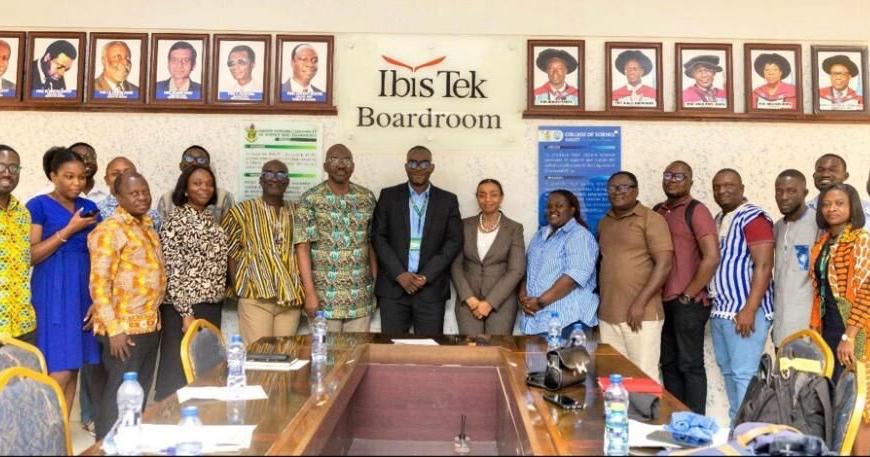
The University of Liberia and the European Union-funded Liberian Food Safety Initiative (LiFSI) have completed an academic scoping mission to Ghana, aimed at identifying strategic partnerships that will strengthen food science education, research, and food safety capacity in Liberia.
The mission brought together representatives from the University of Liberia’s Department of Food Science and Human Nutrition to engage with leading academic institutions in Ghana, including the Department of Food Science and Technology at the Kwame Nkrumah University of Science and Technology, the Department of Clinical Nutrition and Dietetics at University of Cape Coast, and the Department of Nutrition and Food Science at University of Ghana.
Led by Dr. Agnes Reeves-Taylor, Vice President for Academic Affairs at the University of Liberia, the delegation explored opportunities for long-term collaboration through a potential twinning arrangement between the University of Liberia and selected Ghanaian partner institutions.
During the visits, the delegation examined academic programmes, laboratory facilities, research activities, student training systems, and the institutions’ approaches to food safety and nutrition education. Discussions also focused on opportunities for faculty exchanges, joint research, curriculum development, laboratory strengthening, and other forms of academic cooperation.
The mission forms part of ongoing efforts to build the capacity of Liberia’s food safety workforce and support the development of future food scientists, nutritionists, and food safety professionals. Strengthening higher education and research capacity is a key component of improving Liberia’s national food control system and ensuring safer food for consumers.
Dr. Agnes Reeves-Taylor highlighted the mission’s goal of strengthening partnerships between the University of Liberia and leading Ghanaian universities to advance food science, nutrition, and food safety through curriculum development, joint research, academic exchanges, and knowledge sharing.
Through regional collaboration and knowledge exchange, the Liberian Food Safety Initiative implemented by the United Nations Industrial Development Organization (UNIDO) continues to support national efforts to strengthen food safety governance, enhance technical capacity, and build a skilled workforce capable of addressing emerging food safety challenges.
The academic scoping mission builds on the broader work of LiFSI to strengthen food safety systems, improve compliance, and enhance food safety practices across Liberia. Most recently, the Liberia Food Safety Coordinating Committee (LFSCC) convened its first issue-based meeting in Monrovia, chaired by the Director General of the Food Authority of Liberia, Honourable Precellia Cherue, and co-chaired by the Chief Executive Officer of Joyce Frozen Foods, Fatima Conneh-Farah. The meeting resulted in the adoption of two formal resolutions aimed at addressing critical gaps in Liberia’s food safety governance framework. Through initiatives such as these, LiFSI continues to support national efforts to build a more coordinated, effective, and sustainable food safety system.
DISCLAIMER
This report has been produced with funding from the European Union (EU). The content, conclusions, and recommendations presented in this report are those of the authors and do not necessarily reflect the views or opinions of the EU. The EU is not responsible for any use that may be made of the information contained herein. The authors assume full responsibility for the accuracy and completeness of the information provided, and any errors or omissions are solely their own.
This document has been produced without formal United Nations editing. The designations employed and the presentation of the material in this document do not imply the expression of any opinion whatsoever on the part of the Secretariat of the United Nations Industrial Development Organization (UNIDO) concerning the legal status of any country, territory, city or area or of its authorities, or concerning the delimitation of its frontiers or boundaries, or its economic system or degree of development.
Designations such as “developed”, “industrialized” or “developing” are intended for statistical convenience and do not necessarily express a judgement about the stage reached by a particular country or area in the development process. Mention of firm names or commercial products does not constitute an endorsement by UNIDO.
