
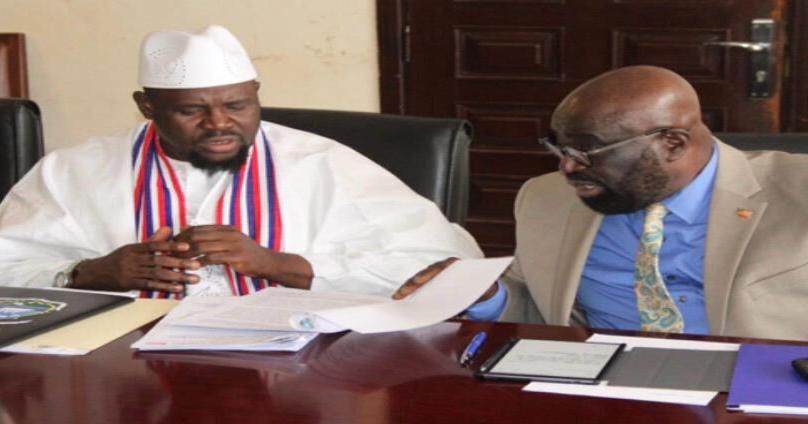
A potentially significant political rift is emerging between the Executive and Legislative branches after the House of Representatives moved aggressively against Ambassador-at-Large Sheikh Moustapha Kouyateh over allegations that lawmakers accepted bribes and illicit inducements linked to concession agreements and investment approvals.
The controversy, which has rapidly evolved from a public war of words into a matter with broader governance implications, is now being viewed by political observers as an early test of President Joseph Nyuma Boakai’s ability to maintain cohesion within government while advancing his administration’s reform, accountability, and development agenda.
At the center of the dispute are comments allegedly made by Ambassador Kouyateh accusing some legislators of receiving financial benefits from foreign commercial interests in exchange for facilitating legislative approvals — accusations that triggered outrage within the House of Representatives and prompted lawmakers to demand a sweeping public retraction.
Under a formal resolution adopted by House leadership, Kouyateh has been ordered to submit a written apology to the Speaker of the House, fully retract statements described as “prejudicial, inflammatory, and injurious” to the Legislature’s reputation, publish the apology in four national newspapers for four consecutive days and appear on OK FM, the same platform where the allegations were reportedly made, to publicly retract and clarify his statements.
The House indicated that compliance with the directives could pave the way for reconciliation and institutional closure.
But beyond the apology itself, the unfolding tensions have exposed deeper anxieties surrounding governance credibility, corruption allegations, institutional trust, and political unity within Liberia’s ruling establishment.
The dispute comes at a particularly sensitive time for the Boakai administration, which came to power promising national renewal, institutional reform, improved public service delivery, and a decisive break from governance failures that have long frustrated Liberians.
Since assuming office, President Boakai has repeatedly emphasized anti-corruption reforms, accountability, institutional respect, economic recovery, and rebuilding public trust in government.
However, many believe that sustaining those objectives requires strong cooperation between the Executive and Legislature — especially in a country where governance progress often depends on political consensus, budgetary collaboration, and legislative backing for reforms.
“This is more than just a disagreement over statements,” an influential lawmaker noted on Monday. “It touches the very heart of state cohesion and political trust. When public accusations of corruption emerge from within the government itself, they create internal suspicion and weaken confidence in governance institutions.”
He added that while the Legislature has a legitimate interest in defending its institutional reputation, the controversy also raises important questions about transparency and accountability in public office.
Lawmakers argue that the House’s response is intended not merely to punish Ambassador Kouyateh, but to defend the integrity of the Legislature as a constitutional institution.
The House leadership reportedly viewed the allegations as politically destabilizing, diplomatically reckless, damaging to democratic governance, and capable of eroding public trust in the First Branch of Government.
The requirement that the apology be published repeatedly in newspapers and aired publicly on radio is widely being interpreted as an extraordinary effort to rehabilitate the Legislature’s public image.
Political commentators say the House’s reaction reflects growing institutional sensitivity within Liberia’s political system, where accusations of corruption frequently dominate public discourse and often deepen distrust between citizens and elected officials.
Liberia’s Legislature has long faced criticism over issues including alleged bribery, opaque concession approvals, budget controversies, payroll irregularities, legislative benefits, and concerns about transparency in oversight functions.
Against that backdrop, Kouyateh’s allegations — whether substantiated or not — struck at an already fragile area of public confidence.
Executive Attempts to Contain the Fallout
Amid the growing tensions, Minister of State and Chief of Staff Samuel A. Stevquoah reportedly intervened directly with House leadership to convey President Boakai’s dissatisfaction with the ambassador’s comments.
According to sources familiar with the engagement, the Minister emphasized the administration’s commitment to respectful inter-branch relations, constitutional diplomacy, political stability, and cooperative governance.
The Executive’s quick intervention, many observe, reflects concerns that the situation could escalate into a broader political confrontation if left unmanaged.
“The Boakai administration understands the risks of prolonged institutional conflict,” a political commentator who leads a popular talk-show, said. “Liberia’s governance system requires continuous collaboration between the Executive and Legislature, especially for national budgets, infrastructure projects, social services, and anti-corruption reforms.”
The he warned that public fractures within government could complicate efforts to pass key legislation and weaken the administration politically ahead of future elections.
Political observers say one of the biggest dangers of an Executive-Legislative breakdown is the potential paralysis of governance priorities.
President Boakai inherited a country facing widespread youth unemployment, poor infrastructure, rising public expectations, healthcare and education challenges, fiscal constraints, and mounting demands for economic relief.
Delivering on those priorities requires strong coordination between ministries, state agencies, and lawmakers responsible for budget approval, legislative oversight, policy ratification, and concession agreements.
Some say if mistrust deepens between the two branches, it could slow government operations and weaken the administration’s reform momentum.
“In countries with fragile democratic institutions, political fragmentation often comes at the expense of development,” the political commentator noted. “The people suffer when state institutions become consumed by internal political battles instead of service delivery.”
While lawmakers condemned Kouyateh’s remarks, the controversy has also reignited public debate about corruption and governance accountability in Liberia.
Corruption remains one of Liberia’s most persistent governance challenges, repeatedly cited by citizens, civil society groups, and international development partners as a major obstacle to national progress.
Over the years, allegations involving concession negotiations, procurement processes, misuse of public funds, payroll fraud, and abuse of office have repeatedly surfaced across multiple administrations.
Although successive governments have pledged reform, many Liberians remain skeptical about whether meaningful accountability has truly taken root.
For some observers, the intensity of the House’s response may also reflect fears about growing public frustration with corruption allegations involving state institutions.
“Liberians are increasingly demanding accountability,” one civil society advocate said. “So whenever accusations emerge from insiders within government, the reaction becomes politically explosive because the public already has deep concerns about corruption.”
Many believe that the manner in which the Boakai administration manages this controversy could carry long-term political implications heading toward the crucial 2029 presidential and legislative elections.
Historically, internal divisions within ruling coalitions in Liberia have often weakened governing parties ahead of elections.
Political cohesion, observers note, will be critical if the administration hopes to maintain reform credibility, defend its governance record, sustain public trust, and build electoral momentum.
“If internal tensions continue to grow publicly, the opposition will likely capitalize on perceptions of disunity,” the political commentator argued. “Voters tend to judge governments not only by promises, but by their ability to govern cohesively.”
The commentator added that public disputes involving corruption allegations can be particularly damaging because they undermine the moral authority of reform-oriented governments.
The unfolding controversy also highlights a broader democratic challenge confronting many developing democracies: balancing the need for transparency and accountability with the need to preserve institutional stability and mutual respect among branches of government.
Some observers argue that allegations involving public corruption should always be independently investigated rather than resolved solely through political apologies.
Others insist that public officials must exercise restraint and responsibility when making allegations capable of damaging national institutions.
For now, political attention remains fixed on whether Ambassador Kouyateh will fully comply with the House’s directives and whether the Executive and Legislature can successfully contain the tensions before they evolve into a deeper political confrontation.
But Liberians agree on one point that at a time when the country is demanding better governance, stronger institutions, and improved social services, prolonged political friction inside government could distract from the very national priorities the administration was elected to address.
