
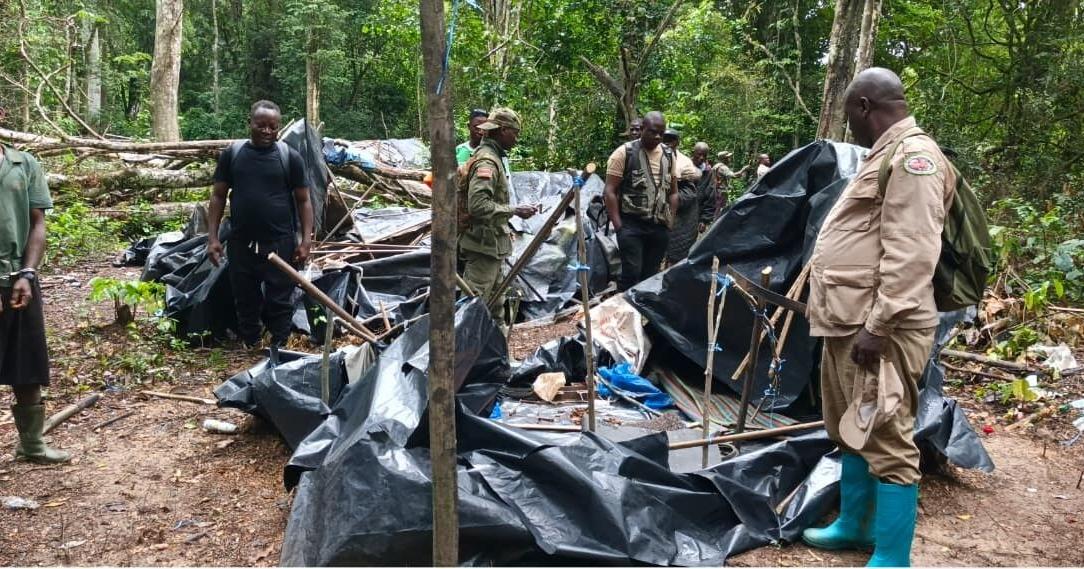
The country’s efforts to protect its remaining forests are confronting one of their most significant governance challenges as repeated confrontations between forestry authorities and local communities in Grand Gedeh County expose growing resistance to environmental law enforcement, raising concerns about the state’s ability to safeguard protected areas from illegal mining, unauthorized settlements, and other forms of forest exploitation.
The latest incident—reported by the Rural Reporters News Network (RRNN)—involved the detention of Forestry Development Authority (FDA) personnel, including the agency’s Regional Forester, during an enforcement operation targeting alleged illegal mining activities around the Krahn-Grebo National Park. The episode has intensified concerns that community resistance, traditional authority structures, and competing economic interests are increasingly undermining the enforcement of Liberia’s forestry laws.
For many observers, the incident represents more than an isolated dispute between local residents and government officials. Rather, it illustrates the complex intersection of environmental conservation, rural livelihoods, traditional governance, and transnational criminal activity that has made forest governance one of Liberia’s most difficult policy challenges.
The Krahn-Grebo National Park forms part of Liberia’s globally significant Upper Guinean Forest ecosystem, one of the world’s biodiversity hotspots. Established to protect endangered wildlife and preserve critical forest habitats, the park has increasingly come under pressure from illegal mining, agricultural encroachment, hunting, logging, and cross-border migration.
According to RRNN, the most recent confrontation began after FDA officers conducted operations targeting alleged illegal miners—many reportedly Malian nationals—operating around the Cavalla River and within protected sections of the national park.
Sources said the officers were detained in Druwoh Town, Konobo District, for approximately 16 hours after traditional authorities intervened following the enforcement operation.
The officials were reportedly held from about 9:00 a.m. on Monday until nearly 1:00 a.m. the following day before being released. Reports indicate they were also compelled to pay substantial fines.
The FDA has maintained that the operation was conducted strictly to enforce forestry and environmental laws governing protected areas.
The latest confrontation is not the first time FDA personnel have reportedly faced resistance while carrying out official duties in Grand Gedeh.
RRNN reports that on March 2, 2025, Park Warden Selma Kolako and fellow enforcement officer Oliver Jelleh fled to Ziah Town after receiving warnings of imminent arrest by traditional authorities following awareness campaigns promoting conservation around the national park.
Kolako recalled receiving an urgent warning late at night.
“I was in bed when I heard a persistent knock at my door,” she said. “The person pleaded with me, saying, ‘Kolako, you must leave right now before the worst happens. You are no longer safe in Ziah Town.'”
The recurrence of such incidents suggests that resistance to conservation enforcement has evolved beyond isolated disagreements into a broader governance challenge affecting the FDA’s ability to operate safely within some communities.
At the heart of the dispute lies a long-standing tension between environmental protection and local economic survival.
Many rural communities surrounding Liberia’s protected forests depend on agriculture, artisanal mining, hunting, and forest resources for their livelihoods.
Reports indicate that foreign migrants, particularly from neighboring West African countries, have increasingly entered forest regions where they engage in cocoa farming and small-scale mining, often with support from local residents who benefit economically from those activities.
The recent Global Witness report paints a troubling picture of illegal activities within the forests and has reinforced concerns that protected areas are becoming increasingly vulnerable to organized exploitation.
For conservation authorities, these activities threaten biodiversity, water systems, and Liberia’s international conservation commitments.
For some local communities, however, restricting access to forest resources may also mean limiting already scarce economic opportunities in areas with few formal employment alternatives.
This tension has complicated enforcement efforts, particularly where community members perceive conservation measures as conflicting with immediate livelihood needs.
One of the most significant aspects of the Grand Gedeh incidents is the apparent collision between customary authority and statutory law.
According to RRNN, traditional leaders allegedly intervened during FDA operations, while community members reportedly erected roadblocks that prevented officers from leaving the area.
The reports further allege that local cultural leaders detained not only FDA personnel but also Electoral Committee Chairman Ashai Gaye and Community Forest Management Body Secretary Bedell Krayou, accusing them of cooperating with government authorities.
Such developments raise broader questions about governance in rural Liberia, where customary leadership structures often coexist with formal state institutions.
While traditional authorities play an essential role in community governance and conflict resolution, legal experts note that national laws governing protected areas remain enforceable throughout Liberia.
When customary decisions obstruct statutory law enforcement, tensions can emerge over jurisdiction, legitimacy, and the rule of law.
The reported detention of government officials also raises concerns about the operational security of public institutions responsible for managing Liberia’s natural resources.
According to RRNN, mediation efforts involving Paramount Chief James Saylee and Electoral Committee Chairman Ashai Gaye reportedly failed to immediately resolve the confrontation.
Community representatives later accused FDA officers of destroying cocoa farms and structures allegedly used by foreign miners during enforcement operations.
The FDA has rejected those allegations, maintaining that its activities were confined to enforcing environmental regulations within the national park.
The agency further clarified that it did not notify the Community Forest Management Body because the operation targeted activities inside a protected national park rather than community-managed forests.
An investigative team from Monrovia has since reportedly been dispatched to examine the incident.
The Grand Gedeh confrontation illustrates several structural weaknesses affecting forest governance across Liberia.
First, it demonstrates the growing sophistication of illegal activities occurring within protected areas, including cross-border movements of foreign miners and the involvement of organized local support networks.
Second, it highlights the challenges government agencies face when enforcement operations encounter resistance from influential local actors.
Third, it underscores the importance of balancing conservation objectives with sustainable livelihood opportunities for communities living adjacent to protected forests.
Development specialists have long argued that successful conservation requires not only effective law enforcement but also community participation, economic alternatives, and transparent management of natural resources.
Without those complementary measures, enforcement alone may struggle to achieve long-term compliance.
Beyond conservation, the dispute may carry broader economic consequences.
Reports indicate that prospecting activities by a logging company in Konobo have already experienced delays because of the ongoing tensions.
Observers warn that prolonged instability surrounding forest governance could discourage future investment, complicate community forestry initiatives, and weaken confidence in Liberia’s ability to effectively manage natural resources.
The uncertainty also risks undermining donor-supported conservation programs that have invested heavily in protecting Liberia’s internationally significant forests.
Ultimately, the events unfolding in Grand Gedeh extend beyond environmental management.
They represent a broader test of Liberia’s ability to enforce national laws while maintaining constructive relationships with rural communities whose livelihoods remain closely tied to forest resources.
Resolving the crisis will likely require more than criminal investigations or enforcement operations. It will demand sustained dialogue among government agencies, traditional leaders, conservation organizations, and local communities to address the underlying economic and governance pressures driving conflict around protected forests.
As illegal mining, agricultural expansion, and cross-border migration continue to place increasing pressure on Liberia’s forests, the Grand Gedeh dispute may well become a defining case for how the country balances environmental protection, community development, and the rule of law in one of West Africa’s most ecologically important landscapes.
