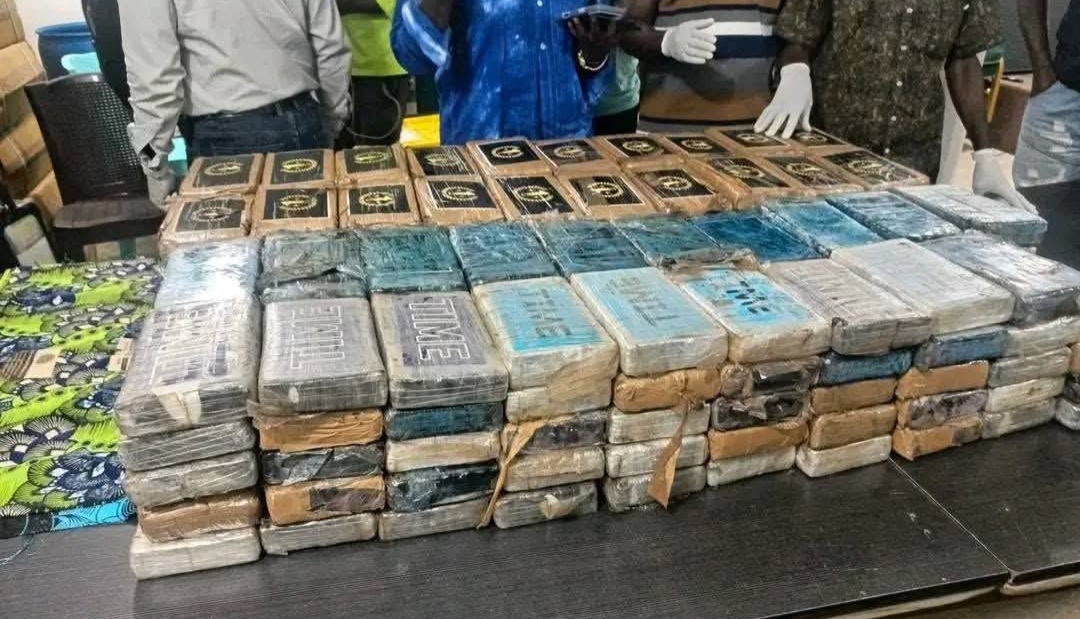
How did nearly four tonnes of cocaine move through West African logistics systems?
MONROVIA — Two of West Africa’s most consequential cocaine cases are now unfolding in Ghana and Liberia, separated by geography but connected by a disturbing question:
\n
How can shipments weighing nearly four tonnes pass through sophisticated commercial and transportation networks without being detected until authorities intervene—or, in Ghana’s case, until foreign customs officers make the seizure?
The question has become increasingly important after French customs officers intercepted nearly 3.9 tonnes of cocaine at the Port of Dunkirk on September 10, 2026, in a container of plastic waste that had arrived from Ghana. French authorities estimated the shipment’s value at approximately €225 million, or about US$261 million. Part of the shipment was reportedly destined for Antwerp, Belgium.
\n
The Ghana case now has suspects before the courts.
Liberia, meanwhile, has been dealing with its own enormous cocaine case after authorities discovered 3,971 kilograms of cocaine in Duazon in July. Reuters reported an estimated value of about US$317 million at the time, while Liberian authorities later placed the value of the destroyed haul at approximately US$336 million. Two foreign nationals were arrested.
\n
The similarities are impossible to ignore.
But the differences in the two investigations may be even more revealing.
\n
GHANA: THE DRUGS LEFT THE COUNTRY
The French seizure has raised uncomfortable questions about Ghana’s export-control system.
\n
The cocaine was hidden inside a container carrying plastic waste and was discovered only after the shipment reached Dunkirk.
Ghanaian authorities subsequently arrested people allegedly connected to the shipment. Four Ghanaians have been charged with conspiracy to export narcotic drugs and the exportation of narcotic drugs. Prosecutors allege links to Dutch fugitive Jos Leijdekkers, popularly known as “Bolle Jos.” The accused have pleaded not guilty.
\n
The investigation has therefore moved beyond the question of who allegedly organized the shipment.
It is increasingly asking:
\n
Who handled the container in Ghana?
Who inspected it?
\n
Who cleared it?
What information was available to Customs?
\n
Were there warning signs that should have triggered a physical inspection?
Those questions have become sufficiently serious that Ghanaian opposition figures are calling for Customs officers who were on duty when the container departed to be questioned.
\n
That does not establish wrongdoing by any Customs officer.
But it demonstrates the institutional accountability question now surrounding the case.
\n
LIBERIA: THE DRUGS WERE FOUND BEFORE THEY LEFT
Liberia’s case is different.
\n
Rather than being intercepted by a foreign government after leaving the country, nearly four tonnes of cocaine were discovered inside Liberia.
Police found 3,971 kilograms in Duazon, according to Inspector General Gregory Coleman. Two foreign nationals were arrested. The origin and ultimate destination of the cocaine remained subject to investigation.
\n
The case subsequently became even more serious because allegations emerged involving members of Liberia’s security apparatus.
The case implicated senior police officials, including the chief of highway patrol and the head of the major crimes unit, while another police official connected to the airport was under investigation.
\n
That introduces another dimension largely absent from the initial Ghana narrative:
The question of whether people inside state institutions may have facilitated or enabled trafficking.
\n
Again, allegations are not convictions. Any individual accused of wrongdoing is entitled to due process.
But the institutional question cannot simply disappear.
\n
TWO COUNTRIES. TWO DIFFERENT QUESTIONS.
The Ghana and Liberia cases can therefore be viewed through two different accountability lenses.
\n
In Ghana, the immediate question is:
How did nearly four tonnes of cocaine pass through the country’s export and port systems and reach France?
\n
In Liberia, the question is broader:
How did nearly four tonnes of cocaine enter Liberia, reach a storage location in Duazon and allegedly move through an environment where security officials have themselves become part of the investigation?
\n
Both questions point toward the same larger issue:
West Africa’s vulnerability to international cocaine trafficking is no longer merely a border-security problem. It is an institutional problem.
\n
THE FOREIGN-INTERCEPTION PROBLEM
The Ghana case presents another uncomfortable reality.
\n
The shipment was intercepted in France.
That means the decisive intervention occurred thousands of kilometres away from where the container originated.
\n
This raises a fundamental question for Ghana:
Should Ghana’s anti-narcotics success be measured primarily by the arrests it makes after foreign authorities intercept shipments connected to Ghana, or by its ability to prevent those shipments from leaving Ghana in the first place?
\n
The same question can be asked of Liberia.
A country can publicly destroy tonnes of cocaine after discovering it. That is important.
\n
But the deeper measure of institutional effectiveness is whether authorities can identify trafficking networks before the drugs reach warehouses, ports, airports and international markets.
THE COMMON WEST AFRICAN PROBLEM
\n
The two cases come against a wider regional backdrop.
West Africa has increasingly been used as a transit region for cocaine moving from South America toward European markets. Reuters reported in July that Liberia’s nearly 4,000-kilogram seizure illustrated the region’s continuing role in international trafficking networks.
\n
The Ghana case reinforces that concern.
The sheer size of the shipments demonstrates that traffickers are not merely moving small quantities through West Africa.
\n
They are moving industrial-scale consignments.
And industrial-scale trafficking requires logistics.
\n
It requires storage.
It requires transportation.
\n
It requires documentation.
It requires communications.
\n
It requires money.
And, potentially, it requires people willing to look the other way.
\n
That last point must be established by evidence within each individual case—not assumed simply because a massive shipment passed through a country.
THE REAL TEST IS NOT THE BURNING OF THE COCAINE
\n
Liberia has received considerable attention for publicly destroying the cocaine seized at Duazon, as well as the 237.6 kilograms seized earlier at Roberts International Airport.
Destroying seized narcotics removes the physical evidence from circulation.
\n
But destroying the drugs does not destroy the criminal network that financed, transported, stored or protected them.
That is why the real test is what happens after the seizure.
\n
Who financed the operation?
Who recruited the local actors?
\n
Who arranged the transportation?
Who provided the storage facility?
\n
Who controlled the communications?
Who moved the money?
\n
Who knew?
Who facilitated?
\n
And, critically:
Who inside government or private logistics systems may have enabled the operation, if investigators find evidence of such involvement?
\n
GHANA’S LESSON FOR LIBERIA
Ghana’s current investigation offers Liberia an important lesson: the investigation cannot end with the people physically caught with the drugs.
\n
The entire chain must be reconstructed.
That means following the container.
\n
Following the documentation.
Following the money.
\n
Following the communications.
Following the companies involved.
\n
Following the port and customs procedures.
And following the people who had authority over the shipment at every stage.
\n
Liberia should be asking the same questions about the Duazon operation.
The country needs to know not simply where the cocaine was found, but how it got there and who made its movement possible.
\n
THE QUESTION THAT BOTH COUNTRIES MUST ANSWER
The Ghana and Liberia cocaine cases are not simply stories about enormous quantities of illegal drugs.
\n
They are tests of state capacity.
They are tests of port security.
\n
They are tests of intelligence gathering.
They are tests of financial investigation.
\n
They are tests of law enforcement.
And, perhaps most importantly, they are tests of institutional accountability.
\n
Ghana now has to explain how nearly four tonnes of cocaine could leave its territory hidden inside a legitimate commercial shipment before being intercepted in France.
Liberia must explain how nearly four tonnes could reach and remain in a property in Duazon while its own security establishment subsequently became the subject of scrutiny.
\n
The answer in both countries cannot simply be:
“We seized the cocaine.”
\n
The harder question is:
Who made it possible for the cocaine to get there in the first place?
\n
That is where the real investigation begins. Reporting by Liberian Investigative Journalist Lyndon Ponnie.
See more Liberia News Network stories in Google Search by adding LNN as one of your Preferred Sources.
★ Add LNN as a Preferred Source