
MONROVIA, LIBERIA – The Liberian government has launched a major effort to strengthen legal protections for witnesses, whistleblowers, and victims by proposing sweeping amendments to two landmark accountability laws aimed at closing gaps that officials say have weakened anti-corruption efforts and discouraged citizens from reporting wrongdoing.
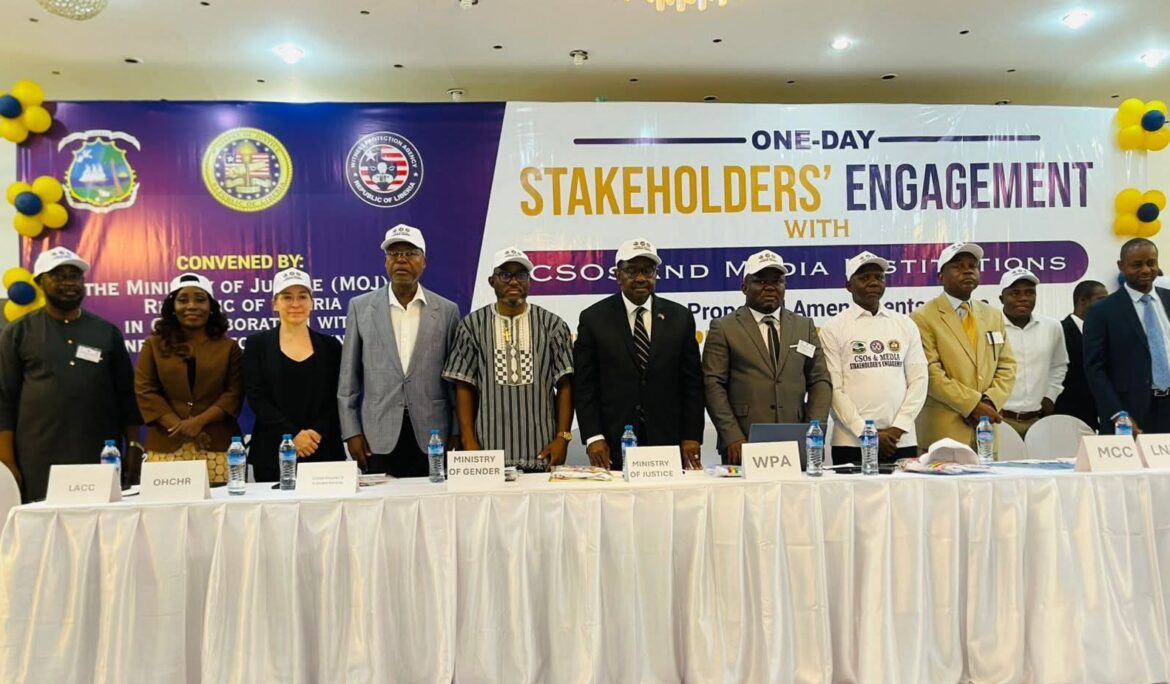
The initiative, spearheaded by the Ministry of Justice, the Liberia Anti-Corruption Commission (LACC), and the Witness Protection Agency (WPA), brought together civil society organizations, media institutions, government agencies, and international development partners at Monrovia City Hall on Friday, July 3, 2026, to review proposed amendments to the Witness Protection Act of 2021 and the Whistleblower Act of 2021.
Held under the theme, “Strengthening Protection Mechanisms for Witnesses, Whistleblowers, and Victims: Advancing Liberia’s Anti-Corruption and Transitional Justice Commitments,” the consultation forms part of the Boakai administration’s efforts to strengthen accountability and address legislative and operational gaps identified during the implementation of both laws.
The proposed amendments seek to reinforce confidentiality protections, broaden eligibility for witness protection, improve coordination among justice institutions, strengthen safeguards against retaliation, and address emerging threats such as digital surveillance and the unauthorized disclosure of protected identities.
One of the key proposals would increase financial rewards for whistleblowers from 5 percent to 10 percent, while introducing bounty incentives to encourage the reporting of corruption, organized crime, smuggling, and other serious offenses.
If enacted, the amendments would also criminalize retaliation against protected witnesses and whistleblowers, prohibit the unauthorized disclosure of protected identities, impose stronger penalties on employers who fail to comply with whistleblower protection requirements, and strengthen legal safeguards before, during, and after criminal proceedings.
Opening the consultation, Justice Minister and Attorney General Cllr. N. Oswald Tweh described the review process as a national priority rather than a routine legislative exercise.
“A witness who will not speak, a whistleblower who will not report, and a victim who will not come forward are not isolated failures of personal courage. They are indictments of institutional failure, and this nation can no longer afford that failure,” Tweh said.
The Attorney General acknowledged that while the Witness Protection Act of 2021 and the Whistleblower Act of 2021 marked important milestones in strengthening Liberia’s justice system, their implementation had exposed significant gaps requiring legislative reform.
He said the proposed amendments would expand the mandate of the Witness Protection Agency, strengthen penalties for retaliation and the unlawful disclosure of protected identities, improve digital security protections, and create stronger incentives for individuals willing to expose corruption and other serious crimes.
Tweh emphasized that the reforms are consistent with Liberia’s obligations under the United Nations Convention against Corruption (UNCAC), the Rome Statute of the International Criminal Court, and the United Nations Convention against Transnational Organized Crime.
He assured participants that recommendations from the consultation would be incorporated into a comprehensive stakeholder report before the draft legislation is submitted to the Legislature.
“The protection of witnesses, whistleblowers, and victims is not simply a legislative issue,” Tweh said. “It is a fundamental requirement for strengthening the rule of law, combating corruption, and advancing Liberia’s transitional justice commitments.”
Speaking at the forum, Witness Protection Agency Director Teklo Maxwell Grigsby II underscored the indispensable role of civil society organizations and the media in promoting accountability while cautioning that the unauthorized publication of protected identities could constitute a criminal offense under the proposed amendments.
“Civil Society and the Press are the frontline guardians of accountability in the Republic of Liberia,” Grigsby said. “Hold us accountable, ask the hard questions, and walk this road together with us.”
He also encouraged the Press Union of Liberia to develop professional protocols that balance investigative journalism with the protection of vulnerable witnesses and whistleblowers.
Speaking on behalf of the Executive Chairperson of the Liberia Anti-Corruption Commission, Vivian S. Akoto emphasized that successful anti-corruption efforts depend on citizens having confidence that they will be protected when reporting wrongdoing.
“No nation can successfully combat corruption if those who witness wrongdoing fear retaliation for speaking the truth,” she said, adding that strong laws must be backed by effective implementation, adequate institutional resources, and sustained political commitment.
Acting Governance Commission Chairperson Alaric K. Tokpa also stressed that no anti-corruption framework can succeed where witnesses fear testifying or whistleblowers face reprisals for exposing corruption, abuse of office, organized crime, or human rights violations.
The consultation brought together representatives from the Ministry of Justice, Witness Protection Agency, Liberia Anti-Corruption Commission, Ministry of Finance and Development Planning, Governance Commission, Office for the Establishment of the War and Economic Crimes Court (OWECC), Liberian National Bar Association, Press Union of Liberia, United Nations Office of the High Commissioner for Human Rights (OHCHR), civil society organizations, development partners, and other stakeholders.
Speaking on behalf of the OHCHR and the United Nations Resident Coordinator, Christian Mokosa described witness protection as essential to the successful establishment of the War and Economic Crimes Court (WECC) and the proposed National Anti-Corruption Court (NACC). He praised Liberia for establishing one of the few dedicated witness protection agencies in Africa and pledged continued United Nations support.
Meanwhile, OWECC Executive Director Dr. Jallah Barbu called for the decentralization of the Witness Protection Agency, arguing that expanding its presence across Liberia is critical to ensuring that citizens feel safe enough to testify and support accountability efforts.
The consultation concluded with the establishment of a Witness and Whistleblower Protection Coordinating Platform, to be supervised by interim representatives from the media and civil society organizations.
Recommendations from the engagement will be consolidated into a Stakeholder Consultation Report to guide the final draft of the proposed amendments before they are submitted to the Legislature.
Participants reaffirmed that strengthening protections for witnesses, whistleblowers, and victims is essential to advancing accountability, combating corruption, addressing human rights violations, supporting transitional justice, and reinforcing public confidence in Liberia’s justice system.
