
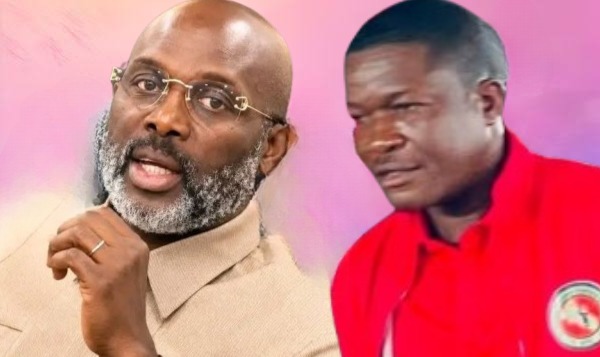
MONROVIA, LIBERIA — Emmanuel C.D. Gonquoi, political leader of the Economic Freedom Fighters of Liberia (EFFL), has called for equal justice and warned against political protection for former leaders.
His remarks come as a cocaine-trafficking controversy and allegations of a possible government action against former President George Manneh Weah continue to heighten political tensions.
The controversy surrounding Weah has taken a new turn, as Gonquoi publicly challenged the idea that the former Liberian president should be exempt from criminal investigation or potential arrest because he once held the presidency.
In a strongly worded Facebook post published Saturday, November 14, Gonquoi questioned whether Weah has special standing that puts him beyond the reach of Liberia’s justice system.
He maintained that no one, regardless of political status or past service to the country, should be above the law.
Titled “The Difficult Truth,” the post addressed supporters of the former ruling Coalition for Democratic Change (CDC), the government of President Joseph Boakai, and Liberians involved in the increasingly heated debate over Weah’s potential legal exposure.
“So, Former President Weah is above the Laws in Liberia? Is he above our Country values?” Gonquoi asked, before urging the government to investigate the former president if credible information links him to criminal activity.
“If he is link[ed] to any crime, he should be investigated and if possible arrested,” he wrote.
Although Gonquoi did not identify a specific criminal accusation against Weah or provide evidence connecting him to an offense, his remarks have placed the former president at the heart of an increasingly sensitive national debate, regarding whether Liberia’s commitment to equal justice can withstand the political influence and loyalty surrounding its former leaders.
Gonquoi’s intervention comes amid rising political tensions over the government’s investigation into a major cocaine seizure in Liberia and claims by CDC figures that the Boakai administration may be targeting former officials and opposition figures for political reasons.
The controversy intensified in August, when former Vice President Jewel Howard-Taylor was arrested at the Roberts International Airport on August 19, 2026, in connection with an investigation into the seizure of about four tons of cocaine in Duazon, Margibi County, in July.
The drugs were reportedly valued at US$317 million. Howard-Taylor was later charged with drug trafficking, money laundering, criminal conspiracy, and related offenses.
On August 25, she was remanded at the Monrovia Central Prison after the court rejected her lawyers’ request for compassionate detention.
Her arrest became a major political flashpoint, particularly within the CDC, where concerns arose that the investigation might expand to include other prominent figures linked to the Weah administration.
Former President Weah later threatened to mobilize CDC supporters and other Liberians to oppose what he characterized as efforts by the Boakai administration to target and intimidate opposition politicians and former officials under the pretext of combating illicit drugs.
Gonquoi, however, publicly rejected any attempt to use political mobilization to obstruct the government’s anti-drug investigation.
In August, Gonquoi warned that he would mobilize against protests aimed at disrupting the investigation, arguing that the drug crisis was too serious to be turned into a partisan political contest.
His latest remarks appear to broaden that stance beyond the investigation itself, prompting questions about whether Weah should be treated differently from other citizens if investigators establish a legitimate basis to question him.
At the center of Gonquoi’s argument is a constitutional issue that has become increasingly prominent in Liberia’s political debate: the scope of presidential immunity and whether it can protect a former president from criminal accountability.
Article 61 of Liberia’s 1986 Constitution grants the President immunity from suits, proceedings, arrest, and detention for acts carried out in the exercise of presidential authority in accordance with the Constitution and other laws.
Howbeit, the same provision states that the President is not immune from prosecution after leaving office for a criminal act committed while in office.
The constitutional language makes an important distinction between protection for the lawful exercise of presidential duties and accountability for alleged criminal conduct.
It does not establish that a former president is automatically guilty of an offense, nor does it mean an arrest may be ordered merely because a political figure calls for one.
How Article 61 applies in specific circumstances requires legal interpretation and must be resolved through the proper constitutional and judicial processes.
The Supreme Court’s February 12, 2026, reaffirmation of its decision permitting the prosecution of former Finance Minister Samuel D. Tweah and others to proceed also renewed national discussion of presidential immunity.
The Court held that the defendants were not entitled to the immunity Article 61 grants to the President. That ruling, however, addressed Tweah and his co-defendants; it did not establish Weah’s criminal liability.
Gonquoi’s latest intervention also has a political history. The EFFL leader has previously challenged Weah over the former president’s opposition to the government’s handling of the drug investigation.
In August of this year, Gonquoi rejected Weah’s proposed political mobilization against what the former president described as government intimidation.
Gonquoi argued at the time that political interests should not obstruct the fight against illicit drugs.
His latest post appears to distinguish between protecting Weah’s constitutional and democratic rights and shielding him from legitimate criminal investigation.
He appears to be telling people on both sides of the political divide that the former president should not be targeted because of his political identity, nor shielded because of his former office.
His message also warns the Boakai administration that Weah should be investigated only when there is a meaningful basis to do so, that the law must be respected, and that the justice system must not be used to intimidate political opponents.
“However, if you don’t have something meaningful to question the Former President about, leave him alone and focus on the day to day Governance of the state,” Gonquoi wrote.
Gonquoi’s stance is likely to deepen an already polarized debate between those calling for public officials to be held accountable and those concerned that the anti-drug campaign could become a means of political persecution.
For CDC loyalists, any suggestion that Weah might be arrested is especially sensitive, given the former president’s public warnings about what he regards as politically motivated investigations.
In September, CDC Secretary-General Jefferson Koijee alleged that President Boakai had ordered Weah’s arrest and that former Justice Minister N. Oswald Tweh was removed after refusing to carry out the purported order.
Koijee offered no evidence to support the allegation, and the government had not publicly confirmed same.
The allegation has added another dimension to the controversy, making the prospect of Weah’s possible arrest a political issue even before any publicly confirmed criminal charge against him had been identified.
Gonquoi’s latest statement presents a different argument: the risk of political unrest should not be used to shield anyone from lawful scrutiny.
Perhaps the most politically significant element of Gonquoi’s message is his insistence that Liberia must not have a justice system that prosecutes ordinary citizens while protecting powerful figures.
“The laws are not meant for the poor only!” He declared.
He also cited world leaders who have faced prosecution or arrest, including former Brazilian President Jair Bolsonaro and former United States President Donald Trump, while acknowledging that the legal circumstances of those cases differ considerably.
His examples were intended to underscore the principle that political prominence should not automatically exempt anyone from legal accountability.
Howbeit, Gonquoi also cautioned against what he characterized as the use of the judiciary to advance improper political action.
He stressed that Weah must retain his constitutional rights, including the freedom to participate in the nation’s political affairs without judicial intimidation.
That position presents Liberia’s political institutions with an important test: investigations must be grounded in evidence, arrests must have a legal basis, and political affiliation must neither establish guilt nor ensure protection.
Although Gonquoi’s statement has brought renewed energy to the debate, several key questions remain unanswered.
Has a competent Liberian investigative authority formally named Weah as a suspect in a criminal investigation? Has he been called in for questioning? Is there evidence linking him personally to the cocaine-trafficking case, or is the controversy driven mainly by political exchanges between the CDC and the EFFL?
Gonquoi’s latest Facebook post provides no answers to these questions and presents no specific evidence against the former president.
As of publication, none of the multiple sources consulted for this report had established evidence that Weah had been charged in connection with the cocaine seizure.
Ultimately, Gonquoi’s intervention has returned the former president’s legal status, constitutional protections, and political rights to public scrutiny.
Beneath the increasingly heated exchanges is a question Liberia’s justice system will eventually have to resolve through law and evidence, rather than political declarations: Can a former president be held accountable for criminal conduct without turning the pursuit of justice into a source of political tension?
See more Liberia News Network stories in Google Search by adding LNN as one of your Preferred Sources.
★ Add LNN as a Preferred Source