
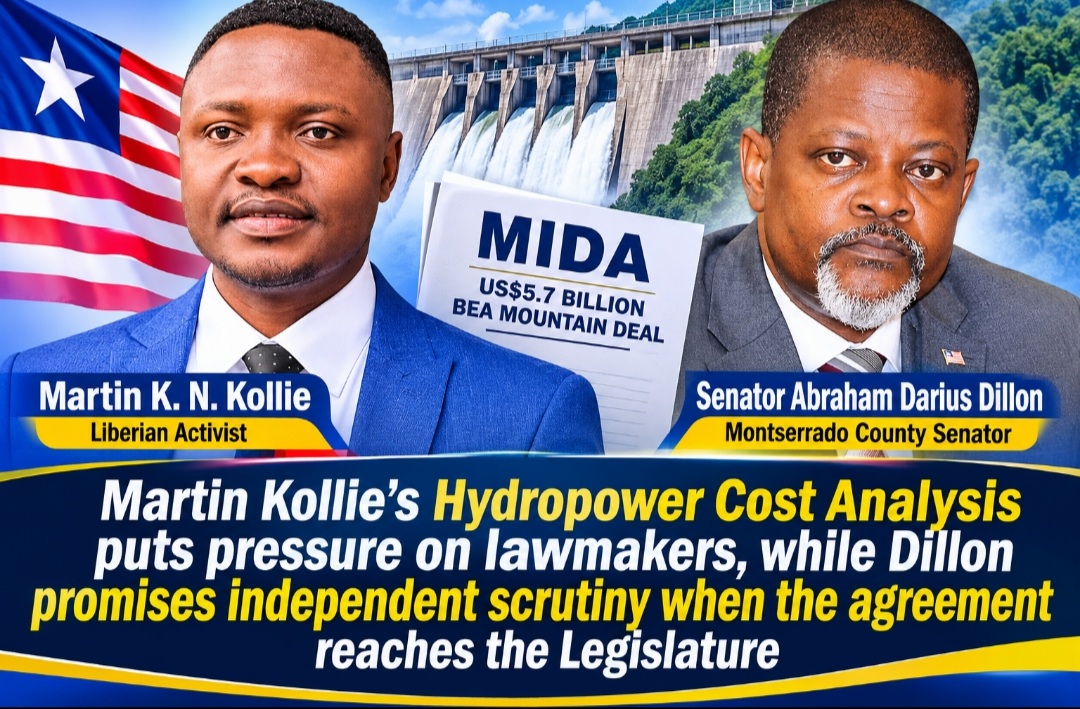
MONROVIA – A growing public debate over the proposed US$5.7 billion Master Infrastructure Development Agreement (MIDA) between the Government of Liberia and Bea Mountain Mining Corporation (BMMC) has placed Senator Abraham Darius Dillon under renewed pressure to demonstrate the kind of legislative oversight that previously earned him recognition as one of the country’s outspoken advocates for public accountability.
The debate intensified following a public challenge from Liberian activist Martin K. N. Kollie, who has questioned the financial structure, projected construction costs, and legislative oversight provisions of the proposed agreement, while appealing directly to Dillon to revive what he describes as the senator’s former reputation for challenging questionable public financial arrangements.
Kollie’s argument is built around a fundamental concern: whether Liberia is committing itself to infrastructure costs that are economically justified, technically competitive, and consistent with the country’s long-term national interests.
In his detailed commentary on Wednesday, November 25, 2026, titled “Potestne lux paulisper rursus accendi?” translated as “Can The Light come back on for just a moment?”, Kollie invokes Dillon’s political identity as “The Light,” challenging the senator to demonstrate the same level of public advocacy that characterized his opposition to controversial financial arrangements during the previous administration.
The activist particularly questions the proposed costs of three hydropower facilities under the agreement.
According to the figures cited in Kollie’s analysis, the proposed 100-megawatt Via Hydropower Plant carries an estimated cost of US$2.07 billion, while the 100-megawatt St. Paul River 3 (SP-3) facility is valued at approximately US$1.17 billion. The proposed 10-megawatt St. Paul River 4 (SP-4) facility is listed at US$634.4 million.
Using these figures, Kollie calculates construction costs of approximately US$20.7 million per megawatt for Via, US$11.7 million for SP-3, and US$63.4 million for SP-4.
His most pointed question concerns the SP-4 facility, where the projected expenditure appears particularly high relative to its proposed generating capacity.
Kollie further compares the figures with hydropower projects in other African countries, including Côte d’Ivoire, Mali, Guinea, and Nigeria, arguing that their reported construction costs per megawatt are substantially lower than those presented for Liberia’s proposed facilities.
However, such comparisons require detailed technical examination because hydropower projects differ in reservoir size, geological conditions, civil engineering requirements, transmission infrastructure, resettlement obligations, and other associated costs. The decisive question is whether the proposed Liberian facilities offer sufficient technical and economic justification for their projected prices.
Beyond construction costs, Kollie raises concerns about the agreement’s provisions for recovering infrastructure expenditure through government revenue entitlements and the extent of legislative authority over subsequent spending.
He argues that certain provisions could substantially restrict the Legislature’s ability to exercise continuing oversight after an initial ratification.
That interpretation, if supported by the final agreement, would raise important constitutional and public financial management questions about the relationship between legislative authorization, future appropriations, and government revenue commitments.
It is against this background that Dillon issued his response, emphasizing that the Legislature has not yet formally received the agreement and played no role in its negotiation or signing.
“The Legislature played no part in the negotiations and signing of the DEAL,” Dillon stated, explaining that the agreement was negotiated by relevant Executive Branch authorities and would be transmitted to lawmakers following presidential action.
The senator maintained that legislative scrutiny would become necessary when the agreement is formally submitted for ratification.
He also called for the participation of knowledgeable Liberians, technical professionals, and individuals with informed positions either supporting or opposing the arrangement.
Dillon said his office was available to engage those offering credible expertise and opinions, stressing that the national debate should be conducted without political sentiments or uninformed commentary.
His statement represents a commitment to an open-minded legislative review. However, it also leaves a critical question for the senator and his colleagues. What level of scrutiny will be sufficient to protect the country’s financial and constitutional interests?
While Dillon maintains that the Legislature’s formal responsibility comes when the agreement is transmitted for ratification, the questions raised by Kollie demonstrate why lawmakers should begin familiarizing themselves with its implications before that stage.
Legislative oversight is not merely about voting for or against an agreement. It also requires the capacity to interrogate financial assumptions, examine technical specifications, obtain independent assessments, identify potential liabilities, and determine whether the proposed arrangement provides adequate protection for public revenue.
The Government has presented MIDA as a major infrastructure initiative expected to deliver 270 megawatts of electricity through four power plants, alongside major road, transmission, and grid improvement projects. The administration argues that the arrangement could help address Liberia’s longstanding infrastructure constraints and support economic development.
The agreement’s financing structure also deserves particular attention. Available reporting describes a system under which BMMC would initially finance approved infrastructure projects and subsequently recover eligible costs through specified government revenue entitlements. This makes it essential to understand not only the headline investment figure but also the actual revenue streams, recovery periods, interest provisions, and financial consequences for the national budget.
For Dillon, the challenge is therefore larger than responding to Kollie’s appeal. It is about demonstrating that legislative independence and public accountability remain important regardless of which administration negotiated an agreement.
His previous political identity as “The Light” has become the central reference point in Kollie’s challenge. Whether that identity continues to carry weight will depend less on public statements and more on the senator’s willingness to demand comprehensive documentation, independent technical reviews, and meaningful safeguards during legislative consideration.
Kollie’s intervention may be politically confrontational, but the questions surrounding project costs, revenue recovery, and legislative oversight cannot be dismissed simply because they come from an activist or someone critical of the agreement.
Similarly, Dillon’s call for informed opinions should be welcomed as an opportunity to move the discussion beyond political exchanges and toward substantive examination.
The Legislature will have to determine whether the proposed arrangement represents a financially responsible pathway to infrastructure development or creates obligations that could constrain Liberia’s economic choices for years to come.
The country does not need a Legislature that simply receives an agreement and approves it. It needs lawmakers capable of examining every provision, challenging every questionable assumption, and defending the interests of the Liberian people.
For now, Kollie has posed the question. Dillon has promised scrutiny. The real test will come when the agreement reaches the Legislature.
See more Liberia News Network stories in Google Search by adding LNN as one of your Preferred Sources.
★ Add LNN as a Preferred Source