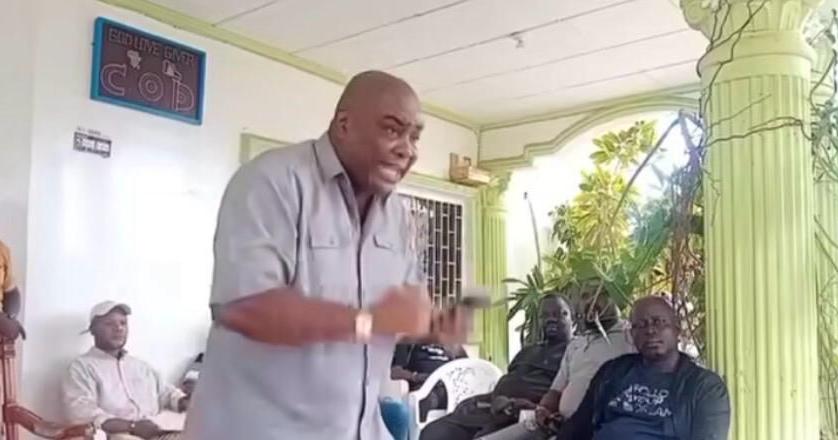
Sinoe County Senator and political leader of the People’s Economic Movement (PEM), Crayton Oldman Duncan, has launched a blistering attack on foreign concession companies operating in Liberia, accusing them of exploiting the country’s natural resources while Liberians continue to live in poverty.
Senator Duncan said Liberia’s persistent economic hardship is not solely the result of corruption among local officials, arguing that the country’s natural resources have for decades been negotiated and exploited under arrangements that give foreign companies a far greater share of the wealth than the Liberian people.
He called on Liberians, particularly young people, to educate themselves about concession agreements and demand a system that ensures the country receives a greater economic return from its minerals, petroleum and other resources.
“Don’t be under the illusion that somebody will come from America and change your life or help to build this country,” Duncan said, warning Liberians against depending on foreign governments and companies to transform the country’s economy.
Duncan argued that foreign concessionaires have been able to take advantage of Liberia because successive governments have failed to negotiate aggressively in the national interest.
He challenged Liberian leaders to stand up to foreign companies and demand better terms, rather than becoming concerned about possible sanctions or other consequences from powerful foreign interests.
“If somebody puts you in jail for Liberian interest, be happy to go to jail,” Duncan declared. “If they put you on sanction for the interest of the Liberian people, be proud to be on sanction.”
According to the senator, Liberia has vast deposits of iron ore and other minerals, yet the country remains heavily dependent on external assistance and struggles to provide basic services to its citizens.
Duncan claimed that about 1.1 billion tons of iron ore remain underground and questioned how much of the wealth generated from the resource actually benefits Liberia.
He also criticized what he described as concession arrangements in which foreign companies retain the overwhelming share of profits while Liberia receives a relatively small return.
“Who determines the profit? Him,” Duncan said, questioning the ability of concessionaires to determine their own operational costs and subsequently calculate profits.
Duncan singled out Bea Mountain Mining Corporation, claiming that the company generates approximately US$31 million every week from its operations.
He said that, if multiplied over 52 weeks, the figure would amount to approximately US$1.6 billion annually.
Duncan compared the figure with Liberia’s national budget, which he said is about US$1.2 billion, using the comparison to illustrate what he believes is the enormous value being generated from Liberia’s natural resources.
The senator also criticized the structure of royalties paid to the government, describing the country’s share as inadequate compared with the revenues generated by mining companies.
However, Duncan did not provide supporting documentation during his remarks for the US$31 million weekly revenue figure.
The PEM political leader extended his criticism to Liberia’s petroleum sector, raising concerns about the terms governing offshore oil exploration and potential discoveries.
Duncan questioned why Liberia would agree to royalty arrangements that, according to him, could result in the country receiving only a fraction of the value generated from oil discoveries.
He claimed that petroleum discovered within a certain depth could attract a 10 percent royalty for Liberia, while discoveries beyond that depth could attract only 5 percent.
Duncan also criticized the involvement of foreign investors in Liberia’s oil blocks, arguing that some investors could acquire Liberian petroleum assets at relatively low prices and later resell them for substantially higher amounts.
He said Liberians should be given greater opportunities to participate in the ownership and development of the country’s natural resources.
“There is nothing wrong with a Liberian man being a millionaire,” Duncan said, rejecting what he described as a system that prevents Liberians from accumulating capital and investing in their own country.
Duncan also raised environmental concerns over mining operations, particularly mineral-processing facilities.
He warned that the waste produced during mineral processing could threaten rivers and streams in mining communities if not properly managed.
Using the concentrator plant in Nimba County as an example, he argued that while mineral processing could improve the quality of exported iron ore, government must ensure that the environmental consequences do not become a burden on surrounding communities.
Duncan claimed that residents are already experiencing problems with water sources around mining areas.
He warned that the long-term environmental consequences of mining could become another cost borne by Liberians while foreign companies reap the financial benefits.
The senator also challenged the argument that corruption is the primary reason Liberians remain poor.
While acknowledging corruption as a major problem, Duncan said Liberia’s economic difficulties are also linked to the structure of its natural-resource agreements and the country’s dependence on foreign financial support.
He criticized the influence of international financial institutions and donor assistance on Liberia’s national priorities.
Duncan questioned why a country with billions of dollars in natural resources should remain dependent on relatively small amounts of external assistance.
He argued that foreign financial support can give donors disproportionate influence over government policy because assistance often comes with conditions attached.
Duncan urged Liberians to look beyond immediate political benefits and focus on long-term economic independence.
He said his own understanding of Liberia’s economic challenges developed gradually through his professional experience, including nine years at the Central Bank of Liberia and later service in the Legislature.
He said his work examining government revenues, expenditures and budgetary allocations helped him understand the structural problems affecting Liberia’s economy.
Duncan said his political movement is intended to mobilize Liberians around the need to protect the country’s resources and ensure that greater benefits remain within Liberia.
“I’m looking for people who love the country,” he said, urging citizens to sacrifice short-term gains in favor of long-term national interests.
He called on young Liberians to use available information to understand concession agreements and hold leaders accountable for the management of the country’s natural wealth.
Duncan maintained that Liberia cannot achieve meaningful economic transformation if foreign companies continue to extract the country’s resources while the majority of citizens remain poor.
He therefore challenged political leaders to renegotiate arrangements he considers unfavorable and build an economy in which Liberia’s natural resources serve as a foundation for national development rather than continued dependency.
See more Liberia News Network stories in Google Search by adding LNN as one of your Preferred Sources.
★ Add LNN as a Preferred Source