
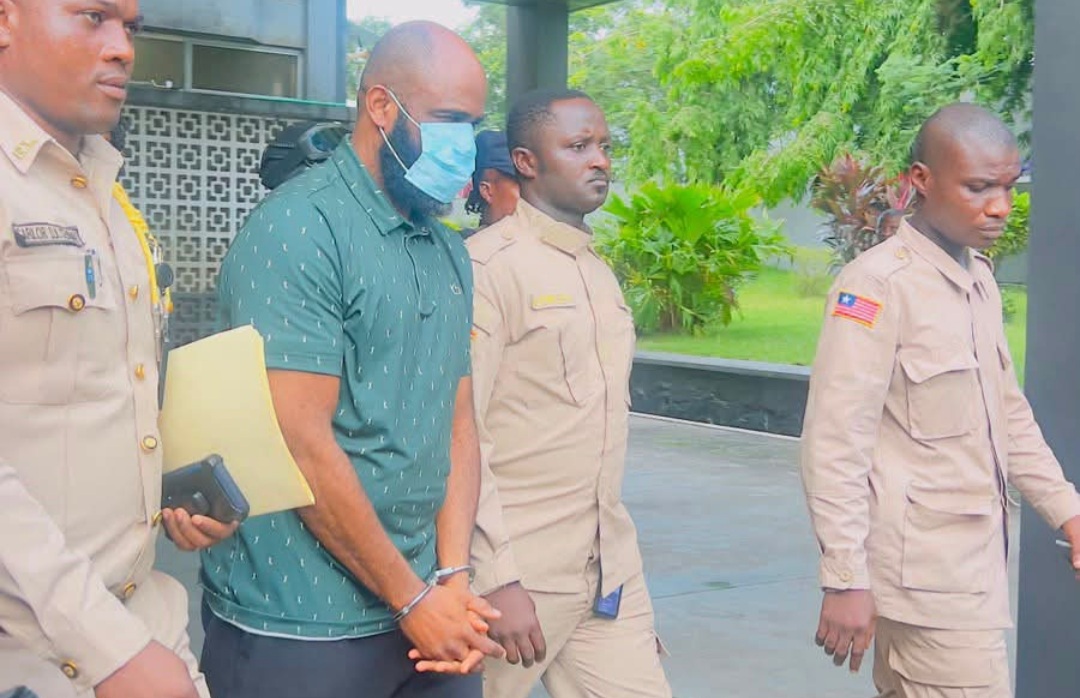
MONROVIA – Prosecutors on Thursday, July 9, 2026, presented their first witness in the ongoing preliminary hearing into the alleged attempted exportation of approximately 237.6 kilograms of cocaine valued at more than US$19 million, with a senior investigator alleging that lead defendant Paul J. King coordinated the shipment through Roberts International Airport (RIA).
The testimony was delivered before the Monrovia City Court by Col. Moses L. Meah, Chief Investigator of the Liberia Drug Enforcement Agency (LDEA), who outlined what prosecutors describe as a coordinated transnational drug trafficking operation involving King and several co-defendants.
According to Meah’s testimony, King, whom investigators identified as the Operations Manager of Global Logistics Services (GLS), coordinated the shipment of six cargo boxes destined for England through Express Handling Services (EHS). Meah told the court that the boxes were collected from King’s residence before being transported to Roberts International Airport for international export.
The LDEA investigator testified that airport security officers became suspicious after routine X-ray screening produced unusual scanner images, prompting the cargo to be isolated for a physical inspection. According to the witness, the inspection led to the discovery of substances that later tested positive for cocaine using United Nations Office on Drugs and Crime (UNODC) field-testing kits.
Meah further testified that the seized narcotics weighed approximately 237.6 kilograms and carried an estimated street value exceeding US$19 million, making it one of the largest cocaine seizures ever prosecuted in Liberia.
The prosecution also alleged through its witness that, following the seizure of the cargo, King attempted to negotiate the release of the shipment. Meah further testified that investigators concluded several of King’s co-defendants were members of what prosecutors describe as an organized drug trafficking syndicate allegedly involved in the attempted exportation of the cocaine.
To support its case, the prosecution introduced several pieces of documentary evidence, including King’s statement to investigators, witness statements, shipping documents, photographs of the seized cargo, laboratory-related exhibits, and the official police charge sheet.
Defense lawyers vigorously challenged portions of the prosecution’s evidence, raising several objections during the proceedings. While the court overruled many of those objections, it allowed defense counsel to note formal exceptions for the record, preserving those issues for any subsequent legal review.
Following the presentation of both oral testimony and documentary evidence through its first witness, the prosecution rested, with the preliminary hearing expected to continue as prosecutors seek to establish probable cause for the case to proceed to trial before a higher court.
King and his co-defendants are facing multiple felony charges, including illegal trafficking in controlled substances, criminal conspiracy, criminal facilitation, unlawful importation and exportation of controlled drugs, illegal transportation and possession of controlled substances, and criminal solicitation.
Under Liberia’s criminal justice system, all defendants are presumed innocent unless and until proven guilty by a court of competent jurisdiction.
The latest courtroom proceedings follow the opening of the preliminary hearing on Monday, July 6, 2026, when Paul J. King entered a not guilty plea to all charges after being forwarded to the Monrovia City Court by the Liberia National Police (LNP).
According to the police charge sheet dated July 6, 2026, investigators allege that on June 5, 2026, King coordinated the shipment of six cargo boxes through Roberts International Airport for export to Europe. Prosecutors contend that routine X-ray screening by airport security officers revealed suspicious images, prompting a more thorough inspection that allegedly uncovered approximately 237.6 kilograms of cocaine concealed within the shipment.
The case has drawn national and international attention because of the massive quantity of narcotics allegedly involved, the estimated US$19 million street value of the cocaine, and growing concerns that Liberia could be exploited as a transit point for transnational drug trafficking networks.
