The Putu Timeline
Sept. 2010: Government ratifies 25-year Mineral Development Agreement with Severstal
2011–12: Severstal buys out partner Afferro Mining, takes 100% control via subsidiary Lybica Holdings
2014: Class A mining license granted; Ukraine-related sanctions begin isolating Severstal
Dec. 18, 2025: AMR wins competitive IMCC bidding process (88.6 pts vs. Planet One’s 55.6)
Dec. 2025: Government and AMR execute binding Memorandum of Agreement
March 12, 2026: Severstal tells ministry AMR is “least advanced” bidder; pushes for Planet One
April 22, 2026: Acting Minister Blay-Archibald grants consent for Severstal-to-Planet One transfer
Late April 2026: Putu Contact Group and communities’ protest; scoring disparity goes public
April 30, 2026: President Boakai halts the Planet One transfer, upholds AMR memorandum
May 2026: AMR secures OFAC sanctions clearance and AFC financing backing
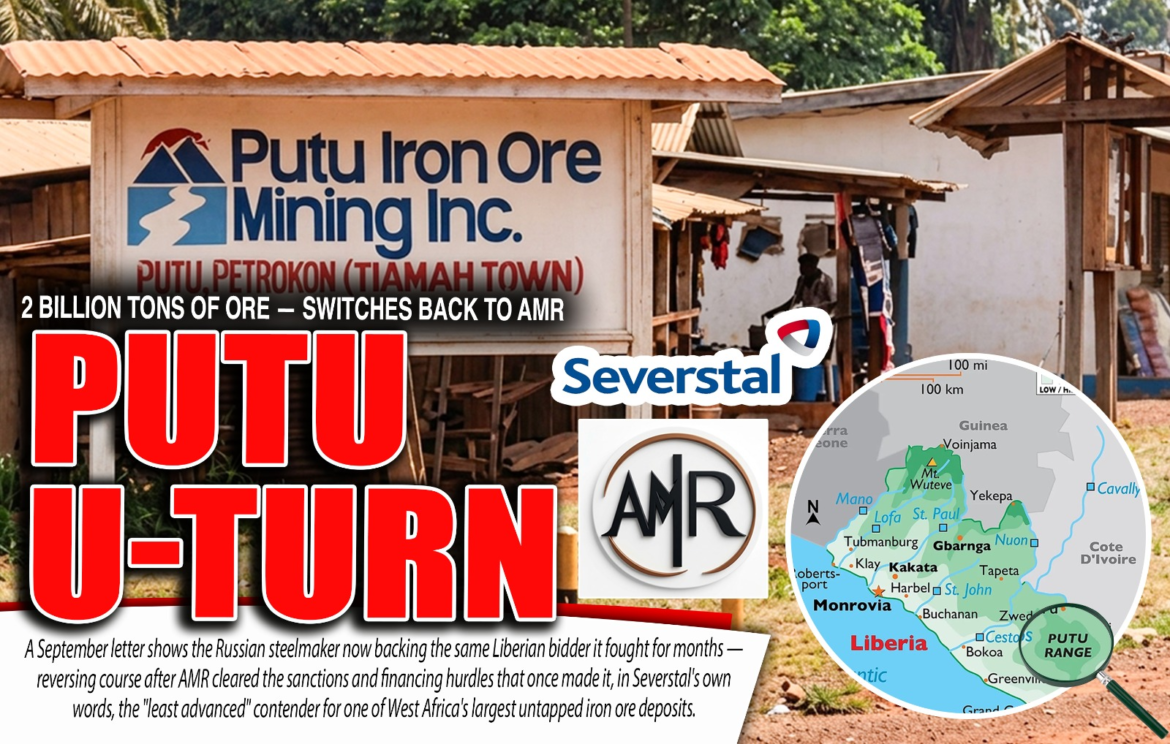
Sept. 11, 2026: Severstal notifies government that AMR’s binding offer beats Planet One’s
Monrovia – For a decade and a half, the mountain has mostly kept its secrets. Putu, tucked into the forested hills of Grand Gedeh County, holds an estimated 2.37 billion tonnes of iron ore — enough, by some reckonings, to rank among West Africa’s largest untapped deposits. And for just as long, it has sat there: surveyed, licensed, argued over, and never mined.
That may be changing. In a letter dated September 11 and addressed to Mines and Energy Minister R. Matenokay Tingban, Severstal — the Russian steel giant that has held the Putu concession since 2010 — told the government something it had spent much of this year arguing against: that Africa Metallic Resources Inc. has come through with a binding offer, and that it beats the rival bid from Planet One Natural Resources Holdings on price and terms alike.
It is a small paragraph with a long backstory.
A mountain with a complicated past
Putu’s modern history begins in 2010, when the Liberian government signed a 25-year mineral development agreement handing Severstal control of the deposit. The timing was almost immediately unlucky. Feasibility studies dragged on. Then came 2014, and Russia’s annexation of Crimea, and the first wave of Western sanctions that would follow Moscow for the next decade. By the time the war in Ukraine escalated those sanctions further, Severstal was, in practical terms, a foreign operator that couldn’t easily raise financing, sell into Western markets, or move equipment through the usual channels. Putu never got past drilling and paperwork. Twenty thousand potential jobs sat, on paper, in a country that badly needed them.
So Severstal went looking for an exit. And that’s where the story most Liberians have been following since spring actually starts.
A contract, a reversal, and a lot of noise
In December 2025, following a competitive review by Liberia’s Inter-Ministerial Concessions Committee, AMR — a Liberian-led consortium built around Cherif Abdallah’s Conex Group, with the Africa Finance Corporation as a financing partner — was named preferred developer. It scored 88.6 out of 100 in the government’s own evaluation, well ahead of a company called JSW and far ahead of Planet One, which came in last at 55.6.
Then, in the space of a few months, the deal seemed to unravel. Severstal began telling the Ministry of Mines that AMR was moving too slowly — that it hadn’t produced proof of funds, hadn’t cleared U.S. sanctions review, and was, in the company’s words, the “least advanced” of the potential buyers. By March and April, Severstal was actively lobbying for Planet One instead, and on April 22, an acting minister granted consent for exactly that transfer.
“What about us, the affected communities? Are we going to be silenced like before?” — Putu Contact Group chairman Joseph Geebro
It didn’t sit well. The Putu Contact Group, representing communities that live in the shadow of the deposit and have watched outside companies come and go for fifteen years without a shovel touching ground, called foul — loudly. Their argument was simple: the government’s own scoring had ranked Planet One last, and yet Planet One was suddenly winning.
President Joseph Boakai stepped in and hit pause. Citing a binding December memorandum with AMR, he ordered the Planet One transfer halted and directed that the existing agreement be given every chance to work before any alternative was considered.
What actually changed Severstal’s mind
Here’s the part of the story that tends to get lost in the back-and-forth: Severstal’s objections to AMR were never really about who AMR was. They were about two specific, fixable problems — sanctions clearance and proof of funds. Over the summer, AMR appears to have solved both. By May, the company had secured clearance from the U.S. Office of Foreign Assets Control, removing the sanctions uncertainty that had been Severstal’s loudest complaint. Financing commitments through the Africa Finance Corporation, a strategic partner of the U.S. International Development Finance Corporation, filled in the rest.
“The company Severstal spent the spring calling the ‘least advanced’ bidder is now the one it’s endorsing.”
That is presumably why Severstal is now writing letters that read almost like an endorsement — telling the ministry that AMR’s terms are better than Planet One’s, and that both bidders offer roughly the same timeline to production. Whatever the company’s earlier reservations, the practical obstacles behind them have largely disappeared.
The Liberian company behind the letters
AMR’s public face has been John B.S. Davies III, who has described Putu less as a mining deal than a test case for a different kind of resource development in Liberia — one where ownership, procurement, and processing stay closer to home rather than following the familiar path of raw ore shipped out and profit following it. Above Davies sits Cherif Abdallah, the Conex Group chairman whose business footprint in Liberia already runs through energy, logistics, and real estate — he’s the same figure who bought out Total’s Liberia and Sierra Leone operations a few years back. It’s Conex’s balance sheet and regional infrastructure, alongside AFC’s financing muscle, that gives AMR’s bid its weight.
What’s actually on the table for Liberia
If the deal closes on the terms in Severstal’s letter, the pitch is substantial: more than 20,000 jobs, government equity carried free of cost, a share offering open to ordinary Liberian investors, and commitments to build out roads, rail, power, and port infrastructure alongside the mine itself — rather than simply exporting raw ore and leaving the rest to someone else.
It’s worth saying plainly, though, that a binding offer is not a closed deal. The Share Sale and Purchase Agreement still has to be finalized, and the same questions about execution capacity that dogged AMR in the spring haven’t entirely vanished just because the sanctions issue has been resolved. Fifteen years of false starts at Putu have taught the southeast to be patient about promises made on paper.
A skeptic’s caution
Not everyone is convinced this reversal changes the fundamentals. Back when Severstal was still lobbying for Planet One, former Minister of Mines and Energy Wilmot Paye warned publicly against treating any change of ownership at Putu as progress in itself.
“I do not believe that a mere change of control is adequate to achieve any more desirable outcome than maintaining the status quo,” Paye said at the time, questioning what had specifically qualified Planet One over other bidders after Severstal had reportedly “concluded” transfer terms with them — the same abrupt reversal now playing out again, in the opposite direction, in AMR’s favor.
Paye’s broader argument was less about which company wins than about the structure underneath the fight. “Mining is not like harvesting a cassava farm,” he said, cautioning that Liberia won’t fully understand what it has agreed to until a real deal is signed — and warning that a successor could eventually seek to extend the existing Mineral Development Agreement through amendment, leaving the country “tied up” again. “The consequence?” he asked. “The vicious circle continues.”
Whether AMR’s newly cleared sanctions status and financing commitments answer that concern, or simply repeat the pattern Paye described with better paperwork, is likely to be argued over for as long as the deal itself takes to close.
The president’s bet
Seen from a few months’ distance, Boakai’s April intervention looks less like picking a side in a corporate dispute and more like buying AMR the runway it needed to clear the objections that were actually holding things up. Whether that reads as prudent mediation or as a government that nearly reversed a fair, competitive process before catching itself is likely to depend on who’s telling the story — and it’s a question this paper’s readers deserve to see asked plainly, not just answered on the government’s terms.
See more Liberia News Network stories in Google Search by adding LNN as one of your Preferred Sources.
★ Add LNN as a Preferred Source