Summary
- A coalition of African civil society leaders are pushing donors to give African organizations and communities more control over development money as traditional foreign aid shrinks. They are also looking to Africans to raise more funds themselves and restrain corrupt money flowing out of the continent.
- A growing number of African organizations are rejecting funding agreements that they say do not match their needs.
- Leaders say shifting control to African institutions will only work if those institutions are also accountable to the communities the money is meant to help.
By Tetee Gebro, gender and health correspondent with New Narratives
ACCRA, Ghana — When a donor offered money to an organization working in Kenya, it came with an opportunity to expand its work into more communities. For a small organization that needed funding, it might have seemed like an easy decision. It wasn’t.
The donor wanted the organization to expand quickly. The organization said the communities it was already working with needed deeper support before it moved elsewhere. So they made a tough decision.
“They respectfully denied the funding,” said Nafissatou Sene, senior manager of Portfolio Services at African Collaborative, an organization that raises money and funds for African groups working in health, education, gender justice, agriculture and livelihoods.
Sene declined to identify the Kenyan organization because she did not have permission to name it. She said its budget was small and it needed money, making the decision especially difficult, but in the end it decided it had no choice.
“We’re not going to take anything just because it comes our way,” Sene said of the organization’s position.
That kind of decision-making is what Nana Asantewa Afadzinu, executive director of the West Africa Civil Society Institute, said has too often been missing from development in Africa.
“For too long we’ve had development done to us,” Afadzinu said. “We’ve not been in the driving seats of deciding what the solutions should be to our own problems and resourcing them.”
The story has become an example of the kind of power a grouping of African civil society organizations gathered here for the first-ever meeting of African civil society leaders, say they want: the ability to decide what their communities need and insist that donors adjust their requirements to match the communities’ priorities rather than their own.
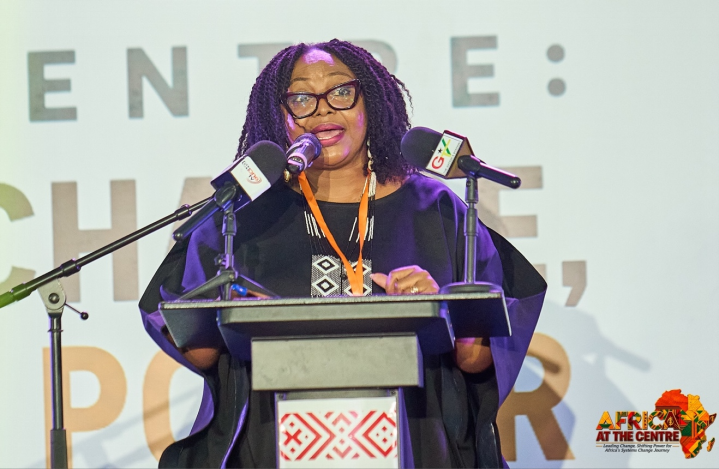
The three-day conference “Africa at the Centre: Leading Change, Shifting Power” brought together more than 200 civil society leaders, funders, policymakers and development experts from 30 countries, including Liberia. Organizers said decades of development assistance have left foreign donors with too much control over which African problems receive money, how projects are designed and how success is measured. They say this has led to failed projects, lack of accountability, talent diverted from entrepreneurship and job creation, dependency and corruption.
Now, as traditional foreign aid from rich countries shrinks, they are pushing for African organizations and communities to have greater control over development spending by demanding donors listen. But they are also looking to raise more funds from Africans and African governments, and to limit the amount of money that flows out of the continent in corruption and debt payments.
But some at the conference said their proposed solution raises another difficult question: if foreign donors give up power, who in Africa gets it? African governments and civil society organizations have their own problems with corruption, weak accountability and failure to listen to communities. Moving control of development money from foreign institutions to African ones will not necessarily put that power in the hands of the people the money is supposed to help.
Edwin Mende-Cole (far right), executive director of Youth Climate Change Liberia and participants at the Africa at the Centre convening in Accra discuss proposals for shifting greater control over development decisions to African organizations and communities. Credit: Africa at the Centre/WACSI
One Liberian at the conference, Edwin Mends-Cole, said he knows how difficult the first part of that equation can be. Mends-Cole, executive director of Youth Climate Change Initiative Liberia, said small civil society organizations often depend on donor projects to survive. Funding opportunities can be so scarce that organizations adapt what they do to what donors are willing to finance.
“It is hard to say realistically ‘I will not accept,’” Mends-Cole said.
Liberia’s dependence on foreign assistance extends far beyond civil society. World Bank data shows the country received about $563 million in net official development assistance and official aid in 2023, equivalent to two thirds of the national budget. A separate World Bank assessment found official development assistance averaged about 12 percent of Liberia’s gross domestic product between 2022 and 2024.
The limited income of the national government has meant major public services have been left to donors. Donor aid funds at least 50 percent of Liberia’s health sector, for example. But stories of corruption and mismanagement abound, and the government is no closer to standing on its own.
Mends-Cole agrees that donors need to better listen. He said he has seen what can happen when a local organization is able to challenge the way a donor wants to solve a problem.
In 2023, his organization worked on a project under the United Nations Development Programme’s Small Grants Programme to protect biodiversity and mangroves in the Mesurado wetlands. Mends-Cole said the proposed approach focused on educating communities about the need to stop destroying mangroves.
But some people were cutting the mangroves because they depended on them to make a living. Telling them about environmental protection without giving them another way to earn money would not stop the cutting, Mends-Cole said.
“We are on the ground,” he recalled telling the funder. “This approach will not work.” After discussions, he said, the project was changed to include alternative livelihoods.
Mends-Cole said local organizations demanding more power from donors must therefore be prepared to give communities more power too. Before designing a project, he said, organizations should first ask people what problem they need solved. They must be transparent and report to communities on how the funds are spent and results obtained, as well as donors.
West African Civil Society Institute’s Afadzinu said changing the system does not mean simply replacing foreign money. It also means changing who decides how that money is used. She said she wanted to see donors provide more flexible and core funding that allows African organizations to strengthen themselves instead of moving from one donor-designed project to another.
“Don’t help us to continuously depend on you,” Afadzinu said. “Help us to become stronger.”
African countries and organizations must also raise more of their own money, she said, including through local philanthropy, diaspora support, businesses and social enterprises.
Sene said African organizations may already have more power in their relationship with donors than they realize. One organization refusing money may have little influence, she said. Many organizations taking the same position could force donors to listen.
“We cannot give grants or funds to people who refuse to take it from us,” Sene said. “If everybody said no, what are we going to do with the money?”
She acknowledged that completely ending African civil society’s dependence on foreign funding is not realistic in the near future. The immediate goal, she said, should be changing the relationship.
Tendisai Chigwedere of the Flora Hewlett Foundation, a donor at the convening in Accra
At least one international funder at the Accra gathering is already onboard.
Tendisai Chigwedere of the U.S.-based William and Flora Hewlett Foundation, which was a financial backer of the convening, said philanthropy has historically held enormous influence because it controlled the money. She said Hewlett is listening to local organizations, giving them more control with long-term partnerships and flexible funding. The Hewlett Foundation said it awarded $631 million in grants in 2024, with nearly three-quarters provided as flexible funding.
“We don’t want you to be boxed into a project,” Chigwedere said. “Allowing you to have general operating support helps you build the institution, build the vision, and work on the agenda… to do the things you need to do.”
Changing how existing donors give money is only one proposal being discussed.
Wanjiru Kanyiha, network coordinator of the Global Public Investment Network, is pushing a model in which African countries would contribute to a common pool according to their ability and participate in deciding how the money is spent. The idea is summed up in three phrases: all contribute, all benefit, all decide.
Under such a system, Kanyiha said, a poorer country such as Liberia would not be expected to contribute as much as a wealthy country but would still have a voice in decisions and could receive more than it contributed based on need.
The model remains a proposal. It has not yet proved that it can replace or significantly reshape the current aid system. Supporters hope to have governments working around one or two pilots by the end of 2028.
After three days in Accra, the West African Civil Society Institute said it will temporarily steward the work after the meeting, coordinate follow-up and help participants continue developing ideas that emerged from the gathering.
In a post-convening reflection, Charles Vandyck, the Institute’s head of capacity development, acknowledged that transferring power from international organizations to African institutions alone would not transform development.
“Redistributing power is not about reversing hierarchies,” Vandyck wrote. “It is about building systems where power is shared, accountability is mutual, and agency is respected.”
This story was a collaboration with New Narratives.
See more Liberia News Network stories in Google Search by adding LNN as one of your Preferred Sources.
★ Add LNN as a Preferred Source