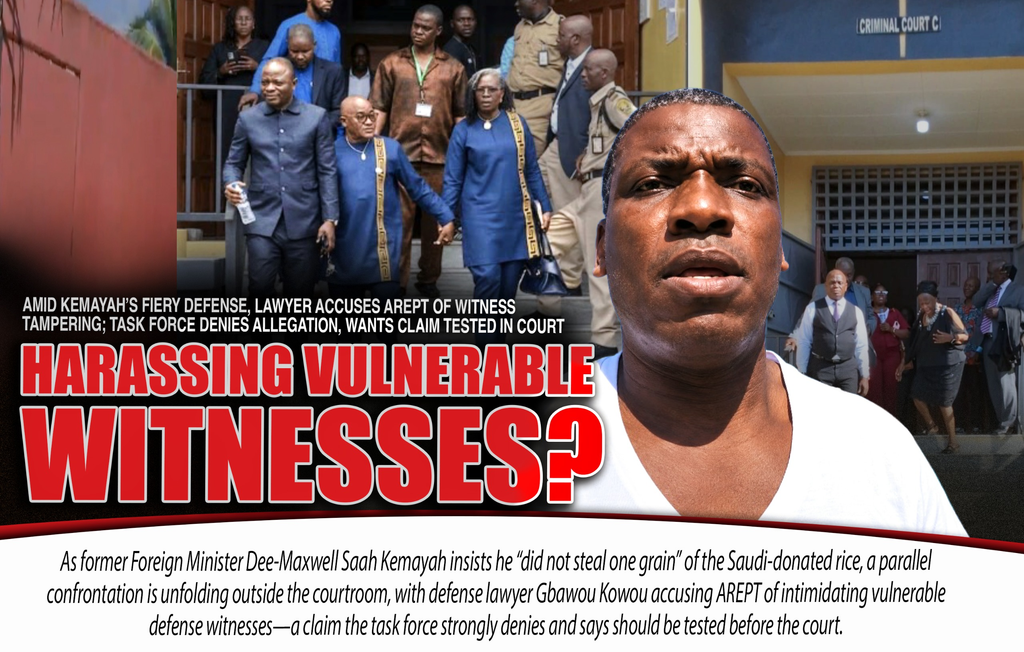
Monrovia – A troubling confrontation outside the courtroom has opened a new front in the criminal trial, with defense lawyer Gbawou Kowou accusing the Asset Recovery and Property Retrieval Taskforce AREPT of intimidating or improperly engaging defense witnesses after they testified.
The drama unfolded as former Foreign Minister Dee-Maxwell Saah Kemayah insisted on the witness stand that he “did not steal one grain” of the Saudi-donated rice.
AREPT has categorically denied the allegation, saying the witnesses were not summoned for questioning, were not interviewed, and were immediately asked to leave its premises after agency lawyers discovered that they had recently appeared in court as subpoenaed defense witnesses.
The dispute, coming as prosecutors prepare to present rebuttal witnesses in the Saudi rice case, has raised a question over the treatment of witnesses in an ongoing criminal proceeding, and whether witnesses who have already testified for the defense can be approached or brought to a prosecutorial agency without their lawyers being informed, and concern over where legitimate investigation ends and improper interference begins.
The answer, both sides now said, should come from the court.
AREPT, in a statement signed by its Public Relations Officer, Joseph F. Daniels, said the incident resulted from a misunderstanding rather than an attempt to interfere with testimony.
According to the task force, a potential witness who had previously provided a statement during the investigation was asked to appear at its office along with other persons familiar with the Saudi rice matter.
The agency said the potential witness arrived with two individuals whom he identified as persons knowledgeable about the matter.
AREPT said its lawyers did not initially know that the two individuals had recently appeared before Criminal Court “C” as defense witnesses.
“Upon recognizing them, AREPT lawyers immediately asked the two individuals to leave the premises,” the statement said.
The agency stressed that the witnesses “were not invited by AREPT, were not interviewed, and no statement was taken from them.”
AREPT therefore rejected the accusation that its lawyers threatened, intimidated or attempted to influence the witnesses.
The agency challenged the defense to take the allegation before the trial judge.
“If defense counsel has evidence of witness tampering or intimidation, that evidence should be presented to the court, where such allegations can be properly addressed,” AREPT said.
But Kowou is not backing away.
The defense lawyer has characterized the circumstances surrounding the witnesses’ presence at the AREPT compound as serious, particularly because the individuals had already testified on behalf of the accused.
Kowou said the witnesses included members of the Group of 77 and members of the community of persons living with disabilities who had appeared before Criminal Court “C” as defense witnesses.
According to the lawyer, the witnesses told him they had been pressured or threatened to report to AREPT following their appearance in court.
Kowou subsequently went to the taskforce’s headquarters in Paynesville, where he livestreamed the confrontation and demanded access to the compound.
“I’m live at AREPT. Witnesses who testified on our behalf yesterday were brought here and threatened,” Kowou said during the broadcast.
At another point, he accused officials of locking the facility’s gate.
“They have locked the gate. The witnesses are in there,” he said. “If the witnesses are not there, open the gate.”
The confrontation eventually drew the attention of Liberia National Police officers, with Kowou continuing to insist that the matter involved possible interference with witnesses in an ongoing criminal proceeding.
He was later allowed into the compound and subsequently taken to a police station following the confrontation.
Kowou later said AREPT officials characterized the incident as a misunderstanding.
But the defense lawyer maintained that the circumstances remained troubling.
Harassing Vulnerable Witnesses?
The controversy is particularly sensitive because of the identity of some of the witnesses at the center of the dispute.
Kowou said the witnesses were drawn from vulnerable and organized community groups and had appeared in court to give evidence for the accused.
For the defense, the central issue is not simply whether AREPT lawyers spoke to the witnesses.
It is whether any contact occurred in circumstances capable of influencing, intimidating or otherwise affecting witnesses who had already placed their testimony on the official record.
That distinction could become important as the matter moves before the trial court.
Under Liberia’s Penal Law, witness tampering is a serious offense where prohibited conduct is used with the purpose of influencing testimony or preventing or altering a person’s participation in an official proceeding.
Kowou did not speak further on the next course of action, but a defense lawyer who prefers anonymity told FrontPageAfrica that the defense team has already taken action against the alleged situation, in line with the laws of Liberia.
However, an accusation of witness tampering is not itself proof that tampering occurred.
AREPT’s position is that its lawyers did precisely the opposite of what Kowou alleged; once they realized that the individuals were defense witnesses, they asked them to leave.
The agency said no interview took place, no statement was taken, and no effort was made to influence their testimony.
The competing accounts now create a factual question that may have to be resolved through evidence.
A Trial Already Defined By Contested Evidence
The witness controversy comes against the backdrop of an increasingly combative Saudi rice trial, where the prosecution and defense have presented sharply different accounts of how a Saudi government-to-government donation was received, stored, transferred and ultimately distributed.
The case involves 13 former government officials accused of corruption-related offenses arising from the handling of the Saudi-donated rice.
The defense has consistently challenged the prosecution’s interpretation of the documentary record, the quantity of rice received, the role of the National Disaster Management Agency, the involvement of the General Services Agency and the authority exercised by officials from the Ministry of Foreign Affairs.
That battle intensified when Kemayah himself took the witness stand.
Kemayah: ‘I Did Not Steal One Grain’
Kemayah delivered a forceful and emotional defense of his role in securing and managing the humanitarian rice project.
His central message was blunt: “I did not steal one grain of rice.”
The former minister acknowledged that he personally negotiated with Saudi authorities to secure the donation.
But he rejected the prosecution’s characterization of his involvement as an abuse of authority.
Kemayah told the court, in substance, that his intervention was motivated by the need to secure food assistance for vulnerable Liberians.
He said the government could have routed the rice through institutions such as the Liberian National Red Cross Society or the World Food Programme but instead selected NDMA to handle the humanitarian component.
For Kemayah, that decision undermines any suggestion that he secretly seized control of the project.
“I negotiated this rice,” he emphasized, arguing that no one ordered him to seek the donation and that he took the initiative because Liberians needed assistance.
The Saudi Video
Kemayah also relied heavily on a video documentary showing what he described as the formal signing ceremony between the Government of Liberia and the Kingdom of Saudi Arabia.
He presented the footage as evidence that the rice donation was the product of an official government-to-government arrangement.
According to his testimony, the documentary showed Liberian officials and Saudi representatives participating in the process surrounding the donation.
Kemayah said Saudi representatives were assured that the rice would reach vulnerable Liberians rather than government officials.
For the former minister, that assurance is important because it contradicts any theory that the project was created as a mechanism for personal enrichment.
“Where Is the Note of Exchange?”
Kemayah also seized on testimony from Acting Foreign Affairs Minister Etta Davies, who reportedly told the court that officials searching the Ministry of Foreign Affairs failed to locate the Note of Exchange connected to the Saudi donation.
The former minister questioned how the absence of a copy from Liberia’s current ministry records could invalidate the existence of the diplomatic transaction.
He argued that because Saudi Arabia remains a diplomatic partner of Liberia, missing government-to-government documentation could be sought through diplomatic channels.
The issue has now become another point of contention over the reliability and completeness of government records.
The 29,412-Bags Question
Perhaps one of the most key factual battles in Kemayah’s testimony centered on the quantity of rice.
Kemayah maintained that 29,412 bags of 25-kilogram rice were received from Saudi Arabia.
The defense has repeatedly challenged figures presented by the prosecution, arguing that the physical quantity of rice, its monetary value, and the logistics surrounding its transportation and storage must be reconciled with the documentary evidence.
Kemayah questioned figures he considered inconsistent with the actual shipment.
For the defense, the dispute over quantity is not merely mathematical.
It goes directly to the prosecution’s theory of what was allegedly diverted or unlawfully handled.
‘To Rescue the Rice’
Kemayah also rejected the allegation that he improperly interfered with NDMA’s statutory responsibilities.
He relied on testimony from former GSA Director-General Mary T. Broh and former NDMA Board Chairman Varney A. Sirleaf concerning the movement of rice from NDMA facilities to GSA warehouses.
Kemayah characterized the decision as an effort to protect the rice from deteriorating because of storage concerns.
He described his intervention as an attempt to “rescue the rice.”
He argued that the movement involved several government officials and institutions and was therefore not a unilateral decision taken secretly by him.
Kemayah further pointed to NDMA officials’ participation in meetings concerning the rice as evidence that the agency’s statutory responsibilities had not been taken over.
‘I Never Distributed A Grain’
The former minister was equally categorical in denying personal involvement in the distribution of the rice.
He told the court that he never recommended, authorized or personally distributed a single grain of the donated rice.
He challenged the prosecution to produce documentary evidence proving otherwise.
“If there is anything, I am prepared beyond this case to redeem my name,” he maintained.
‘Conspire With Who? Rice?’
Kemayah also attacked the conspiracy allegation.
With visible emotion, he questioned why he would conspire with others over humanitarian rice that he had personally worked to secure.
“Conspire with who? Rice? For what?” he asked rhetorically.
He maintained that the project involved multiple government institutions and officials and that the evidence should be viewed in the context of a government humanitarian operation rather than an individual scheme.
His Mother’s Death
The testimony also took a deeply personal turn when Kemayah recounted the circumstances surrounding his arrest and the subsequent death of his mother.
He said armed security personnel arrived at his residence to execute a search and arrest while his mother was staying with him.
According to Kemayah, his mother suffered from a pressure-related illness and was deeply distressed by the events surrounding his arrest.
She was later taken to a Catholic hospital but, he said, never fully recovered.
Kemayah carefully stopped short of directly accusing security personnel of causing her death.
Instead, he maintained that the emotional trauma surrounding his arrest contributed to the deterioration of her condition.
‘This Is Not My Area’
Kemayah ultimately returned to the central theme of his defense, that stealing was not his motive and that his involvement in the Saudi rice project was part of his responsibility as Foreign Minister to mobilize international support for Liberia.
He cited his administration’s efforts to pursue reforms at the Ministry of Foreign Affairs, engage international partners, and improve services for ordinary Liberians.
He maintained that the Saudi rice project belonged within that record of public service.
“Stealing is not my area,” he declared.
But the prosecution continues to maintain that the defendants unlawfully handled and diverted a substantial portion of the Saudi donation.
The New Battle, Witnesses
Now, as the prosecution prepares to present rebuttal evidence, another battle has emerged, this time over the treatment of witnesses.
The defense said witnesses who had already testified were taken to or summoned to AREPT’s headquarters and subjected to pressure.
AREPT said that account is false.
The taskforce insists that the witnesses were not invited, questioned or interviewed and that its lawyers asked them to leave as soon as they recognized them as defense witnesses.
That leaves the court with a potentially consequential question of what actually happened inside and around the AREPT compound, and was any attempt made to influence witnesses who had already testified.
The answer could determine whether the episode remains a heated dispute outside the courtroom, or becomes a formal evidentiary and legal issue inside it.
For now, both sides are pointing toward the same place for resolution, the court.
And with Kemayah fighting to dismantle the prosecution’s case from the witness stand while his lawyer raised allegations of possible witness interference outside the courtroom, the Saudi rice trial has entered an increasingly volatile phase, one in which the credibility of witnesses, the integrity of government records and the conduct of the parties themselves may prove just as consequential as the rice at the center of the case.
The final determination remains with Criminal Court “C” and the jury after consideration of the evidence presented by both the prosecution and defense.
See more Liberia News Network stories in Google Search by adding LNN as one of your Preferred Sources.
★ Add LNN as a Preferred Source