
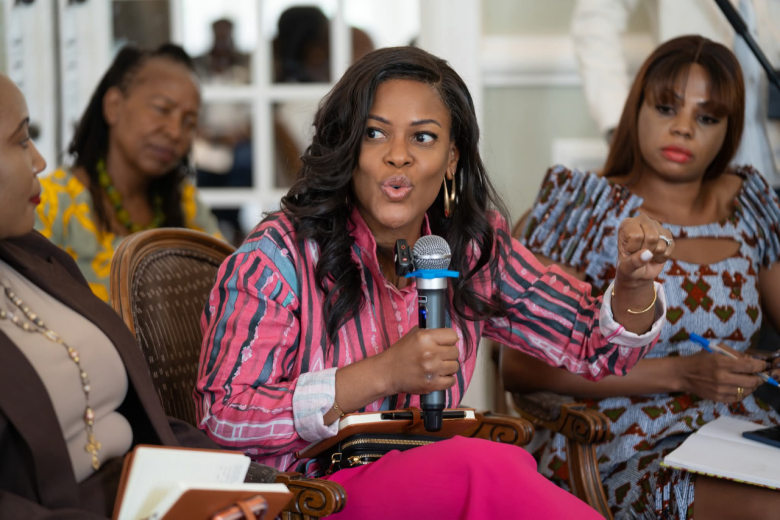
Cllr. Charlyne Brumskine speaking at an AMUJAR event in May at the Ellen Johnson Sirleaf Presidential Center in Monrovia.
Summary
- Charlyne Brumskine is one of five judges selected for the prestigious role serving on the Economic Community of West African States (ECOWAS) Community Court of Justice, which hears cases against regional governments, from 2026 to 2030.
- The lawyer, who brings more than 23 years of legal experience to the court, is the first Liberian woman to serve in that role.
- Brumskine says she wants more West Africans to understand and have access to the Court, including through proceedings outside its headquarters in Abuja, Nigeria.
By Joyclyn Wea, gender correspondent with New Narratives
When Charlyne Brumskine learned she had been selected to the coveted post as a judge on the Ecowas Community Court of Justice, her thoughts turned to her late father.
Charles Walker Brumskine, the prominent lawyer and four-time presidential candidate who died in 2019, had hoped to serve as vice president of the Economic Community of West African States Commission himself, his daughter said.
“My father did not get it. You can imagine how proud I feel to have been able to achieve that,” Brumskine said.
Brumskine is one of five judges selected to serve on the regional court from 2026 to 2030, alongside judges from Nigeria, The Gambia, Togo and Benin. The Court’s bench rotates among Economic Community of West African States member states every four years.
Brumskine is not the first Liberian to serve on the Court. Liberian judges Micah Wilkins Wright and Yussif D. Kaba previously served on the bench. But she is the first Liberian woman.
“Is a privilege that I do not take lightly,” Brumskine said. “I am continuing the legacy of Liberian women who came before me, those who plaited the mat on which I sit. But I am also a forebearer of those who will come after me. I am simply keeping the seat warm for them and providing a blueprint of how Liberian women must represent our country with dignity, excellence, and purpose.”
Based in Abuja, Nigeria, the Community Court of Justice is the judicial arm of the Economic Community of West African States. It interprets regional laws and treaties, settles disputes involving member states and Economic Community of West African States institutions, and hears human rights cases.
Its human rights jurisdiction gives the Court particular importance to ordinary citizens. Individuals can bring qualifying human rights complaints directly before it without first exhausting all remedies in their national courts.
One recent example saw a group of survivors of the 1990 St. Peter’s Lutheran Church massacre, in which up to 600 people were killed by Armed Forces of Liberia soldiers, sue the Liberian government, accusing successive administrations of failing to investigate and prosecute those responsible. But in October 2024, the court threw out the case, ruling it lacked jurisdiction because the violations fell before the court’s human rights mandate existed.
Brumskine said about 90 percent of the Court’s cases concern human rights, covering issues ranging from human trafficking and unlawful detention to freedom of expression and due process.
Liberians have used the Court in other cases. Kabineh Ja’neh, the former Supreme Court associate justice, challenged his impeachment there in 2020. The Court ruled in his favor, finding the government had violated his right to a fair hearing and ordering the government to pay him compensation and restore certain rights. Liberia later sought a review, but the Court rejected the application and ordered compliance with its original judgment.
In another recent case, the Court in July 2025 dismissed an application involving Abrahim Sheriff, raised in Guinea but claimed to be of Liberian origin, who brought a case against Liberia and Guinea at the Court, alleging both governments unlawfully arrested and detained him on unfounded claims of armed insurrection and mercenary activity, subjecting him to torture and enforced disappearance and confiscating $180,000.
Those cases, Brumskine said, demonstrate the breadth of issues that can reach the regional bench. But she said she hopes that Liberians will not have to go there.
“I hope that our government, our judicial system, affords our citizens the opportunity to fundamental rights so that no one appears before me or before any of the justices from Liberia,” she said.
Despite several landmark human rights rulings, the Court faces mounting criticism over poor compliance by member states, with enforcement of its binding judgments remaining one of its toughest challenges since it began operations in 2001. That weakness was on display in the Lutheran Church massacre case, where the court’s narrow reading of its jurisdiction let the Liberian government avoid accountability.
The Court’s independence is also being tested by politically sensitive cases, including a suit by Ghana’s suspended and later dismissed Chief Justice, Gertrude Torkornoo, who is seeking $10 million in damages over her removal. Most recently, the court has been drawn into regional migration politics, hearing a case accusing Ghana of unlawfully detaining and deporting refugees transferred from the US under a secret deportation agreement — the first case filed under the 1979 ECOWAS Free Movement Protocol.
Brumskine comes to the Court with more than 23 years of legal experience. She has also been active in politics and was Alexander Cummings’ running mate in the 2023 presidential election.
During the Ellen Johnson Sirleaf administration, Brumskine worked with the Ministry of Justice on Liberia’s anti-human trafficking framework and with the Ministry of Commerce as Liberia negotiated accession to the World Trade Organization. During the George Weah administration, her law firm served as external counsel to the Central Bank of Liberia.
She is founder of CMB Law Group and has taught at the Louis Arthur Grimes School of Law and the Liberian School of Law. She is licensed to practice law in Liberia, New York and Washington, D.C., and has worked across private practice, public policy and international negotiations.
That background differs from Economic Community of West African States judges who often reach the regional bench after careers in national judiciaries. But previous service as a judge was not required. Candidates could qualify with at least 20 years of relevant professional experience as a judge, lawyer or legal academic.
The selection process was competitive.
The Liberian government submitted three nominees after being allocated a seat on the rotating bench. The three were interviewed in Sierra Leone in April by the ECOWAS Community Judicial Council, made up of chief justices from across the region. Jutonu Kollie, Ministry of Justice communications officer, did not respond to questions about the identities of the other two finalists by deadline.
Brumskine recalled sitting before nine regional chief justices who were sitting as the Economic Community of West African States Community Judicial Council, the body responsible for screening and recommending candidates for the court judgeship as part of her interview panel, wearing headphones as interpreters translated among English, French, and Portuguese speakers. The questions ranged from Economic Community of West African States treaties and human rights protocols to regional affairs and legal philosophy.
The Judicial Council ranked the three candidates and sent its recommendations to the Economic Community of West African States Council of Ministers before the Authority of Heads of State and Government gave final approval.
Former president Sirleaf, Charlyne Brumskine, along with other influential Liberian women, at a dollar campaign in April 2025 to raise funds to support Edith Gongloe Weh’s Senatorial race.
Brumskine said one of her priorities will be helping ordinary West Africans better understand a Court many do not know exists. She wants the Court to become more visible outside Abuja, including by holding activities and proceedings in member states.
“Let the Court come to Monrovia,” she said. “Let people come and see and hear and feel what the Community Court of Justice is. Let’s take it to Accra. Let’s take it to all the different countries in the region.”
She said she believes that access matters particularly for women and other citizens seeking remedies for human rights violations, including human trafficking, which has been growing in Liberia and where the government has done little to protect victims. She stressed that the court is for all West African citizens, not just the elite, to hold governments to account.
“A woman in Buchanan can take her case to the Economic Community of West African States Court of Justice if she meets certain criteria,” Brumskine said.
Her appointment means yet another Liberian woman has attained a prestigious post outside the country while women in the country continued to struggle for representation in leadership. Women hold just 10 of 103 seats in the Legislature. Brumskine said progress has been slow, but she sees her own responsibility as extending beyond occupying a regional seat.
Bowoulo Taylor Kelley, vice president of the Association of Female Lawyers of Liberia, said Brumskine’s appointment demonstrates what Liberian women can achieve when given the opportunity. “These barriers do not reflect a lack of talent,” Kelley said. “Rather, they reflect systems that must be deliberately opened and made fairer.”
At her Monrovia law firm, she said she is mentoring three young women lawyers to take on greater responsibilities eventually. “It’s my role to train. It’s my role to mentor so that when Charlyne Brumskine goes out, they are stepping up to take my place locally,” she said.
For Brumskine, however, the immediate task is the Court and the four years ahead.
“To be a judge, it is the pinnacle, it is the height, it’s the peak of our professional career,” she said. “And not just a judge in Liberia. To be a regional judge.”
Brumskine’s term begins in Mid-October 2026.
This story was produced in collaboration with New Narratives as part of the Investigating Liberia project. Funding was provided by a private donor and the Swedish International Development Cooperation Agency. The donors had no say in the story’s content.
See more Liberia News Network stories in Google Search by adding LNN as one of your Preferred Sources.
★ Add LNN as a Preferred Source