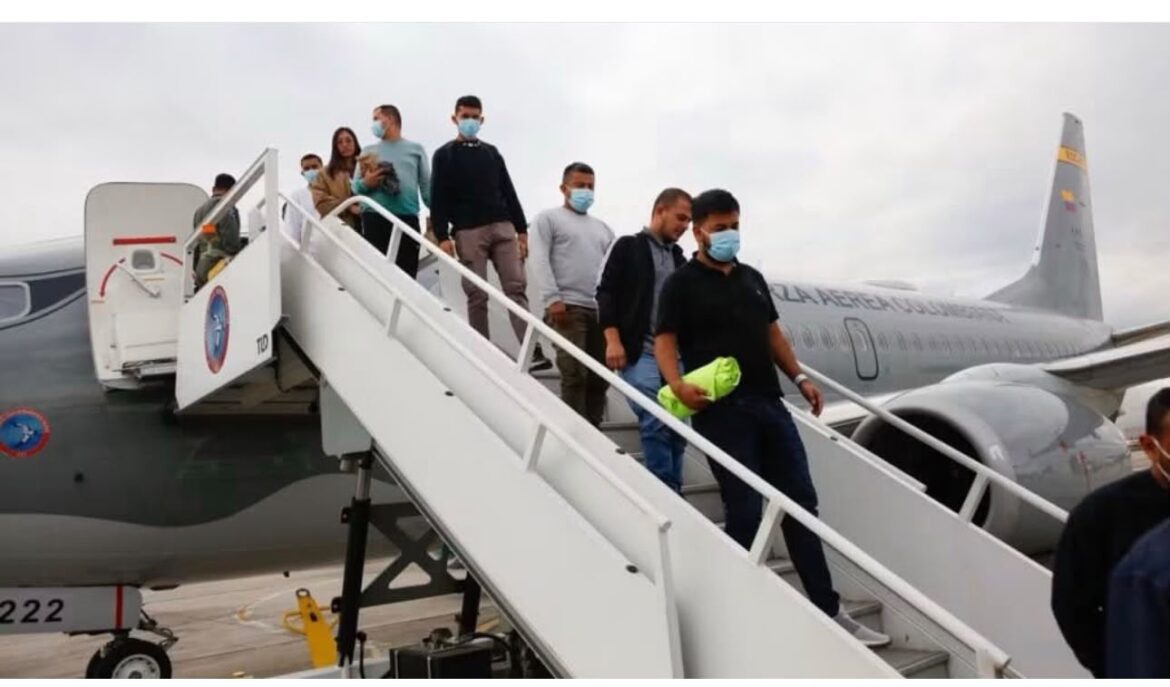
Monrovia — Liberia’s controversial deportation arrangement with the United States took effect Thursday with the arrival of the first 20 third-country deportees at Roberts International Airport, but the transfer was overshadowed by a dramatic standoff after five of the deportees reportedly refused to leave the aircraft and were restrained by U.S. federal agents.
By Emmanuel Weedee-Conway
The five men were among the 20 deportees flown to Liberia under an agreement between the Liberian government and the administration of U.S. President Donald Trump that could see as many as 1,200 third-country nationals sent to Liberia over the next 12 months.
According to The New York Times, the five men resisted efforts by American federal agents to remove them from the aircraft after it landed at Roberts International Airport.
The agents reportedly restrained the men for several minutes and eventually forced them off the plane. However, the five were subsequently returned to the aircraft.
The men were reportedly later flown onward to Equatorial Guinea, although the circumstances surrounding their reported transfer remain unclear.
The Liberian government has not publicly explained what happened to the five men, whether they were formally admitted into Liberia, or why they were reportedly flown to another African country.
Neither Liberian nor U.S. authorities had, as of publication, provided a detailed public account of the incident.
The episode has intensified questions about the implementation of the deportation agreement, including the legal status of the deportees, their consent or otherwise to being transferred to Liberia, and what happens when individuals refuse to disembark.
Five Refuse to Deplane
The confrontation reportedly began after the aircraft carrying the 20 deportees landed at RIA.
According to The New York Times, five men refused to leave the plane when U.S. federal agents attempted to remove them.
The agents reportedly restrained the men for several minutes before forcing them off the aircraft. The five were later returned to the plane, according to the report.
Their reported onward flight to Equatorial Guinea has raised additional questions about whether Liberia was ultimately their intended destination and whether other countries are involved in the implementation of the U.S. third-country deportation arrangement.
The Liberian government has yet to provide an official explanation.
Deportees Secretly Moved from RIA
The drama surrounding the five deportees unfolded against a backdrop of secrecy surrounding the arrival of the 20-person group.
Airport and state security personnel restricted journalists from accessing the arrival area and prevented local and international media organizations, including AFP and DW, from observing the deportees’ processing.
According to a FrontPage Africa reporter at the scene, security officers ordered doors closed and were deployed at entry points, restricting movement in and out of the area.
Journalists later discovered that the deportees had already been moved from the airport without media access to their departure.
The group was reportedly transported from the airport in a bus operated by the Liberia Refugee Repatriation and Resettlement Commission through a back exit, rather than through the main arrival hall.
No interviews were permitted, and journalists were unable to obtain photographs or video footage of the deportees.
The manner in which the group was moved out of RIA has fueled criticism over the government’s handling of the arrangement and its commitment to transparency.
LRRRC Tight-Lipped
Officials of the LRRRC, the government agency responsible for receiving the deportees, declined to provide details about the group at the airport.
Staff referred questions to the commission’s headquarters in Montserrado County but did not provide information about the identities, nationalities or immediate plans for the 20 deportees.
The government had previously stated that the deportees would include nationals of African and Western Hemisphere countries, with most expected to come from Latin American countries, including Venezuela, Cuba and Colombia.
Information Minister Jerolinmek Piah has said the deportees would be received “as guests” and would have the option to apply for asylum in Liberia.
Secretive Arrival Sparks Youth Anger
The secrecy surrounding the arrival has also triggered frustration among some Liberian youths, who argue that the government should prioritize addressing domestic unemployment and poverty before accepting deportees from other countries.
Youth advocate Levi Levala told FrontPage Africa that Liberia is already struggling with unemployment and inadequate social services.
“We, the youth in this country, have nothing right now. No job. No support. And now these people are being brought here? They say America will sponsor them, but Liberia is already suffering. This is not the partnership we need,” Levala said.
“My message to America is: take them back. Liberia is not a dump site,” he added.
Levala and other residents of Unification Town argued that Liberia’s economic challenges make the country ill-equipped to accommodate large numbers of third-country deportees.
How the Deal Came About
The Liberian government announced earlier this week that it had agreed to accept up to 1,200 people deported from the United States who cannot be returned to their countries of origin.
The government has described the arrangement as “entirely humanitarian” and not a “quid pro quo,” while acknowledging that Liberia will receive U.S. support to manage the program.
The Ministry of Justice has not disclosed when the next group of deportees will arrive, although the government expects the full group of up to 1,200 to be accommodated over a 12-month period.
Rights Groups Demand Answers
The agreement has generated growing concern among human-rights advocates in Liberia and elsewhere in Africa, particularly over the prospect of countries accepting deportees who have no meaningful connection to them.
Liberian human-rights lawyer and activist Adama Dempster said the government must answer fundamental questions about the arrangement.
“The issue of deportations is raising many concerns that can’t be left unanswered,” Dempster said.
“What conditions will they be held in?” he asked, while questioning other aspects of the agreement.
The identities and backgrounds of the 20 deportees have not been publicly disclosed, making it unclear whether any have criminal records in the United States.
The lack of information has intensified calls for the Liberian government to publish the agreement and explain the legal framework governing the deportees’ arrival, stay and possible departure from Liberia.
A New Test for Liberia
Thursday’s events have placed the Boakai administration under renewed scrutiny over an agreement officials have defended as being in Liberia’s national interest.
But the refusal of five deportees to leave the aircraft — followed by their reported onward flight to Equatorial Guinea — has raised fresh questions about the humanitarian, legal and diplomatic dimensions of the arrangement.
It also remains unclear whether Liberia is simply the destination for the deportees or whether the agreement forms part of a broader U.S. arrangement involving multiple African countries.
As Liberia prepares for potentially hundreds more arrivals, pressure is mounting on the government to disclose the terms of the agreement, explain the treatment of the first 20 deportees and provide a full account of what happened to the five men who refused to disembark at Roberts International Airport.
See more Liberia News Network stories in Google Search by adding LNN as one of your Preferred Sources.
★ Add LNN as a Preferred Source