Published: September 30, 2026
Tiawan Gongloe says President Joseph Boakai’s “good lawyer knows the judge” remark sends the wrong message to law students and young lawyers.
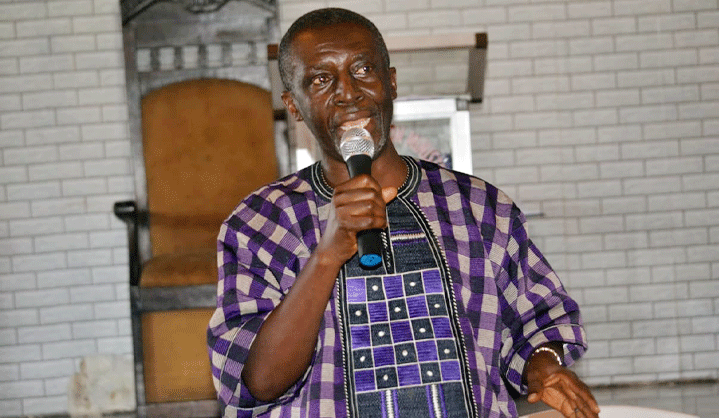
MONROVIA – Former Liberia National Bar Association President Tiawan Saye Gongloe said that President Joseph Nyuma Boakai’s quip that a “good lawyer knows the judge” promotes an unethical view of legal practice and sends the wrong message to young lawyers and law students, urging Liberians to hold the president accountable for the remark.
“I always say a brilliant lawyer knows the law, good lawyer knows the judge,” Boakai said during what appeared to be an informal exchange at a Liberian diaspora gathering in Washington, D.C. Lewis Browne, Liberia’s permanent representative to the United Nations, laughed and replied, “By the time we are done arguing I say I have to go.”
“If I was president of Liberia, I would never have made the joke that President Boakai made in the United States,” Gongloe said in his podcast on Facebook. “How can you say I always say a brilliant lawyer knows the law but a good lawyer knows the judge?”
“What?! A good lawyer knows the judge?” he said.
Gongloe, who teaches at the Louis Arthur Grimes School of Law at the University of Liberia, said a president’s public words carry more weight than ordinary political banter.
“We have young people listening to him. We have young lawyers,” he said. “I am teaching at the Law School and telling my students not to listen to that. I have told them to try and study the law and go by procedure and the ethics of the law.”
“I am really, really angry,” Gongloe said. “This is terrible!”
He urged Boakai to be more careful about the words he uses in public.
The president’s own words
The remark sits against Boakai’s repeated public criticism of the justice system. In his 2024 annual message, he said the system, which is meant to protect the innocent and punish the guilty, had been affected by “inefficiency, corruption, and lack of public trust.” Then-Chief Justice Sie-A-Nyene Gyapay Yuoh responded by challenging justice actors to show that the system was efficient, trustworthy and free from corruption.
In August, commissioning 17 judicial officers, including two judges and 15 court marshals, Boakai said they were accepting a public trust and that their conduct could strengthen or weaken public confidence in the courts. He has called for a judiciary that works “without fear, favor or delay.”
Who pays for the gap
Gongloe’s objection lands in a system where access already depends heavily on money. A 2023 World Bank assessment found that formal courts were perceived as more accessible to wealthier Liberians because of concerns about corruption and the cost of litigation, and identified long case resolution times, high costs and limited access to courts in rural areas as continuing problems.
The U.N. Development Programme reported in 2025 that overloaded dockets, limited access to courts and prolonged pretrial detention fell hardest on poor and vulnerable groups. In 2021, the agency said poor Liberians often could not hire lawyers because attorneys were expensive or scarce in parts of the country, contributing to unfair trials and long pretrial detention.
The Constitution guarantees the right to counsel, and the judiciary runs a National Public Defense Program for poor criminal defendants. In 2024, the UNDP backed a project with the bar association to expand pro bono representation for poor Liberians facing prolonged pretrial detention, and in 2025 the government and justice-sector partners were working to harmonize a proposed Legal Aid Bill that would create a Legal Aid Fund and an independent Legal Aid Board.
See more Liberia News Network stories in Google Search by adding LNN as one of your Preferred Sources.
★ Add LNN as a Preferred Source