
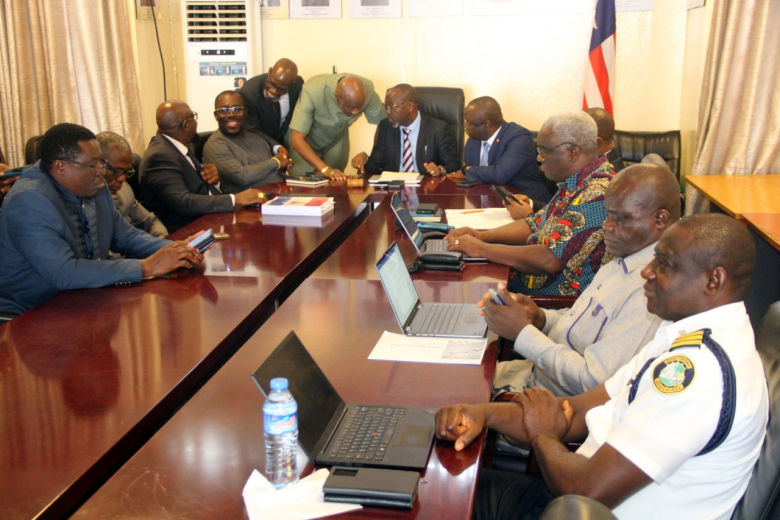
Capitol Building – The Chairman of the House Committee on Ways, Means, Finance and Budget, Representative P. Mike Jurry, has assured Liberians that lawmakers would examine whether the proposed FY2027 revenue framework is realistic, equitable, administratively achievable and sufficient to support Liberia’s development priorities.
\n
By Emmanuel Weedee-Conway
\n
As it goes on to do the business of the Liberian people, the Maryland County Electoral District #1 Representative insists that the committee will do due diligence to the process by properly cross examining the proposed financial instrument in the interest of Liberians and Liberia.
\n
The declaration was contained in his opening remarks at the ongoing revenue hearing into the FY2027 National Budget. The hearing is intended to scrutinize the credibility of revenue projections, assess the assumptions and methodologies behind the estimates, review FY2026 collection performance and evaluate the capacity of revenue-generating institutions.
\n
Issues For Legislative Attention
\n
He also identified revenue leakages, exemptions, concessions, weaknesses in revenue administration and statutory obligations of state-owned enterprises as key issues requiring legislative attention.
\n
“The Joint Committee will seek to achieve the following objectives: Examine the credibility and feasibility of the proposed FY2027 revenue projections; assess the assumptions and methodologies underpinning the revenue estimates; examine FY2026 revenue performance against approved targets; evaluate domestic revenue mobilization strategies and institutional collection capacities; identify and find remedies to revenue leakages, exemptions, concessions and weaknesses in revenue administration; examine statutory revenue obligations and contributions by state-owned enterprises; identify opportunities for expanding the domestic revenue base and provide evidence-based recommendations to inform legislative consideration and approval of the FY2027 National Budget,” he asserted.
Advertisement
The committee chairman stressed that domestic revenue mobilization is essential to Liberia’s fiscal sovereignty and long-term economic independence, adding that the country must strengthen tax compliance, broaden its revenue base, improve customs administration and use technology to reduce revenue losses.
\n
Call For Fair Revenue Mobilization
\n
He cautioned that revenue mobilization must be fair, arguing that compliant taxpayers and legitimate businesses should not bear an unreasonable burden while tax evasion, under-declaration, smuggling and other forms of non-compliance persist.
\n
Rep. Jurry further emphasized that revenue collection must be matched by transparency and accountability in public spending, noting that citizens are more willing to meet their tax obligations when they see public resources being managed responsibly and used to deliver essential services.
\n
The hearing is expected to provide lawmakers with an opportunity to question the Ministry of Finance, the LRA and other revenue-generating institutions on the assumptions, risks and policy measures underpinning the FY2027 revenue estimates.
\n
MFDP Defends Budget
\n
When given the time for remarks, Deputy Minister for Fiscal Affairs at the Ministry of Finance and Development Planning, Anthony G. Myers, defended the proposed US$1.54 billion Fiscal Year 2027 National Budget.
\n
In so doing, he projected a significant increase in domestic revenue collection despite concerns over the feasibility of the estimates and the absence of major one-off mining signature bonuses.
\n
The Projection That Matters
\n
Deputy Minister Myers told the House Joint Committee on Ways, Means, Finance and Budget and the Public Accounts Committee that the proposed budget is expected to reach US$1,538,916,274, representing an 11.5 percent increase over the FY2026 year-end revenue estimate of US$1.380 billion and 18.1 percent above the approved FY2026 budget of US$1.303 billion.
\n
Myers noted that the FY2027 revenue projection is built primarily on recurring domestic revenue rather than one-off receipts, noting that tax revenue is expected to increase by 26.5 percent, from US$847.5 million to US$1.072 billion.
\n
He explained that the FY2026 revenue performance benefited from exceptional mining receipts, including more than US$220 million in signature bonuses, but said the FY2027 forecast deliberately excludes similar windfalls from its baseline assumptions.
\n
The Deputy Minister dismissed concerns that the proposed budget could face a significant shortfall without another major mining signature bonus, arguing that the country’s economic growth is increasingly driven by sectors beyond mining.
\n
He stated that Liberia’s economic output was US$3.9 billion in 2025, with preliminary estimates placing it at US$4.1 billion in 2026 and projecting US$4.3 billion for 2027.
\n
He said the services sector is expected to remain the largest contributor to economic activity, averaging US$1.5 billion annually over the medium term, followed by agriculture and fisheries at US$1.1 billion, while mining and quarrying are projected to average US$800 million.
\n
Myers identified wholesale and retail trade as the largest projected revenue source, contributing US$466.2 million, including US$313.7 million from taxes on international trade. Services revenue is projected at US$378 million, while recurrent revenue from mining and quarrying, excluding signature bonuses, is estimated at US$323.3 million.
\n
He further disclosed that recurrent mining revenue is expected to remain strong, with tax revenue from the sector projected to increase from US$146.6 million to US$167.6 million, despite the absence of a major signature bonus.
\n
VAT and Other Revenue Measures
\n
The Deputy Minister outlined several policy measures expected to support the FY2027 revenue target, including the implementation of a 15 percent Value Added Tax (VAT), a two percent advance corporate income tax on mining and agriculture companies, and stronger tax compliance and administration.
\n
He said VAT will replace the existing 13 percent Goods and Services Tax (GST) effective January 1, 2027, and is projected to generate US$224.8 million, comprising US$76.6 million in domestic VAT and US$148.2 million in VAT on imports.
\n
Myers clarified that rice and petroleum products will remain outside the VAT regime, contrary to reports circulating in some sections of the public. He said the exclusion is intended to prevent disruptive price increases for consumers and producers.
\n
He added that the two percent advance corporate income tax on the turnover of companies in the mining and agriculture sectors is expected to generate US$57.3 million in FY2027, compared with US$7.6 million in the FY2026 approved budget.
\n
The measure, he explained, is intended to address risks associated with base erosion and profit shifting and will be reflected on a full-year basis in the 2027 budget following delays in its enforcement due to legal challenges by some concessionaires.
\n
Other measures under the proposed Liberia Tax Amendment Bill of 2026 include electronic tax invoicing, stronger customs controls, authorization for the Liberia Revenue Authority (LRA) to match third-party information against tax returns, and excise taxes on fees charged for digital financial services.
See more Liberia News Network stories in Google Search by adding LNN as one of your Preferred Sources.
★ Add LNN as a Preferred Source