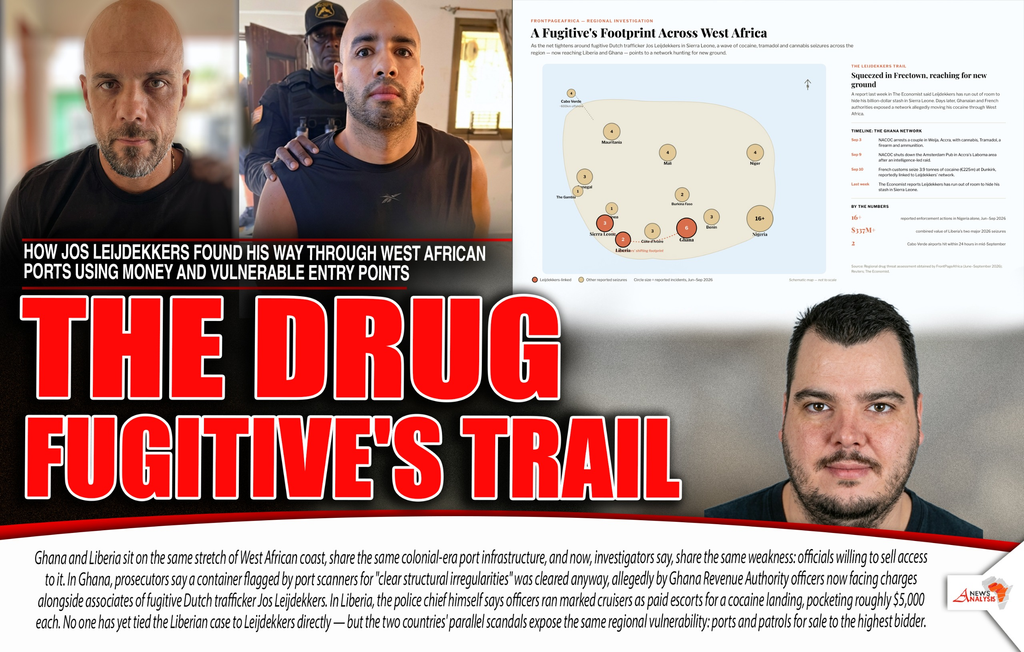
Ghana and Liberia sit on the same stretch of West African coast, share the same colonial-era port infrastructure, and now, investigators say, share the same weakness: officials willing to sell access to it. In Ghana, prosecutors say a container flagged by port scanners for “clear structural irregularities” was cleared anyway, allegedly by Ghana Revenue Authority officers now facing charges alongside associates of fugitive Dutch trafficker Jos Leijdekkers. In Liberia, the police chief himself says officers ran marked cruisers as paid escorts for a cocaine landing, pocketing roughly $5,000 each. No one has yet tied the Liberian case to Leijdekkers directly — but the two countries’ parallel scandals expose the same regional vulnerability: ports and patrols for sale to the highest bidder.
\n
By Rodney D. Sieh, [email protected]
\n
MONROVIA — Two countries, an ocean apart in almost everything except geography and a shared coastline of vulnerability, are now telling versions of the same story. In Ghana, prosecutors say a port scanner flagged a shipment’s “clear structural irregularities” — and someone cleared it anyway. In Liberia, the country’s own police chief says officers ran marked cruisers as paid escorts for a coastal cocaine landing, pocketing roughly $5,000 apiece from a $10,000 envelope. Different currencies, different officers, same failure: the men who were supposed to stand between West Africa’s ports and its traffickers instead opened the gate.
\n
Nothing yet on the public record ties the Liberian case to Jos Leijdekkers, the fugitive Dutch trafficker reportedly sheltering in Sierra Leone. But the pattern emerging on both sides of the Ghana-Liberia corridor — officials allegedly paid to look away — is precisely the kind of institutional crack that lets a network like his keep moving even as the walls close in elsewhere in the region. Leijdekkers, it now appears, isn’t just passing through West Africa’s ports. He’s paying his way through them.
\n
The Dunkirk Shipment
\n
It started, as these things often do, with a routine scan that wasn’t routine at all. On September 10, French customs officers at the port of Dunkirk pulled apart four containers that had sailed out of Ghana’s Tema Port and found roughly 3.9 tonnes of cocaine packed inside — a haul worth an estimated €225 million, or $261 million. Leijdekkers’ lawyers, Jan-Hein Kuijpers and Guy Weski, told the Dutch outlet NU.nl that their client denies any involvement.
\n
Ghana’s Narcotics Control Commission moved quickly, arraigning four Ghanaians it says “represented and facilitated” Leijdekkers’ activities: Desmond Koranteng Curiel — who has also gone by “Paul Kweku Yeboah” and “Biggs” — along with Musah Attah (“Kromo”), Kweku Otchere, and Jessica Hartog. Dutch reporting fills in the backstory on Curiel, describing him as one of Leijdekkers’ “most important accomplices” and noting the two once shared a Dutch prison, where Curiel was serving time for a string of violent jewelry-store robberies. All four were remanded at the High Court in Accra on September 16 and return to court October 13.
\n
The Officers Who Cleared It
\n
But four tonnes of cocaine don’t leave a working port on its own — and this is where the case turns from a trafficking story into something closer to a story about the port itself. Separately from the four accused of fronting for Leijdekkers, Ghanaian prosecutors have charged three Ghana Revenue Authority officers — Frank Adu-Boahen, Andrews Tetteh Amponsah, and Togbe Agbeti — plus freight-forwarding director Francis Narh Amanor, over how the shipment made it out of Tema at all. The scan had already raised the alarm, according to the charges; the secondary inspection those red flags were supposed to trigger simply never happened. Adu-Boahen, prosecutors say, went further still — handing his own system login, the credentials used to sign off on scan results, to his co-defendants — and he’s now named as a beneficial owner of the shipment itself. Amanor was arrested September 15, Adu-Boahen the next day; all appeared in court September 17 and are due back September 24.
\n
No filing has drawn a straight line from these three officers to Leijdekkers personally. The charges concern the shipment, not the man alleged to be behind it. But laid side by side, Ghana’s two cases sketch the same failure from opposite ends: a network with a documented personal tie to Leijdekkers on one side, a screening system allegedly hollowed out from within on the other. A scan overridden. A login shared. A shipment waved through.
\n
Accra has noticed. MP Ntim Fordjour has publicly called for a parliamentary probe into what he’s calling Ghana’s emergence as a “cocaine coast,” and the presidency has since ordered inter-agency investigations and restored NACOC’s mandatory role in screening port cargo — the kind of response that suggests officials themselves see Dunkirk as a systemic breach, not a bad afternoon at customs.
\n
A Familiar Pattern, Still Unconfirmed, in Liberia
\n
Liberia’s own reckoning is unfolding on a parallel track. Inspector General Gregory Coleman has told reporters that Liberian National Police officers actively helped move roughly four tons of cocaine — “We have identified key state actors who played a role in transporting, escorting the movement of this narcotic substance,” he said. Two names have surfaced: Wadell W. Kwarbo, chief of the Highway Patrol Section, and Anthony T. Blaye, chief of the Financial Crime Division, both accused of escorting a shipment from a coastal landing site in marked police cruisers for roughly $5,000 each.
\n
It’s a near-mirror image of what’s now public in Ghana — officials allegedly easing a shipment’s path for cash. What’s missing, so far, is the Leijdekkers connection. Coleman’s account doesn’t name him or link the seizure to a Dutch buyer or supplier, and no other source has made that connection either. Until someone does, the Liberia case stands on its own: proof of the same vulnerability across the region, not proof of the same hand behind it.
\n
The Ghana-Liberia thread runs deeper than the two escort allegations, though. Liberian officials tell FrontPageAfrica that one of the foreign nationals now in Liberian custody carries a Ghanaian passport — one Ghanaian authority have since called fake — and a residence permit issued under two different names: Mihovil Vrhovac, also known as Michael. It’s not an isolated detail. Liberian authorities say most of the Eastern Europeans moving through these networks — Serbian, Croatian, Ukrainian, Georgian — are based in Accra and carry Ghanaian passports, some of them, FrontPageAfrica has learned, using those documents to enter Liberia as far back as 2021.
\n
Liberia’s own case has produced two arrests so far tied to July’s $318 million bust: Spanish Colombian national Johann David Garces Grajales and Serbian former kickboxer Srđan Seleš. Prosecutors have charged five European nationals in total in the wider investigation, including Croatian nationals Nikolai Ivancic (also spelled Nicolad Avancik) and Mihovil Vrovac (Mio Vuvak), and Ukrainian national Tara Zaderieko (Taras Zargo) — the latter three indicted and now pursued in absentia through Interpol. Investigators have since traced four of them — Mihovil, Tara, David, and Seleš — to multiple visits to Freetown, with what officials describe as strong indications of ties to Leijdekkers. Mihovil, notably, was arrested in Accra at Liberia’s request — and then reportedly vanished.
\n
A Region Under Siege
\n
Dunkirk didn’t happen in isolation. A regional drug threat assessment obtained by FrontPageAfrica on Sunday describes an intensifying run of seizures across nearly every country on the West and Central African coast between June and September — a stretch that raises an uncomfortable question: how many of those cases, like Ghana’s, involved not just traffickers but the officials meant to be stopping them?
\n
In Ghana alone, the Dunkirk arrests landed a week after NACOC shut down the Amsterdam Pub in Accra’s Laboma neighborhood on September 9, arresting three suspects while the principal target got away. Days before that, a joint NACOC-National Security raid in Weija caught a couple, Jibreel Hardi, 51, and his wife, Abiba Fatawu, 42, with cannabis, Tramadol, a firearm, and 50 rounds of ammunition. In August, police in the Upper East Region seized 500 cartons of Tramadol from a network allegedly running through Mali, Togo, Burkina Faso, and Senegal via the town of Widana — and earlier that month, 866 parcels of cocaine worth an estimated $6.9 million turned up hidden in sacks of gari at Tema Harbor.
\n
Sierra Leone, where Leijdekkers is believed to be hiding, has had its own exposure: a September 10 tramadol seizure in Freetown that turned violent and left one person dead, and weeks before that, 51 kilograms of cocaine found in suitcases aboard a Brussels Airlines flight out of Freetown — leading to the arrest of a 22-year-old Belgian woman who wasn’t even on the flight’s passenger list.
\n
Nigeria’s drug enforcement agency had one of its busiest stretches anywhere in the region — synthetic cannabis, opioids and other drugs found hidden in cargo, speakers and bread across eight states in mid-September, more than 2 million opioid pills and over 2,000 kilograms of cannabis seized in a nine-state sweep on September 6, and 329,865 kilograms of drugs destroyed in Lagos. Cabo Verde’s two main airports were hit within 24 hours of each other, couriers arrested arriving from Dakar and Bissau — one had swallowed 73 capsules of cocaine — while Brazilian authorities separately intercepted more than 100 kilograms bound for the islands hidden in drills, shock absorbers, a dental chair, and chocolate powder tins.
\n
Liberia, for its part, has posted two of the region’s largest seizures in the same window: 3,971 kilograms in Duazon, Margibi County, on July 21 — worth roughly $317.68 million — and 237.6 kilograms at Roberts International Airport on June 8, hidden in six cargo boxes bound for Europe and valued near $19.2 million. Whether either shipment is the same one referenced in Coleman’s police-escort account remains unclear.
\n
The wave has touched Benin, Burkina Faso, Côte d’Ivoire, The Gambia, Guinea, Mali, Mauritania, Niger, and Senegal as well — networks dismantled, drug dens destroyed, everything from tramadol to captagon seized across a sub-region where the trade has clearly stopped respecting borders.
\n
Ghana as the Hub
\n
Liberian authorities, watching two major busts of their own unfold in a matter of months, believe — based on FrontPageAfrica’s reporting — that Ghana has become the operational center of drug smuggling in West Africa. The pattern keeps repeating: a Ghanaian passport later called fake, a residence permit under two names, a community of Eastern European operatives based in Accra who’ve been slipping into Liberia on those same documents since at least 2021.
\n
“Thank God our joint security forces have intercepted or made arrests in Liberia, and not shipped [drugs] out like Ghana, Sierra Leone, and others,” a senior member of Liberia’s joint security drug force told FrontPageAfrica on Monday.
\n
Whether that holds — whether Liberia catches what Ghana’s port let through — may be the question the rest of this story is still being written to answer.
See more Liberia News Network stories in Google Search by adding LNN as one of your Preferred Sources.
★ Add LNN as a Preferred Source