By Rodney D. Sieh | [email protected]
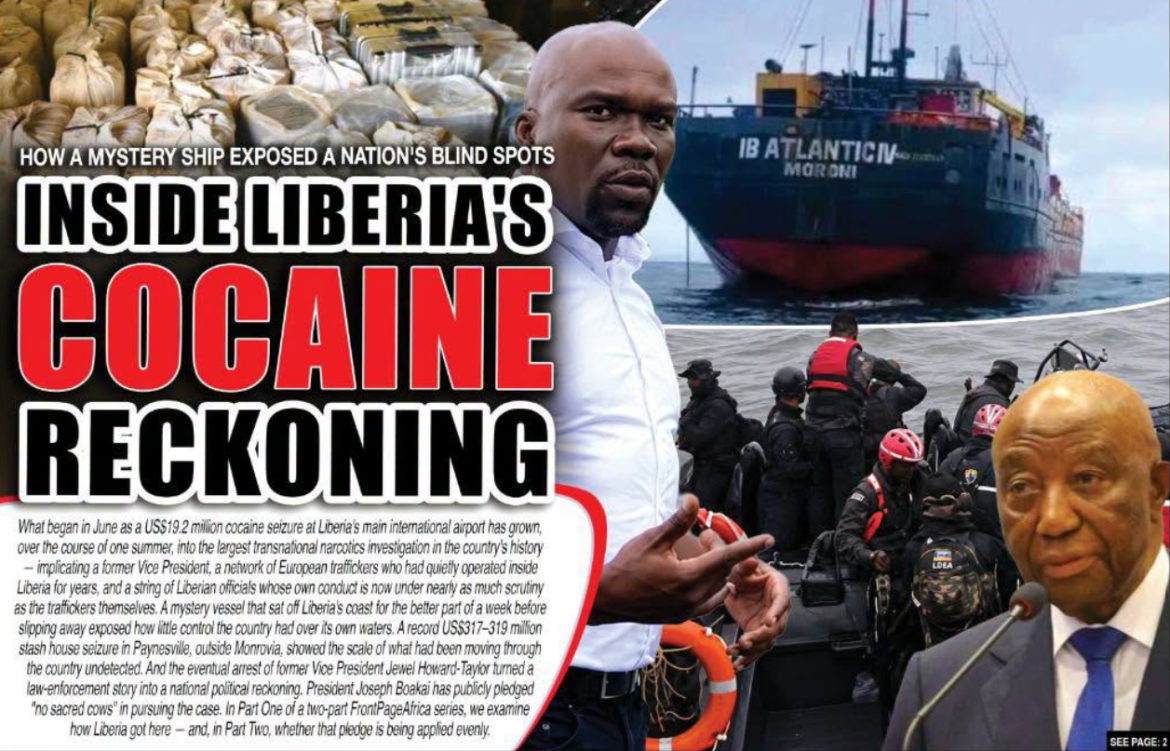
MONROVIA — Liberia is a small country with a long memory for how badly things can go wrong when institutions fail, and a short one, historically, for holding anyone accountable when they do. This summer tested both. What started as a routine-sounding customs seizure at Roberts International Airport in June has, by late August, become something else entirely: a sprawling investigation reaching a former Vice President, a network of European traffickers, and a growing list of Liberian officials whose own conduct — not just their diligence — is now part of the story.
A Small Bust That Became a Big Warning
The first sign of trouble was, by the scale of what followed, almost modest: a US$19.2 million cocaine seizure at Roberts International Airport in June. For a country of roughly five million people with a national budget measured in the hundreds of millions of dollars, even that figure was staggering. It should have been the biggest drug story of the year. Instead, it turned out to be the opening chapter.
The Ship Nobody Could Catch
Weeks later, a vessel — later identified in Liberian press as the IB Atlantic IV — sat off the country’s coast for the better part of a week before anyone in government acted decisively. When the Armed Forces of Liberia finally moved, the patrol boat sent to intercept it was, by multiple accounts, too small to catch a ship determined to reach open water. It did. The episode became a national embarrassment for a simpler reason than politics: it showed, in real time, that Liberia’s maritime security apparatus could not reliably stop a suspicious vessel from doing exactly what it wanted, in Liberian waters, while the government watched. A letter vouching for the vessel as “distressed” — signed by Mark Egon Kuiah, then the operations chief at Roberts International Airport — later became one of the central threads investigators pulled to unravel the wider network.
Five Agencies, One Uncomfortable Pattern
As investigators worked backward from the ship and the airport seizure, the list of implicated institutions kept growing, and so did the list of unresolved questions about those institutions’ own conduct. Kuiah was dismissed from his post in late July over the vessel letter — but as of this writing, two months later, he has not been formally charged with anything. Fitzgerald Biago, the Officer-in-Charge of the Liberia Drug Enforcement Agency, recused himself from the investigation entirely after allegations surfaced that he had personally accepted vehicles from a bar owner tied to the case; President Boakai gave the Minister of Justice 48 hours to report on the matter, and the recusal has never been followed by a public resolution. Inspector General of Police Gregory Coleman, leading the broader Joint Security Investigative Team, told this newspaper that trafficking in Liberia had been “sanctioned at very, very senior level” — a claim serious enough to reshape the entire public conversation about the scandal, and one Coleman has never followed with a name. Jonathan Momolu, a security officer at the airport, was tied both to this year’s case and to a 2023 shipment of methamphetamine disguised as tea leaves that passed through an unauthorized gate while he was the senior inspector on duty; he was questioned briefly and released. None of these threads, individually, proves an official was complicit. Together, they describe a pattern this newspaper has tracked for months: a government capable of finding traffickers, but visibly less capable, or less willing, of moving with the same speed against its own people.
The Record Seizure
The investigation’s defining moment came when authorities raided a stash house in Paynesville, outside Monrovia, and seized what officials have valued at between US$317 million and US$319 million in cocaine — an estimated 238 kilograms to nearly 4 metric tons, by far the largest narcotics seizure in Liberia’s history. It was the kind of number that reframed everything that had come before it: the airport seizure, the mystery vessel, the recusals and dismissals. Liberia was not dealing with an isolated smuggling attempt. It was dealing with an entrenched, well-financed transnational network that had been operating inside the country for years.
The Network Behind the Curtain
FrontPageAfrica’s own investigation identified the core of that network as five men: Croatians Nikola Ivancic and Mihovil Vrovac, Ukrainian Taras Zadereiko, and a Serbian national and a Spanish national charged earlier in the same broader case. Ivancic, known in Croatian law enforcement circles as “the Kingpin,” has a criminal record stretching back to a 2010 indictment by Croatia’s anti-corruption office and was more recently named in a 2026 indictment alongside Croatian cartel leader Kristijan Palic for allegedly attempting to smuggle 6.5 tons of cocaine into Europe; he is believed to operate from Dubai. Vrovac, known locally as “Michael,” is accused of running the network’s day-to-day logistics from a base in Ghana. Zadereiko, known in Liberia as “Tony” or “Tom,” is described by investigators as the group’s engineer and technician, structuring its money laundering and distribution. All three reportedly carried Ghanaian passports, and all three have been charged in absentia — a financier abroad, an operator in the region, and a technician embedded inside the target country, a structure built to survive exactly the kind of scrutiny it eventually received.
The Dubai Introduction
The network’s most consequential connection inside Liberia’s government traces to a single 2022 meeting. A middleman, Sheikh Bassirou Kante, introduced then-Vice President Jewel Howard-Taylor to the network’s Croatian and Ukrainian principals, presenting them as investors interested in putting roughly US$250 million into the Liberian economy. Howard-Taylor met the group in Dubai later that year. Kante, who later ran into legal trouble of his own in the United States and became a cooperating witness, was eventually wired for a phone call in which he told Howard-Taylor that the “investors” she had met in Dubai had sent her a “gift.” That recording, according to investigators, became the basis for her arrest on August 19, and for a formal writ five days later detailing hotel meetings, US$45,000 in cash allegedly handed over for “shopping,” and a foundation, Jewel Star Fish, that prosecutors say quietly received cartel money while she held public office.
The President’s Line in the Sand
President Boakai has at multiple points this summer staked his own credibility on the outcome of this investigation. At a commissioning ceremony for security officials earlier this year, he pledged that his administration would pursue the case with “no sacred cows.” When allegations against LDEA’s Biago surfaced, Boakai gave the Minister of Justice a public 48-hour deadline to report back — a rare, direct presidential intervention into an ongoing case. And when calls for Inspector General Coleman’s dismissal grew loud enough to dominate the news cycle, Boakai addressed Coleman personally and by first name: “Greg, my government remains fully supportive of your actions and leadership as you continue to spearhead the fight against illicit drugs in Liberia. You have the full backing of my government.” Each intervention has told Liberians something about where the president stands. None of them, on their own, has answered the harder question hanging over the entire investigation: whether the speed and force the government has shown against its most politically visible targets will extend, with equal weight, to everyone else this case has touched.
That question — who gets charged quickly, who gets left in limbo, and what the gap between the two says about the investigation’s integrity — is the subject of Part Two.
See more Liberia News Network stories in Google Search by adding LNN as one of your Preferred Sources.
★ Add LNN as a Preferred Source