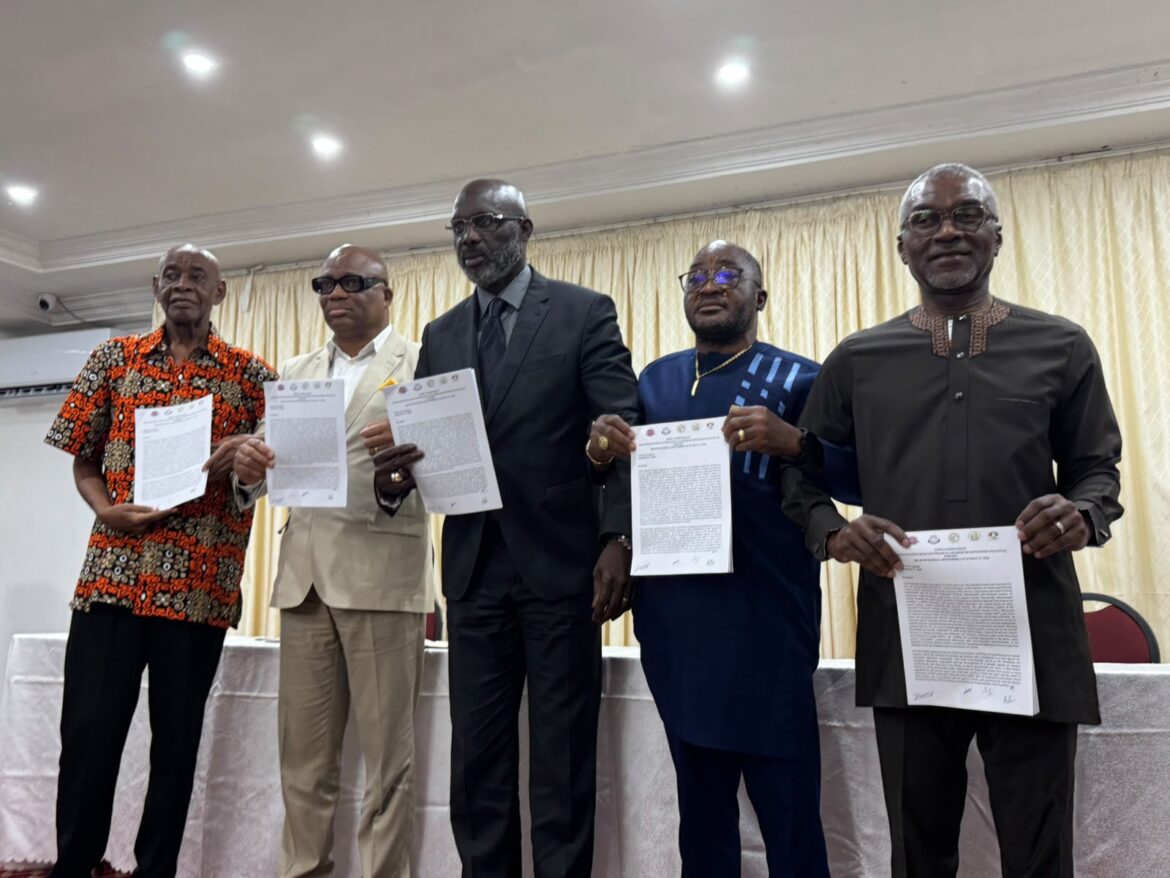
MONROVIA — Five major opposition political parties have formalized a new cooperation framework, accusing the Boakai-Koung administration of weakening democratic institutions, mishandling national security, selectively enforcing anti-corruption laws and failing to deliver meaningful economic relief to Liberians.
The leaders of the Alternative National Congress (ANC), Coalition for Democratic Change (CDC), Movement for Economic Empowerment (MOVEE), Movement for Progressive Change (MPC) and Union of Liberian Democrats Party (ULDP) signed a joint communiqué Sunday, September 27, following a second opposition roundtable at Sinkor Palace in Monrovia.
The communiqué, signed by former President George Manneh Weah, ANC Political Leader Alexander Cummings, MOVEE Political Leader Ambassador Dee-Maxwell Saah Kemayah, MPC Political Leader Simeon Freeman and ULDP Political Leader Jonathan Mason, establishes an Opposition Political Parties’ Joint Technical Committee to develop an implementation and operational agenda for the alliance.
The opposition leaders said their objective extends beyond electoral competition, arguing that their cooperation will focus on accountability, constitutional democracy, economic opportunity, judicial independence and national development.
Border Dispute Takes Center Stage
Among their most prominent concerns is the continuing Liberia-Guinea border dispute in Foya District, Lofa County.
The opposition leaders accused the government of failing to adequately protect Liberia’s territorial integrity and demanded stronger diplomatic action to resolve the dispute.
Their claim comes amid months of tension around Sorlumba. The government has acknowledged the border situation but has maintained that it is pursuing a peaceful diplomatic resolution. In March, Liberia said it had dispatched delegations to Conakry and that Presidents Joseph Boakai, Julius Maada Bio of Sierra Leone and Mamady Doumbouya of Guinea held discussions on the matter.
The opposition, however, said the government must do more through ECOWAS, the African Union and other international mechanisms to safeguard Liberia’s territorial claims.
EU Relations and Transparency
The parties also criticized what they described as a deterioration in Liberia’s diplomatic relations, citing the controversy surrounding European Union Ambassador Nona Deprez.
They alleged that the government sought her recall after she raised concerns about transparency in the mining sector and argued that the subsequent absence of a replacement ambassador reflected a deterioration in relations.
The EU’s official Liberia delegation page continues to identify Deprez as its ambassador and head of delegation, underscoring the need for careful distinction between the opposition’s characterization and the current diplomatic record.
The opposition leaders also demanded greater transparency regarding the United States-Liberia arrangement involving the possible transfer of up to 1,200 third-country nationals to Liberia.
They said Liberians have a right to know the terms, safeguards and implications of the arrangement.
Corruption Allegations
The opposition parties accused the government of applying anti-corruption measures selectively and called on the Liberia Anti-Corruption Commission (LACC) to investigate allegations involving current and former government officials.
They specifically renewed calls for an investigation into what they described as a controversial US$10 million construction project in Foya, Lofa County.
The parties said the ANC previously petitioned the LACC over the project and that the commission responded that it would conduct a preliminary assessment to determine whether an investigation was warranted.
They also called for an investigation into an alleged US$8 million transfer from the Central Bank of Liberia to SIB Liberia in May 2024.
The allegations contained in the communiqué have not been established as findings of wrongdoing, and the opposition is calling for formal investigations.
Rule of Law and Free Speech
The five parties accused the administration of undermining judicial independence and disregarding Supreme Court decisions.
They also raised concerns about the enforcement of Liberia’s new Cybercrime Act, arguing that the law should not be used to criminalize criticism, ridicule or political expression protected by the Constitution.
The issue gained national attention after the arrest of Jerry Nyantee Wrato over an AI-generated image and video involving Vice President Jeremiah Kpan Koung. Koung publicly called for Wrato’s release, but Police Inspector General Gregory Coleman declined to release him and the matter proceeded through the legal process.
The opposition leaders said the case illustrates the need for clear limits between legitimate cybercrime enforcement and constitutionally protected speech.
Drugs, Security and Selective Prosecution
The communiqué also takes aim at the government’s handling of Liberia’s major cocaine investigations.
The opposition leaders called for an independent investigation into the US$19 million and US$317 million drug seizures and said allegations of involvement by senior government officials must be independently examined.
They proposed that credible institutions, including the Liberia National Bar Association, Press Union of Liberia, civil society organizations, Liberia Council of Churches and Liberia National Muslim Council, participate in such an investigative mechanism.
The parties further accused the government of selective prosecution, contrasting the handling of cases involving former officials with cases involving individuals associated with the current administration.
Economy, Jobs, Education and Health
On the economy, the opposition acknowledged the government’s reported achievement of crossing the US$1 billion domestic-revenue mark but questioned how much of that revenue is translating into improved living conditions for ordinary Liberians.
They cited unemployment, limited access to credit, difficulties confronting Liberian-owned businesses and alleged violations of the National Investment Code.
The parties also criticized the government’s handling of education and healthcare, particularly the compensation of teachers and health workers and the continued reliance on voluntary health workers.
They said human-capital development must become a central component of national economic planning.
2029 Elections
Looking ahead, the five parties placed the independence of the National Elections Commission at the center of their cooperation.
They cited the narrow margin in the 2023 presidential election and said the peaceful transfer of power from Weah to Boakai demonstrated the importance of credible elections.
The opposition warned against what it described as perceived efforts to deregister political parties or otherwise undermine electoral competition.
They said they intend to engage the NEC on measures aimed at ensuring free, fair, transparent, peaceful and inclusive elections in 2029.
New Opposition Structure
Rather than immediately announcing an electoral alliance, the parties said their cooperation will preserve the individual identities and organizational autonomy of each political party.
The newly constituted Opposition Political Parties’ Joint Technical Committee will comprise two representatives from each participating party and is expected to develop thematic working groups and mechanisms for engagement with lawmakers, civil society organizations, professional groups and citizens across Liberia’s 15 counties.
The parties said they also intend to bring additional opposition parties and national stakeholders into the process.
“Our coming together is informed by the lessons, challenges and experiences of previous attempts” at opposition collaboration, the communiqué states, emphasizing that the parties intend to build cooperation through consultations and measurable national engagement.
The five political leaders said their immediate focus is not simply on the 2029 elections but on building a sustained opposition platform capable of coordinating policy positions, national advocacy and scrutiny of government.
The communiqué concludes with a call for Liberians who support constitutional democracy, economic opportunity, accountable government and equal justice to participate in what the opposition describes as a broader national conversation.
See more Liberia News Network stories in Google Search by adding LNN as one of your Preferred Sources.
★ Add LNN as a Preferred Source