
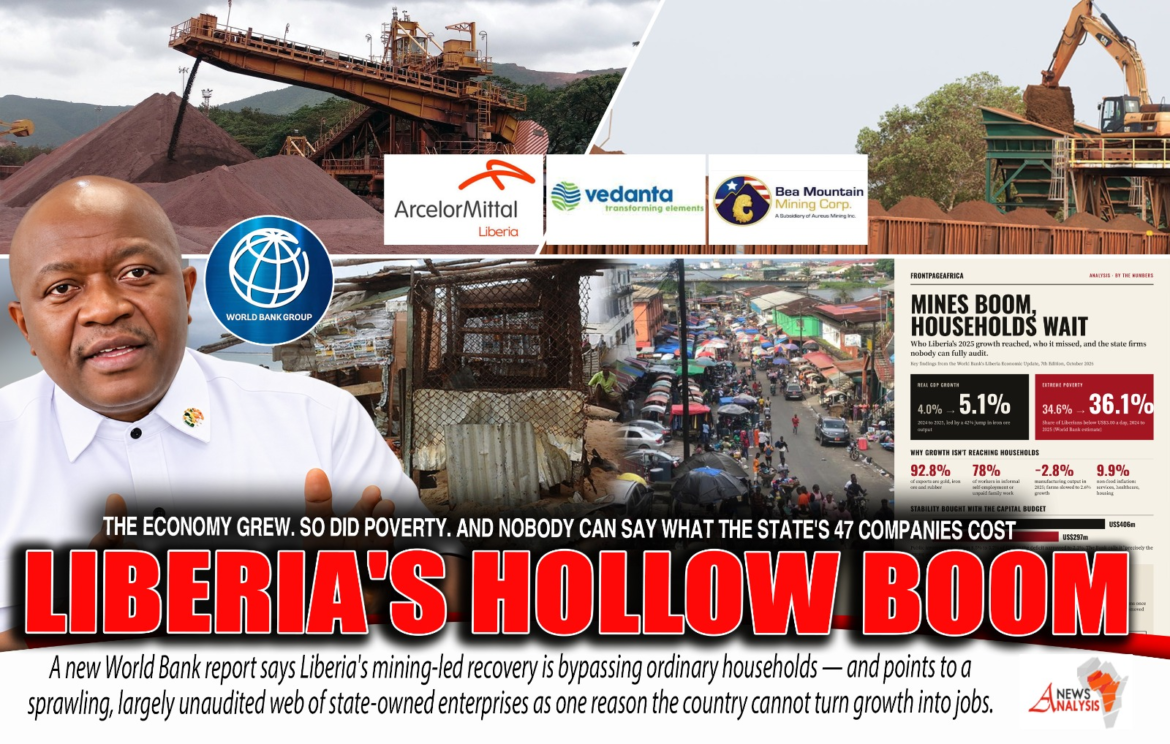
MONROVIA — On paper, 2025 was a good year for Liberia. The economy grew 5.1 percent, its strongest pace in the five years the World Bank charts. Inflation ended the year at 4 percent. The budget deficit narrowed, and export earnings leapt by nearly 58 percent on the back of gold and iron ore.
Yet by the Bank’s own estimate, more Liberians slipped into extreme poverty — from 34.6 percent of the population in 2024 to 36.1 percent in 2025.
That contradiction sits at the heart of Beyond Growth, the 7th edition of the World Bank’s Liberia Economic Update, released in October. Its diagnosis is blunt: Liberia is growing in the places where few Liberians work, and stalling in the places where most of them do. And it turns a spotlight on an institution that rarely features in growth debates — the state’s own portfolio of 62 government-owned entities, whose finances, the report says, the government itself cannot reliably see.
Growth that skips the household
The 2025 numbers were driven by mines, not markets. Industrial output jumped 10.8 percent, powered by a 42 percent surge in iron ore production as a major project scaled up and a 17 percent rise in overall mining output. Gold, iron ore and rubber now account for 92.8 percent of everything Liberia sells abroad; gold alone is 61.8 percent.
The sectors where Liberians actually earn a living moved the other way. Manufacturing shrank 2.8 percent. Agriculture, which still employs about 39 percent of the workforce, slowed to 2.6 percent growth from 3.4 percent, and farm labour productivity has fallen about 1.1 percent a year since 2014.
The labour market tells the rest. Some 78 percent of workers are in what the Bank calls vulnerable employment — informal self-employment or unpaid family work. Wage jobs account for just 20.9 percent of employment, a share that has barely moved in two decades. About 55,000 people join the labour force each year, but the economy creates roughly 50,000 jobs.
Firms are too small to absorb them. Some 86 percent are micro-sized and nearly 89 percent are one-person operations. Liberia registers about two new limited liability companies per 10,000 adults a year — roughly 165 times below the global average, the report says.
Prices compounded the squeeze. Food inflation collapsed after rice prices fell and the government cut the wholesale price of a 25kg bag from US$16.75 to US$14.00. But non-food inflation climbed to 9.9 percent, driven by services, healthcare and housing — costs that hit urban wage earners hardest. The Bank expects poverty to ease to 33.2 percent in 2026 if farming recovers.
Stability bought with the capital budget
Monrovia’s fiscal numbers improved. The deficit narrowed to 2.1 percent of GDP, domestic revenue rose to US$830 million (15.9 percent of GDP), and public debt eased to 55.1 percent of GDP. Domestic revenue now covers 69.3 percent of public spending, up from 59 percent.
But the Bank is plain about how the books were balanced. As donor grants fell from 7.8 to 4.9 percent of GDP, capital spending was cut from US$406 million to US$297 million — from 8.5 to 5.7 percent of GDP. Interest payments, meanwhile, rose from US$49 million to US$87 million.
Cutting the investment Liberia needs to break its jobs trap, the report says, is “precisely the wrong adjustment.” It points instead to money left on the table: tax exemptions worth about US$240 million in 2024, more than 40 percent of tax revenue; a mining sector from which Liberia captures only 15–20 percent of available fiscal value, against 50–60 percent in peer countries; and a domestic capital budget that has historically been only about one-third executed.
The gap matters because the government’s ARREST Agenda development plan needs roughly US$8.4 billion over five years, at a time when concessional finance is shrinking and Liberia remains at high risk of overall public debt distress.
The black box: 47 state firms, few accounts
The report’s second half is its sharpest. Liberia’s government owns 62 entities — 47 operating, 15 dormant — running power, ports, petroleum, water, transport, hospitals, universities and regulators. They control assets worth roughly a quarter of GDP. Yet in 2024 only 19 submitted financial returns to the state’s oversight bureau, and 26 of the 47 active entities report nothing at all. Just 13 percent file compliant quarterly reports.
Where auditors have looked, the picture is grim. Only 17 of the 47 have had even one General Auditing Commission audit since 2019. Of 36 financial-statement opinions issued for FY20–FY24, 25 were adverse, seven qualified and four clean. All ten compliance audits came back adverse.
The self-reported numbers that do exist flatter the portfolio. The 19 reporting firms booked a combined US$29.0 million profit in 2024, but US$19.7 million of that was pension accumulation at the National Social Security and Welfare Corporation (NASSCORP). Strip out US$15.1 million in government subsidies and a US$16.7 million donor grant to the electricity utility, and the group posted a loss of about US$2.7 million.
The bigger risk sits off the subsidy line. Government on-lent or guaranteed US$423.3 million of state-enterprise debt as of end-2025 — debt that lands on the treasury if a company cannot pay. The report also finds firms that did not remit workers’ income tax for years: the Liberia Civil Aviation Authority paid nothing until a marginal sum in 2024. Auditors found NASSCORP could not link US$4.1 million of 2022 deposits to any contributor.
Governance is part of the problem. A 2023 Bank review of eight state firms found ministers on every board and some directors missing three-quarters of meetings. Presidential performance contracts are signed directly with chief executives, bypassing boards. The old Bureau of State Enterprises oversaw this portfolio on less than US$1 million a year.
Its successor, the State-Owned Enterprises Authority of Liberia (SEAL), formally took over on August 23, 2026. The Bank calls it timely but flags weaknesses: no governing board, three political appointees with loosely defined tenure, and funding from a 0.25 percent levy on the very firms it polices. A House-passed bill barring sitting officials from state boards, reported by FrontPageAfrica in March and cited in the Bank’s report, still awaits Senate action.
LEC: the utility at the centre of the risk
No entity illustrates the problem better than the Liberia Electricity Corporation (LEC). It holds about 77 percent of all liabilities reported by state firms, and its accounts have drawn adverse audit opinions year after year.
LEC reported modest losses of about US$3.5 million over 2022–2024. But that was only after booking roughly US$50 million in grant income. Without it, the Bank estimates, losses would have run US$17–20 million a year. Its equity fell from US$51.0 million to US$30.4 million in 2024, as liabilities climbed to 95 percent of assets.
The utility’s biggest deadbeat is its owner. Of US$34.0 million owed to LEC at end-2025, about 91 percent was owed by government ministries and agencies, most of it more than a year old. In December 2025, core government paid 0.3 percent of what it owed, against about 21 percent for customers overall. The government, the report notes, is at once LEC’s shareholder, regulator, least reliable customer and lender of last resort.
Businesses pay the price. More than 90 percent of Liberian firms now own a generator, up from 73 percent in 2017. Auditors also found LEC operated for at least five years without documented board minutes or adopted by-laws. The planned expansion of the Mount Coffee hydropower plant from 88 to about 130 megawatts by 2028 offers relief — if the utility can be run to use it.
What the Bank prescribes — and what to watch
The Bank is careful not to overclaim. It says it has not established that state firms cause Liberia’s jobs problem. Its argument is narrower and harder to dismiss: without accounts, audits and a register of who sits on which board, no one can say what the portfolio costs, what it delivers or what risk it poses to the treasury.
Its fix is deliberately unglamorous. By end-2027, it wants every entity classified as commercial, public-service or hybrid; a published register of entities and directors; a minimum annual reporting template for all 47 operating firms; and audit firepower focused on the five biggest exposures — LEC, NASSCORP, the National Port Authority, the Liberia Petroleum Refining Company and the Liberia Water and Sewer Corporation — with private auditors brought in under the Auditor General’s oversight. By June 2028, it wants government’s tangled money flows with those firms reconciled, public-service obligations costed, the first public aggregate report on state enterprises, and a legal inventory of the 15 dormant companies.
The wider outlook is cautiously positive but exposed. The Bank projects growth averaging 5.3 percent a year over 2026–2028, inflation of 7.0 percent in 2026 and a VAT launch in early 2027. But global growth is forecast to slow to 2.5 percent in 2026 as the Middle East conflict lifts oil prices. A 15 percent fall in gold and a 20 percent fall in iron ore prices would wipe about US$295 million off export earnings, with reserves covering only about two months of imports.
For a country that has heard many reform plans, the test is simple. Growth figures can be announced. Whether the state can account for its own companies — and pay its own electricity bills — will show whether Liberia’s boom is starting to reach the people living through it.
See more Liberia News Network stories in Google Search by adding LNN as one of your Preferred Sources.
★ Add LNN as a Preferred Source