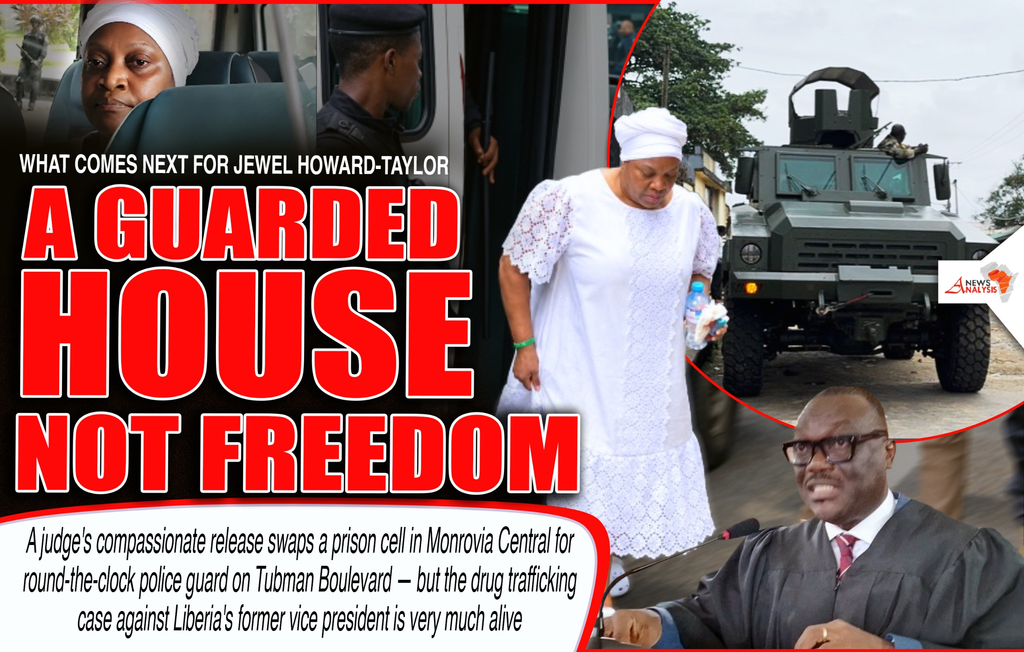
MONROVIA – Eleven days after she was led into Monrovia Central Prison, Jewel Howard-Taylor went home on Thursday — but not to freedom. Under an order signed by Criminal Court “C” Judge Ousman F. Feika, the woman who once stood a heartbeat from the Liberian presidency now lives under a regime nearly as controlled as the one she left. A single-family caregiver has been designated to look after her. Police are posted at the gate around the clock. A visitor’s log, modeled on the one the Bureau of Corrections keeps at the Central Prison, tracks everyone who comes and goes. She cannot step outside the compound on Tubman Boulevard in Sinkor without the court’s advance approval — and even then, only for a hospital appointment.
It is not vindication, and Judge Feika was careful to say so. The order releasing Howard-Taylor from pre-trial detention on medical grounds does not touch the case underneath it. Liberia’s first and only female vice president still faces trafficking, money-laundering and conspiracy charges connected to what prosecutors have called the largest cocaine seizure in the country’s history. What changed this week is where she waits for trial, not what she will have to answer when it begins.
HOW THE CASE REACHED THIS POINT
The case traces back to July 21, 2026, when Liberian authorities intercepted nearly four metric tons of cocaine in Duazon, east of Monrovia — a haul officials valued at roughly $317 million and described as one of the largest narcotics seizures in the country’s history. It followed a smaller but still significant bust in June, when 237.6 kilograms of cocaine worth more than $19 million was seized at Roberts International Airport. Taken together, investigators say, the two seizures pointed to a sustained trafficking corridor running through Liberia — consistent with warnings from the United Nations Office on Drugs and Crime that West Africa has become a key transit route for South American cocaine bound for European markets. The July bust also implicated senior police and intelligence officials, widening the investigation well beyond the traffickers caught with the drugs.
Howard-Taylor was arrested on August 19 at Roberts International Airport. Her lawyers say she was intercepted while on her way to meet them, despite having agreed to report voluntarily to police headquarters — a procedural grievance that has since become part of her defense. A magistrate at the Monrovia City Court initially handled her first appearance, but on August 26, Stipendiary Magistrate Ben Barco ruled that his court had no authority over charges this serious and denied her request for humanitarian home confinement, finding medical assessments showed her “sufficiently stable” to remain in custody. She was transferred to Monrovia Central Prison. Her defense team then carried the fight to Criminal Court “C”, the tribunal with jurisdiction over major felonies, where a preliminary examination opened in early September — pushed back a day at the defense’s request so she could be seen by her personal physician. Days later, Judge Feika granted the compassionate release that now has her under house arrest rather than behind prison walls.
AT A GLANCE — CONDITIONS OF RELEASE
Travel documents surrendered to the Sheriff of the Court immediately upon release.
Confined to her Tubman Boulevard residence in Sinkor, under a single court-approved family caregiver.
Access limited to Howard-Taylor, her caregiver and her physician or physician’s assistant.
A visitor-logging system modeled on the Bureau of Corrections’ protocol at Monrovia Central Prison.
No movement outside the residence except by court order or for an approved medical appointment.
Round-the-clock security or police protection maintained at the residence, with a full visitor log kept on hand.
WHO IS JEWEL HOWARD-TAYLOR
Long before this case, Howard-Taylor had one of the more unusual résumés in Liberian politics. Born in Zorzor in 1963, she married Charles Taylor in 1997 and served as First Lady during his presidency until 2003. She later earned a law degree from the University of Liberia, was elected to the Senate representing Bong County in 2005 as a member of the National Patriotic Party, and chaired the Senate’s committee on health, gender and children’s affairs. In 2017, George Weah picked her as his running mate on the Coalition for Democratic Change ticket, and when the coalition won that December, she became Liberia’s first female vice president, serving from January 2018 until January 2024. More recently, she has clashed with the NPP’s current leadership over her endorsement choices in Liberian politics — friction her supporters now point to as part of the backdrop for a prosecution she calls politically motivated.
THE CASE PROSECUTORS SAY THEY HAVE
According to the writ of arrest, dated August 25 and signed by Clerk of Court Abel Kalay, the state’s narrative begins in 2021, when a man named Sheikh Bashiru Kante allegedly brought two foreign nationals — Taras Zadereiko, a Ukrainian known as “Tony,” and Mihovil Vrovac, a Croatian known as “Michael” — into Liberia to establish a cocaine pipeline between West Africa and Europe. The following year, Kante is accused of introducing the pair to Howard-Taylor at her residence in Congo Town, after which she was allegedly invited to Dubai to meet Nikola Ivancic, a Croatian the writ describes as the ring’s leader. There, prosecutors allege, she received $45,000 in cash. Investigators say further payments followed — $75,000 funneled through the Jewel Star Fish Foundation, a nonprofit associated with her name, and an additional $15,000 delivered through Kante as recently as this past August. On those allegations, she has been charged with importation and exportation of controlled drugs, unlicensed trafficking, criminal conspiracy, facilitation, solicitation and money laundering. Ivancic, Vrovac and Zadereiko have all been charged in absentia; none is currently in Liberian custody. Howard-Taylor and her attorneys — Laveli Supuwood, Kabineh Ja’neh and Finley Y. Karngar — have denied every allegation.
WHERE THE GOVERNMENT’S CASE LOOKS STRONG
Prosecutors are not starting from an informant’s tip; they are starting from four tons of cocaine physically seized and forensically verifiable, which gives the broader investigation a foundation that does not depend on anyone’s credibility. The alleged financial trail is also, in principle, the kind of evidence that outlasts witnesses: if the $75,000 said to have moved through the Jewel Star Fish Foundation left a documentary record — bank deposits, wire transfers, foundation filings — that evidence can be examined independently of what any single witness says on the stand, and money moved through a registered nonprofit is a classic and traceable laundering pattern once investigators have the paperwork. The case also has genuine international reach: two people were captured at the scene of the July seizure carrying Spanish-Colombian and Serbian passports, and three more suspects tied to the alleged Liberia-to-Europe pipeline are Croatian and Ukrainian nationals — a spread that has already drawn the attention of transnational-crime watchdogs and gives Liberian investigators avenues to seek corroboration, such as banking or travel records, from foreign counterparts that a purely domestic case would not have.
WHERE THE GOVERNMENT’S CASE LOOKS SHAKY
The prosecution’s most serious structural weakness is that its alleged ringleader and two of the alleged cash conduits — Ivancic, Vrovac and Zadereiko — are being charged in absentia and are not in Liberian custody. That means the version of events tying Howard-Taylor to a Dubai cash handoff and a foreign trafficking ring rest, for now, on the writ’s narrative and on Kante as the connecting figure, rather than on live testimony from the men prosecutors say ran the operation and paid her. Her lawyers have already signaled how they intend to attack that gap: they argue that meeting foreign businesspeople and traveling abroad were the ordinary furniture of high office, and that a writ describing contacts made “as part of her constitutional responsibilities” does not, by itself, establish criminal intent. The case has also stumbled procedurally in ways that hand the defense real ammunition — an initial prosecution at a court later found to lack jurisdiction, a magistrate’s ruling reversed only after Howard-Taylor was sent to Central Prison, and her lawyers’ still-unresolved claim that she was intercepted en route to meet counsel rather than formally summoned. Her legal team has separately alleged, without offering documentation, that government actors might manipulate audio or video evidence using artificial intelligence — an unproven claim, but one that puts prosecutors on notice that any recorded evidence they introduce will be contested on authenticity, not just content. And the timing lands amid a real rupture between Howard-Taylor and the National Patriotic Party’s current leadership over her recent political endorsements, which gives her camp a ready-made political-persecution narrative that will need to be answered with evidence in a courtroom, not simply asserted in the press.
WHAT HAPPENS NEXT
The house-arrest order is not the end of anything; it is a pause inside a case that is still being built. A grand jury term is expected later this month, and it is the grand jury’s indictment — not Thursday’s ruling — that will determine whether the charges against Howard-Taylor formally proceed to trial. Judge Feika still has a stack of preliminary motions to rule on, including defense requests to quash the arrest writ, a habeas corpus petition, a bail motion despite prosecutors’ argument that the charges are non-bailable, and a motion to suppress evidence. Until those questions are resolved, Howard-Taylor remains, in effect, a prisoner of her own address: watched around the clock, barred from travel, and permitted outside her gate only for the medical care that got her out of Central Prison in the first place.
However, the case resolves, it has already become a test of more than one defendant’s guilt. It is a test of whether Liberia’s judiciary can handle a politically connected defendant the same way it would handle anyone else, at a moment when the underlying seizure has implicated police and intelligence officials of its own. And it is a test, watched well beyond Liberia’s borders, of whether a small West African state sitting astride a major cocaine corridor can make a trafficking case against a former head of the executive branch stick — not just on the strength of a writ, but on evidence that survives cross-examination once the grand jury term begins.
See more Liberia News Network stories in Google Search by adding LNN as one of your Preferred Sources.
★ Add LNN as a Preferred Source