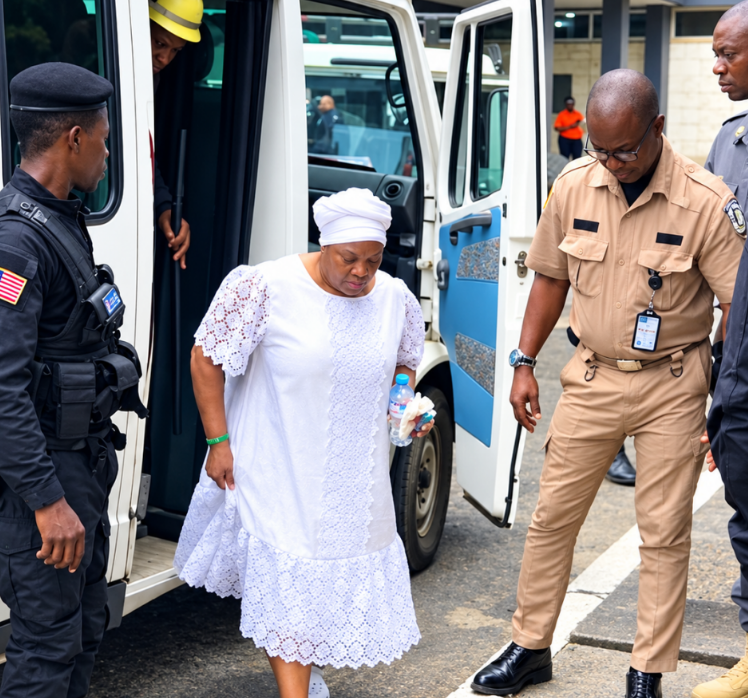
Monrovia – The criminal case against former Vice President Jewel Howard-Taylor has taken another major turn, with her lawyers abandoning a preliminary examination of the evidence after the court declined to grant the defense access to materials it said were necessary to meaningfully challenge the State’s case.
The decision, taken Monday at the Monrovia City Court, clears the way for prosecutors to pursue the next stage of the proceedings, including a possible grand jury indictment.
Magistrate L. Ben Barco granted the defense request to withdraw the preliminary examination and instructed the Clerk of Court to communicate the development to the appropriate criminal court.
But the decision has also opened a new legal and political question: why would Taylor’s lawyers abandon a proceeding they had initially requested to test the State’s evidence?
The answer, according to a statement issued Monday by Taylor’s family and legal support team, is that the defense no longer wanted the preliminary stage to proceed without access to the evidence it considered necessary to challenge the prosecution.
The defense maintains that Taylor has never been served with a formal indictment setting out the specific facts and allegations against her and says its original request for a preliminary examination was intended to scrutinize the evidence used to justify what it described as her “unprecedented arrest and incarceration.”
The legal team said the prosecution objected to the defense request for disclosure and that the court sustained the objection.
“Rather than allow the preliminary stage to become a platform for unproven theories without the safeguard of full discovery,” the family and legal team said, “we have chosen to proceed directly to trial, where pretrial discovery is guaranteed.”
The statement also sought to draw a sharp distinction between the Government’s criminal complaint and an indictment.
“As of this statement, Madam Howard-Taylor has not been indicted by a grand jury,” the statement said, stressing that a complaint is not an indictment and that an indictment, if returned, would not amount to a conviction.
That distinction is at the center of the defense’s public response to the case.
Taylor’s lawyers say the former Vice President remains innocent and accuse government officials and some media reports of creating the impression that she has already been indicted or found guilty.
The Government, meanwhile, has accused Taylor of involvement in an alleged transnational narcotics network and related financial crimes.
The allegations include controlled-drug offenses, illicit trafficking, criminal facilitation, criminal solicitation, criminal conspiracy, money laundering and aiding the consummation of crime. Taylor has denied the allegations.
Three Weeks of Legal Drama
The case has unfolded rapidly since Taylor was stopped at Roberts International Airport on August 19, while preparing to leave Liberia.
Her detention triggered an extraordinary sequence of events involving police custody, medical concerns, court proceedings, imprisonment, compassionate release and a contentious preliminary examination.
Following her detention, Taylor was taken to Liberia National Police headquarters for questioning and investigative procedures. The following day, August 20, concerns over her health became a major issue.
FrontPageAfrica observed medical personnel being taken into the LNP withholding facility as reports emerged that Taylor was experiencing dangerously high blood pressure.
She was subsequently taken for medical treatment after reportedly becoming ill while in police custody. Her lawyers later relied on her medical condition in seeking relief from continued detention, arguing that she required continued medical attention.
From Police Custody To South Beach
Despite the health concerns, Taylor was eventually brought before the Monrovia City Court.
On August 25, the court rejected her lawyers’ request to allow her to remain at a medical facility and ordered her committed to the Monrovia Central Prison, commonly known as South Beach.
The decision placed the former Vice President behind bars while her lawyers continued challenging her detention and raising concerns about her health.
A major shift came on September 4, when Criminal Court “C” Judge Ousman F. Feika granted Taylor compassionate release on medical grounds. The release came with conditions, including the surrender of her travel documents and restrictions concerning visitors and her movement.
The order, however, did not end the criminal case. Taylor was released from custodial detention to receive medical care while the prosecution continued pursuing its allegations.
Preliminary Examination Battle
The preliminary examination became the next major battleground. Taylor’s lawyers had invoked Liberia’s Criminal Procedure Law to seek an examination of the evidence being relied upon by the State.
The purpose of such a proceeding was to test whether the prosecution had established sufficient probable cause for the case to proceed. When the proceedings began on September 4, however, the defense sought access to evidence it said was necessary to prepare for the examination.
The court rejected that request.
The ruling became important, because the defense had wanted to scrutinize the State’s evidence and question prosecution witnesses in a proceeding it viewed as an important safeguard against an unsupported criminal case.
The prosecution subsequently presented Liberia National Police Crimes Services Commissioner Raphael Wilson as its first witness. Wilson testified about an alleged narcotics operation and claimed Taylor had been approached over a proposed protection arrangement.
His testimony also touched on alleged meetings involving Liberians and foreign nationals in Dubai and Liberia, as well as an alleged political plot involving the administration of former President George Manneh Weah. Those allegations remain contested and have not been established as facts by a court.
The Disputed Audio Recording
The proceedings took another contentious turn when prosecutors introduced an audio recording through Wilson. The recording quickly became one of the most disputed pieces of evidence in the preliminary proceedings. Taylor’s defense objected to its admission and challenged the State’s reliance on the recording as it attempted to establish its case.
The dispute raises questions about the evidentiary foundation for recorded conversations, including what prosecutors must establish concerning authenticity, relevance and admissibility before such material can be relied upon in criminal proceedings. But the recording was never tested to a conclusion at the preliminary stage.
Instead, the defense has now withdrawn from the proceeding altogether.
Why Walk Away?
The defense’s decision appears to have been driven less by an abandonment of its challenge to the allegations than by a disagreement over the procedural environment in which that challenge would take place.
The family and legal team say the defense sought the preliminary examination precisely because Taylor had not received a formal indictment detailing the specific allegations against her.
But after the court denied access to evidence the defense considered necessary, continuing the examination could have left lawyers challenging the State’s witnesses without what they regarded as adequate disclosure. The defense has therefore chosen a different route.
Rather than continue the preliminary examination, it says it will proceed directly toward trial, where it expects broader pretrial discovery protections.
That strategy carries an important consequence: the defense gives up the opportunity to continue contesting probable cause at the preliminary-examination stage, while the prosecution gains a clearer path toward seeking a grand jury indictment.
The move does not mean Taylor has been indicted, it does not mean the allegations have been proven and it does not amount to an admission of guilt.
Defense’s Warning
In its statement, Taylor’s family and legal support team appealed to the Government, public officials, the media, civil society, religious leaders and human-rights advocates to maintain what it called the principles of due process.
The family specifically urged the Government to distinguish between allegations, an indictment and a conviction.
It also called on public officials to refrain from what it described as prejudicial pronouncements while the matter remains before the courts.
The defense further urged the media to verify the procedural status of the case rather than present allegations as established facts.
“Madam Howard-Taylor asks for no special treatment,” the statement said, “only the constitutional protections owed to every Liberian.”
The statement concluded with the family and legal team expressing confidence that a fair hearing on the full record would vindicate the former Vice President.
Tear Gas Adds To Courtroom Drama
Monday’s legal development unfolded against the backdrop of another unusual incident at the Monrovia City Court.
As police officers stood in formation awaiting Taylor’s expected arrival, one Liberia National Police officer discharged a canister of tear gas inside the court’s compound.
The incident briefly caused fear and confusion among journalists, lawyers, security personnel and members of the public.
Liberian journalist Saah Augustine Mbayoh was nearly struck by the tear gas, while a FrontPageAfrica Judicial Reporter was also in the immediate vicinity.
The officer responsible had not been publicly identified as of Monday.
FrontPageAfrica observed that, shortly before the incident, the officer had dropped his baton and face shield twice while standing in the police formation.
It remains unclear whether he was experiencing a medical problem, disorientation or another difficulty.
The LNP had not publicly explained the circumstances surrounding the discharge as of Monday.
There is also no indication that the tear-gas incident was connected to Taylor or the criminal allegations against her.
What Happens Next?
The immediate consequence of the defense withdrawal is that the preliminary examination will no longer serve as the forum for testing the State’s evidence. The matter can now proceed toward the indictment stage. But an indictment is not automatic. The prosecution must still pursue the applicable legal process, and any grand jury action would determine whether Taylor is formally indicted.
If an indictment is returned, the case would then move deeper into the criminal court process, where the prosecution would have to prove its allegations beyond the applicable legal standards at trial.
For Taylor, the case has already produced three weeks of extraordinary legal turbulence, an airport arrest, police detention, a reported health crisis, medical treatment, imprisonment at South Beach, compassionate release and a preliminary examination that ended almost as quickly as it began.
For the prosecution, Monday’s withdrawal removes the immediate preliminary-examination hurdle.
For the defense, it represents a strategic decision to bypass a proceeding it says became unfairly constrained by the denial of access to evidence and instead confront the allegations at trial, where it expects fuller discovery rights.
The disputed audio recording, the alleged financial transactions, the narcotics allegations and the Government’s claims concerning Taylor’s alleged connections to an international network are likely to remain central to the case.
But for now, Jewel Howard-Taylor has not been convicted, and according to her legal team, she had not been indicted by a grand jury as of September 7.
The next major test will be whether the Government obtains a formal indictment and, if it does, how prosecutors and the defense ultimately litigate the evidence before a criminal court.
See more Liberia News Network stories in Google Search by adding LNN as one of your Preferred Sources.
★ Add LNN as a Preferred Source