
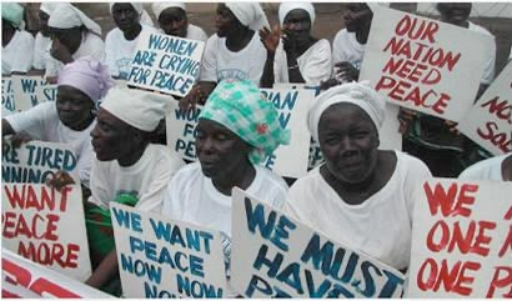
Monrovia – Women from across Liberia will gather Wednesday for a three-day fast and prayer to press for the establishment of a War and Economic Crimes Court and a National Anti-Corruption Court, as efforts to create the long-promised tribunals remain stalled at the Legislature.
The program runs from Wednesday, November 4 to Friday, November 6, 2026, at the Fish Market and Women Prayer Grounds, under the theme “United in Prayer for Peace, Unity, Healing, and Transformation of Liberia through the Establishment of the War and Economic Crimes Court and the Anti-Corruption Court of Liberia.”
The site carries symbolic weight. It was at the fish market on Tubman Boulevard that the Women of Liberia Mass Action for Peace staged daily sit-ins in 2003, in white T-shirts, praying and pressing for an end to the war — a campaign widely credited with helping push warring factions to the peace talks that ended the conflict. The Liberia Women Mass Action for Peace is among the organizers of this week’s gathering.
In a concept note dated October 26, 2026, organizers say they are seeking God’s intervention for the creation of the two courts and for the National Legislature to act on the proposed bills. The program also aims to promote reconciliation through truth-telling, peace and co-existence, and to encourage women to play an active role in peacebuilding.
The three days will feature fasting and prayer sessions, praise and worship, and spiritual reflections, with prayers for the President and the Legislature, for victims, for peace, and for transitional justice actors.
A war without a reckoning
Liberia’s two civil wars, from 1989 to 1996 and 1999 to 2003, killed an estimated 250,000 people and displaced hundreds of thousands more. The conflict was marked by massacres, the widespread use of child soldiers, mass rape and the plunder of the country’s natural resources.
The Truth and Reconciliation Commission, created under the 2003 Comprehensive Peace Agreement, concluded its work in 2009 and recommended an extraordinary criminal court to try those most responsible. For more than a decade, successive governments did not act on that recommendation.
No one has been tried in Liberia for war-era atrocities. Instead, accountability has come from abroad. Former President Charles Taylor is serving a 50-year sentence for crimes committed in neighboring Sierra
Leone, not Liberia. Other former fighters have been convicted in courts in the United States and Europe, among them Mohammed Jabateh, the first of five former warlords convicted over war related crimes in courts in the United States and Europe, whose appeals are now exhausted.
Promises and delays
Momentum built after President Joseph Boakai took office. Senator Amara Konneh has reminded colleagues of the Senate’s overwhelming vote in April 2024 to establish a War and Economic Crimes Court for Liberia, and on May 2, 2024, Boakai signed Executive Order No. 131 establishing the Office of the War and Economic Crimes Court, headed by Cllr. Jallah A. Barbu.
The office’s mandate was later expanded to include an anti-corruption court, a move some advocates opposed. Justice activists condemned the decision, saying it would distract the office from long overdue wartime justice. Under the office’s roadmap, the National Anti-Corruption Court was to begin full operations in November 2026, and the War and Economic Crimes Court in 2027.
The process has been marked by rival bills and internal friction. A coalition led by the Independent National Commission on Human Rights submitted its own war crimes bill, as advocates moved to block an earlier version co-sponsored by Senator Joseph Jallah and Senate Pro Tempore Nyonblee Karnga-Lawrence. In April, Barbu’s office accused senior government officials of deliberately blocking progress, naming the justice minister, the president’s legal advisor and the national security advisor as key obstacles.
President Boakai submitted the bill for the War and Economic Crimes Court to the Legislature in May 2026, along with a separate bill for a National Anti-Corruption Court. Neither court can be established until lawmakers pass the legislation. In June, the Senate Judiciary Committee presented a seven-month legislative roadmap for passage of the bills.
But last week, Barbu said lawmakers will not take up the war crimes court bill until January 2027, and the proposed US$1.2 billion national budget sets aside no money for the court. He said his office learned through the Office of the Speaker that lawmakers were prioritizing other national matters, and warned the delay could undermine efforts to set up the court. His office’s US$2 million annual appropriation covers preparations, not the court itself.
With November now here and no law passed, the anti-corruption court’s target date has effectively slipped. Advocates have warned that further delay could see the war crimes court run into the political cloud of the next election in 2029.
Organizers
The program is being organized by a 21-member Fast and Prayer Organizing Committee, including the Office for the Establishment of the War and Economic Crimes Court for Liberia (OWECC-L), the Liberia Women Mass Action for Peace, WIPNET, WONGOSOL, Liberia Muslim Women for Peace, the National Council of Churches, the Muslim Council of Liberia, AFELL, the Liberia Massacre Survivors Association (LIMASA), the Press Union of Liberia, the Federation of Liberian Youth and NOPSWECO, among others.
Organizers expect women from churches, mosques, communities, civil society and youth groups to take part. They hope the gathering will produce a collective commitment to the courts, greater awareness of women’s role in promoting the bills, and stronger cooperation among women in the push for justice.
“Through collective prayers and action, the women of Liberia can continue as agent of hope and justice to reduce impunity,” the concept note states.
See more Liberia News Network stories in Google Search by adding LNN as one of your Preferred Sources.
★ Add LNN as a Preferred Source