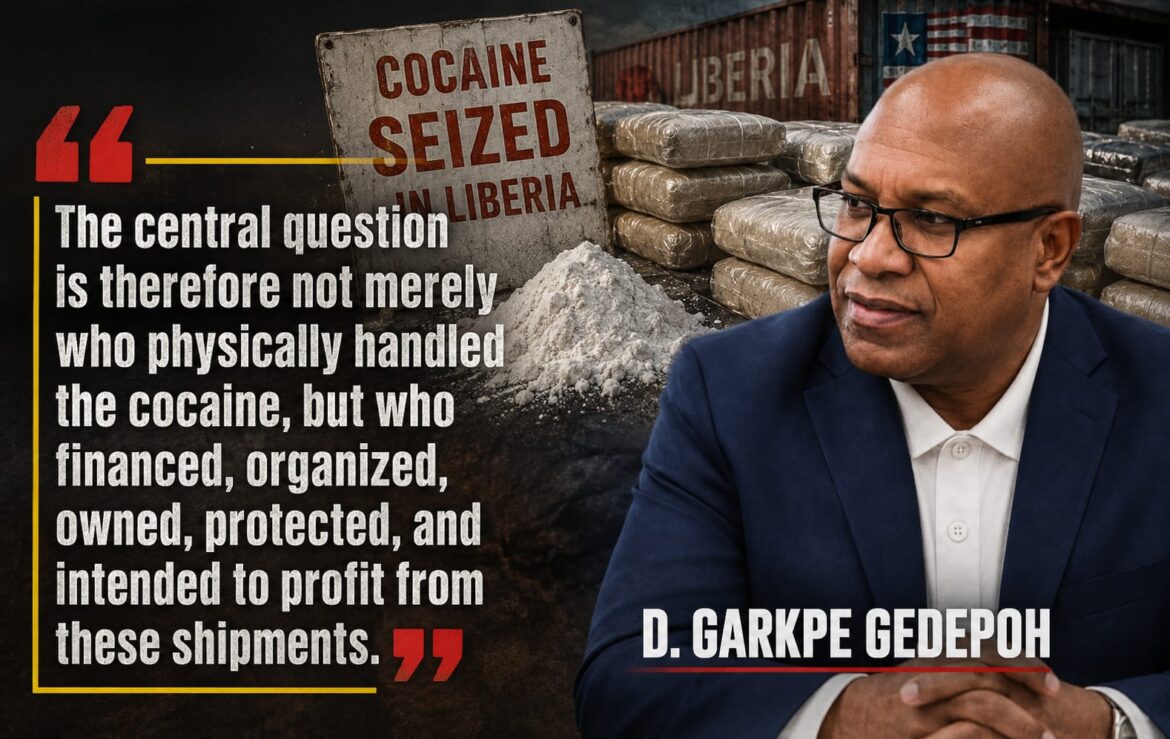
MONROVIA, LIBERIA – Liberia’s record-breaking cocaine seizures have triggered fresh questions about the vulnerability of the country’s security and law-enforcement institutions, with the Panoramic Justice Group urging a deeper investigation into whether transnational drug organizations may have established connections within parts of Liberia’s security apparatus.
The Washington-based organization raised the concern in an August 24 letter to U.S. Congressman Christopher H. Smith, arguing that Liberia’s cocaine problem cannot be adequately understood by focusing only on people caught transporting or possessing narcotics.
The group’s concerns come after two major cocaine seizures in Liberia this year that authorities valued at approximately US$336 million combined.
At Roberts International Airport, authorities reportedly intercepted approximately 237.6 kilograms of cocaine, valued at more than US$19 million.
Approximately six weeks later, law-enforcement authorities recovered another 3,971 kilograms, nearly four metric tons, in Duazon, Margibi County, with an estimated value of approximately US$317 million.
The scale of the shipments has prompted the organization to question how international traffickers could allegedly move such quantities of cocaine through or into Liberia without sophisticated logistical arrangements.
The Panoramic Justice Group pointed to publicly reported allegations and government actions involving individuals associated with several Liberian security and law-enforcement institutions.
According to the organization, personnel reportedly implicated, charged, dismissed, suspended or investigated in connection with drug-related allegations have included individuals associated with the Liberia National Police, National Security Agency, Liberia Drug Enforcement Agency, Roberts International Airport, criminal investigations and intelligence, INTERPOL and highway patrol.
The organization stressed that allegations against individuals do not constitute proof of criminal wrongdoing.
But it said the accumulation of allegations involving personnel connected to different security institutions raises a much larger institutional question: Could elements of Liberia’s security architecture have been compromised or exploited by transnational narcotics organizations?
The group said that question requires an independent investigation rather than assumptions or political conclusions.
It called for investigators to determine whether drug networks have developed relationships with officials or personnel capable of providing access, information, protection or logistical assistance.
The Panoramic Justice Group also highlighted the reported Royesville investigation, in which prosecutors have alleged that fishing operations and maritime routes were used to bring cocaine ashore from the Atlantic.
The allegation, according to the group, deserves closer examination because Liberia possesses an extensive coastline and maritime sector that could potentially be exploited by international trafficking organizations.
The organization said investigators should examine whether trafficking networks are exploiting Liberia’s coastline, fishing industry, ports, airports and security corridors to move narcotics.
Such an investigation, it argued, should not stop when a shipment is seized.
Instead, investigators should seek to establish where the drugs originated, who financed their movement, who controlled the shipment, who owned the businesses allegedly connected to the operation and who expected to receive the proceeds.
The Panoramic Justice Group also referenced earlier public allegations by former Liberia Drug Enforcement Agency Deputy Director General for Administration Gwee K. Porkpah, who had alleged the involvement of senior government officials in Liberia’s illicit drug trade.
Porkpah and other senior LDEA officials were subsequently dismissed for stated administrative reasons.
The organization said the circumstances surrounding those earlier allegations deserve renewed scrutiny.
“Whether his allegations were true or false, Congress should ask whether they were subjected to a credible independent investigation and what findings resulted,” the group said.
The Panoramic Justice Group called for a comprehensive integrity review of Liberia’s security sector.
It specifically identified the police, narcotics enforcement, intelligence, immigration, customs, airport and maritime institutions as areas requiring examination.
The organization said the objective should not be to criminalize entire institutions but to determine whether individual weaknesses, corruption vulnerabilities or compromised personnel could be exploited by international drug networks.
It also called for an independent Liberian citizens commission to strengthen public confidence in the investigation.
At the center of the organization’s argument is the belief that Liberia’s investigation must move beyond the people physically caught with cocaine.
It urged authorities to investigate the financiers, organizers, beneficial owners, money launderers, security facilitators and other individuals who may stand behind the shipments.
The organization said the investigation should trace the drugs, money, businesses, communications and security connections associated with the trafficking operations.
It also urged U.S. authorities to conduct financial investigations and asset tracing where evidence establishes a connection to the United States.
The group said lawful measures, including targeted sanctions or visa restrictions, could also be considered where applicable legal requirements are met.
Despite its call for extensive scrutiny, the Panoramic Justice Group emphasized that it was not asking U.S. lawmakers or investigators to presume guilt.
“We are not asking Congress to presume that allegations are true or that any individual is guilty,” the organization said.
See more Liberia News Network stories in Google Search by adding LNN as one of your Preferred Sources.
★ Add LNN as a Preferred Source