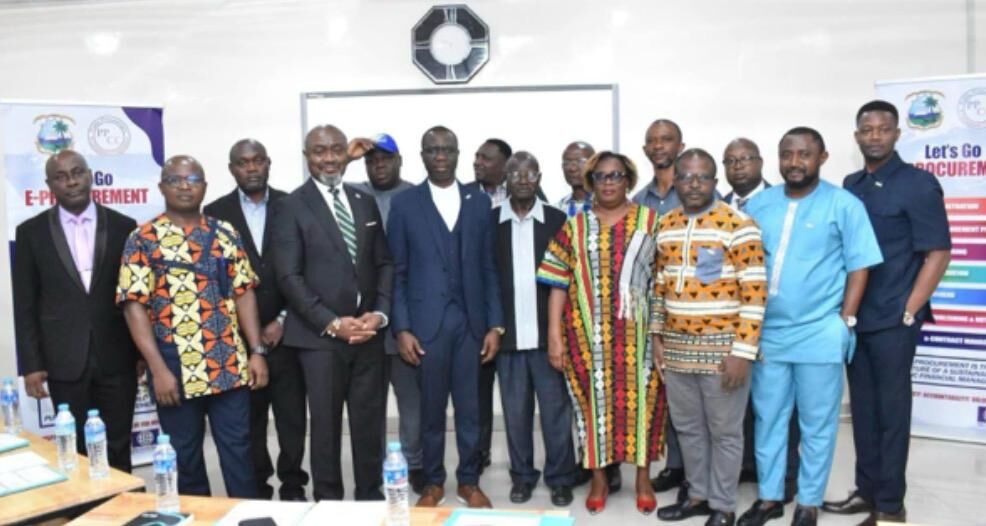
Liberia’s Public Procurement and Concessions Commission (PPCC) and Sierra Leone’s National Public Procurement Authority (NPPA) are strengthening regional cooperation through a two-day study tour focused on Liberia’s Electronic Government Procurement (e-GP) system, one of the most advanced in West Africa.
The visit, running August 6–7 at PPCC headquarters in Monrovia, brings together senior officials from both institutions under the theme “Learning from Liberia’s Electronic Government Procurement (e-GP) System Implementation.” It positions Liberia as a regional model for digital procurement while giving Sierra Leone practical insight as it builds out its own system.
Liberia rolled out its e-GP platform in phases to allow institutions time to adjust and the system to be refined before wider deployment. A pilot phase onboarded six government institutions, allowing the PPCC to test workflows, confirm the system worked as intended, and identify fixes ahead of a national rollout. President Joseph Nyuma Boakai Sr. formally launched the national e-GP system in February 2025, a moment PPCC Executive Director Bodger Scott Johnson called a defining milestone for government transparency and digital reform.
Johnson said the effort has depended as much on people as on technology. The Commission has run capacity-building programs for procurement officers, financial managers, auditors, IT staff, and approving authorities, alongside nationwide outreach to help businesses register, bid, and manage contracts electronically. He credited the African Development Bank and World Bank for financial and technical backing that supported the modernization drive.
Opening the program, Johnson framed the exchange as more than technical training. “It’s a demonstration of regional solidarity and African-led solutions to African development challenges,” he said, adding that the two institutions share a commitment to transparent, accountable procurement as a pillar of public financial management.
NPPA Chief Executive Officer Fodie Konneh, who leads the visiting delegation, said Sierra Leone selected Liberia specifically because it has a working, deployed system to learn from. “You have been able to deploy a system. You have been able to learn from the challenges, and we want to understand those experiences so that we can apply the lessons as we continue developing our own system,” he said.
Konneh described sound public financial management as the foundation of national development and framed the partnership as an extension of broader regional obligations. “As neighbors, we have the responsibility to ensure that no one leaves the other behind,” he said. “If one country progresses, we should progress together.” He linked the visit to wider cooperation under ECOWAS, the Mano River Union, and continental procurement initiatives.
The first day covered Liberia’s reform trajectory, including presentations on procurement modernization, live demonstrations of the e-GP platform, and a walkthrough of supplier registration and validation. The delegation also met with Liberia’s Joint Legislative Committee on Public Accounts and Audit to examine how lawmakers oversee public procurement.
On the second day, delegates are scheduled to visit the Liberia Revenue Authority and the National Social Security and Welfare Corporation to see the e-GP system in use within procuring entities, followed by courtesy calls on the Minister of Finance and Development Planning and the Minister of State for Presidential Affairs and Chief of Staff.
The exchange reflects a broader trend of peer learning among African procurement institutions, as governments across the continent digitize public spending to improve transparency and efficiency. For Sierra Leone, the visit offers a template that could speed up its own digital procurement rollout. For Liberia, it is a marker of the credibility its reforms have gained among its neighbors.
Officials from both countries said they expect the partnership to continue, with the shared goal of stronger governance and more accountable management of public resources across the region.
See more Liberia News Network stories in Google Search by adding LNN as one of your Preferred Sources.
★ Add LNN as a Preferred Source