
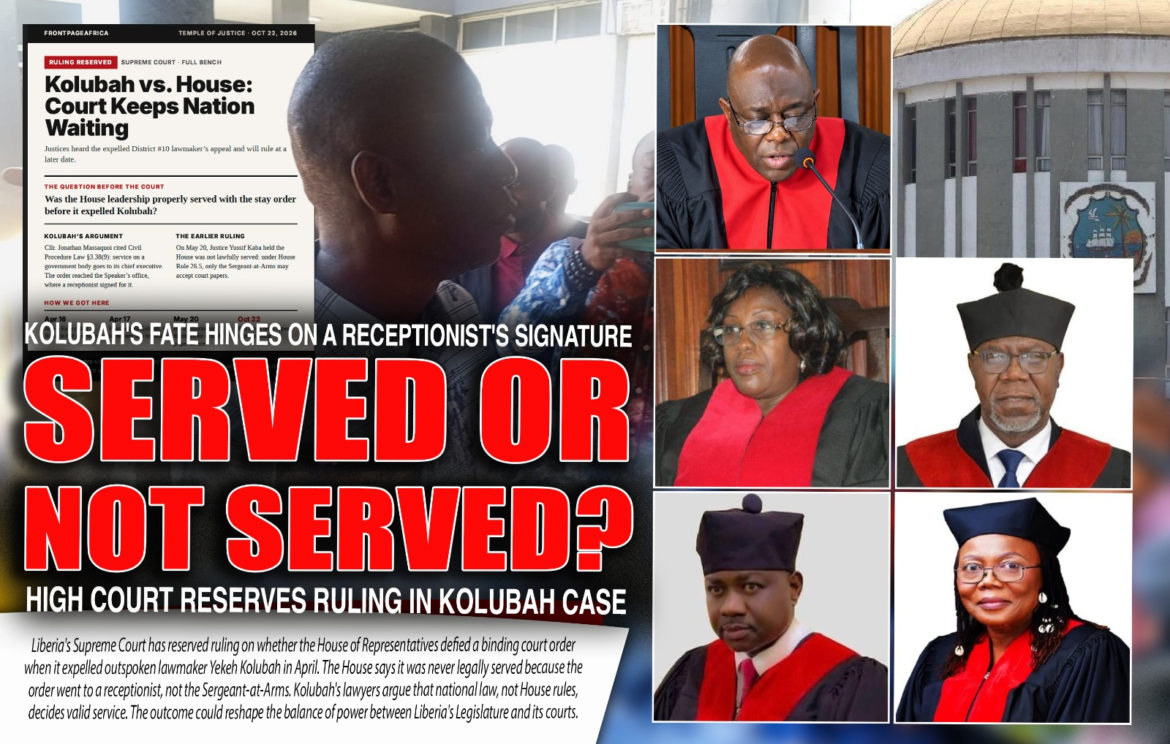
MONROVIA, Liberia — Liberia’s Supreme Court on Thursday reserved judgment in a case that could determine whether the country’s House of Representatives defied a court order when it expelled one of its most outspoken members, Yekeh Kolubah, in April.
\n
By Victoria G. Wesseh
\n
The case turns on a narrow but consequential question: was the House leadership legally served with a Supreme Court order instructing it to halt proceedings against Kolubah before it voted to remove him? If it was, the vote may have been taken in breach of a binding judicial directive. If not, the House may have been free to act.
\n
How the Dispute Began
\n
Kolubah represented District 10 of Montserrado County, which includes the capital, Monrovia, and was long one of the Legislature’s most combative voices. The disciplinary case against him followed a controversial statement he made about the Makona River boundary dispute, one that many considered provocative, even offensive.
\n
Kolubah was formally notified on April 9, 2026, to appear before the House Committee on Rules, Order and Administration on April 13. He and his lawyers walked out of a later committee hearing after it refused to grant them an additional five days and access to evidence.
\n
His lawyers then asked the Supreme Court for a writ of prohibition, an order used to stop a body from exceeding its authority. Associate Justice Yussif D. Kaba granted the petition on April 16, summoning House leaders to a conference on April 20 and ordering them to stay all further proceedings pending its outcome. The directive was addressed to Speaker Richard Nagbe Koon, Deputy Speaker Thomas Fallah, the House Chief Clerk, the Sergeant-at-Arms and everyone acting under their authority.
\n
The next day, the House went ahead. Kolubah was expelled by the full House on Friday, April 17, after a resolution was signed by 49 of the chamber’s 73 members, the two-thirds majority the Constitution requires. The resolution said he was removed for acts and utterances deemed unpatriotic and detrimental to the country’s sovereignty and territorial integrity.
\n
The Service Dispute
\n
The House says it was never properly served. Its lawyers cited Rule 26.5 of the House rules, which names the Sergeant-at-Arms as the only officer authorised to receive court orders on behalf of the House. Court records show the Supreme Court Marshal instead served the documents on a receptionist and a computer operator attached to the offices of the Speaker and the Chief Clerk.
\n
That argument has already succeeded once. In May 2026, Justice Kaba dismissed Kolubah’s follow-up complaint, known as a bill of information, for improper service, reportedly finding that the House had not been properly served with the writ and stay order. Kolubah appealed to the full five-member bench, which heard arguments on Thursday.
\n
Jonathan Massaquoi, who leads Kolubah’s legal team, told the justices that the validity of service should be judged by Liberia’s Civil Procedure Law, not by the House’s internal rules for handling correspondence.
\n
He cited Section 3.38(9), which states: “Personal service upon a subdivision of the government subject to suit or upon a municipal corporation shall be made by reading and delivering the summons to the chief executive thereof.”
\n
On that basis, the petitioners argued that delivering the order to the office of the Speaker, the House’s presiding officer, was sufficient. A court officer identified as Joshua B. delivered the document there, they said, and a receptionist acknowledged receipt and signed for a copy.
\n
Whether the provision covers the House at all is an open question. It refers specifically to “a subdivision of the government subject to suit” or “a municipal corporation,” and the Court must decide whether a branch of the national Legislature falls into either category.
\n
Did the House Defy the Court?
\n
The justices must weigh the wording of the order, the Marshal’s report of service, the receptionist’s acknowledgment and the legal standing of the office that received it.
\n
Even a clear answer on service may not end the dispute. If the Court upholds the dismissal, it will not necessarily have examined or endorsed the disciplinary proceedings; and a win for Kolubah on service would not automatically prove the expulsion unconstitutional.
\n
Other questions hang over the vote itself. A Bomi County lawmaker has denied backing the expulsion, raising questions about whether the House reached the legally required majority. A media adviser to Speaker Koon also told FrontPage Africa the expulsion took place on April 22, not April 17, before abruptly ending the conversation. A later date could matter, because it would fall after the scheduled court conference.
\n
The case has become a test of the balance between Liberia’s branches of government. Critics have likened it to the recent standoff over former Speaker Fonati Koffa, which tested the limits of legislative authority. Prominent lawyer Tiawan Saye Gongloe has said the Court’s options include voiding the expulsion, holding House leaders in contempt, or ordering Kolubah’s reinstatement pending a hearing that satisfies due process.
\n
The Court did not say when it would rule.
See more Liberia News Network stories in Google Search by adding LNN as one of your Preferred Sources.
★ Add LNN as a Preferred Source