By Socrates Smythe Saywon | Smart News Liberia
MONROVIA, LIBERIA — Liberia is on the verge of crossing the US$1 billion mark in domestic revenue collection for the first time in the country’s 179-year history, according to Liberia Revenue Authority Commissioner General James Dorbor Jallah, who has challenged the government, lawmakers, businesses and citizens to turn the milestone into a foundation for greater national self-reliance.
Jallah made the declaration Wednesday, August 19, 2026, at the Ellen Johnson Sirleaf Ministerial Complex in Congo Town, Monrovia, during the launch of the Liberia Revenue Authority Corporate Strategic Plan 2025–2029, held under the theme “Freedom Declared, Freedom Financed.”
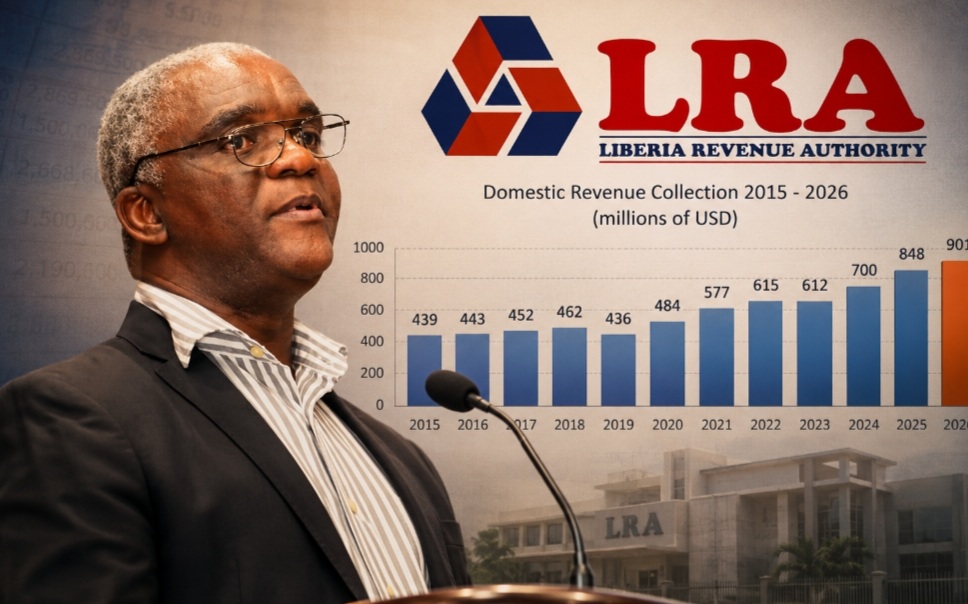
The Commissioner General said the country had reached US$904.7 million in domestic revenue collections as of August 18, with more than four months remaining in the fiscal year.
He said the figure places Liberia within weeks of achieving a historic revenue milestone that, if reached, would represent a significant shift in the country’s capacity to finance its own development.
“In 2014, this Authority collected US$464 million in domestic revenue for the Republic of Liberia,” Jallah said. “Ten years later, in 2024, we collected US$699 million.”
He added that in fiscal year 2025, the LRA collected US$848 million, exceeding its target of US$804.6 million by approximately US$44 million.
The latest performance, according to Jallah, reflects a broader improvement in Liberia’s domestic resource mobilization.
He said the country’s domestic revenue-to-GDP ratio increased from 13.4 percent in 2023 to 15.9 percent in 2025 and is projected to reach 16.3 percent in 2026.
Jallah argued that the significance of the revenue growth should not be measured simply by the size of the collection but by what the money enables the government to accomplish.
“One billion dollars is not a trophy. It is a toolbox,” he said, stressing that the real value of increased domestic revenue lies in its ability to finance schools, clinics, roads and other national priorities without excessive dependence on external financing.
The LRA chief also rejected the notion that the projected billion-dollar collection represents an achievement of the revenue authority alone.
He credited taxpayers, customs officers, revenue officials, businesses, importers and ordinary Liberians for contributing to the growth.
According to Jallah, the revenue figure represents millions of individual transactions and compliance decisions made across the country.
He cited market women, small importers, payroll officers, customs personnel, revenue officers in rural counties, concessionaires and small businesses as contributors to the national revenue effort.
“When we cross that threshold, and we shall cross it, let no one say the Liberia Revenue Authority crossed it. Liberia crossed it,” Jallah declared.
The Commissioner General said the historic revenue performance makes the launch of the five-year strategic plan particularly important because success should not become an excuse for complacency.
He said the Corporate Strategic Plan 2025–2029 is designed to build on recent gains while transforming the LRA into a more modern, digital, efficient and accountable revenue institution.
Jallah said the plan seeks to move the LRA away from traditional manual processes toward integrated data systems, intelligence-led administration and greater automation.
He also emphasized the need to make compliance easier for taxpayers and businesses while improving the government’s ability to collect revenue.
“For the taxpayer: simpler, faster, more transparent,” he said. “For business: better service, faster trade, greater predictability. For Government: sustainable revenue and real fiscal space.”
At the center of the strategy, Jallah said, is the understanding that revenue collection is not merely an administrative function but an essential instrument of national sovereignty.
He described domestic resource mobilization as the financial foundation of Liberia’s ability to determine and finance its own development priorities.
Jallah also announced what he described as a new covenant with taxpayers, acknowledging that the relationship between citizens and tax collectors has historically been characterized by mutual suspicion.
He pledged that the LRA would make compliance easier than evasion by simplifying processes, publishing rulings and procedures, improving transparency and protecting taxpayer information.
In return, he called on taxpayers to accurately declare their income, transactions and imports.
The Commissioner General warned that tax evasion ultimately shifts the burden onto compliant citizens and businesses.
“The tax that is never paid is still paid,” Jallah said. “It is simply paid by somebody else.”
He argued that unpaid taxes affect the ability of the government to finance public services, adding that every dollar lost through noncompliance represents resources that could otherwise support national development.
Jallah also disclosed that the LRA has dismissed more than 40 employees found culpable of fraudulent and unethical practices.
He said the disciplinary measures were necessary to strengthen institutional integrity and demonstrate that increased revenue collection must be accompanied by internal accountability.
“Integrity is what you do when the file is closed,” he said.
Despite the LRA’s revenue gains, Jallah acknowledged that significant operational challenges remain.
He disclosed that the ASYCUDA customs system has been rolled out to 11 of the LRA’s 17 Customs Business Offices, leaving six yet to be covered.
The Authority has also introduced shortwave radio systems at five customs offices to improve communication in areas without reliable GSM coverage.
On the tax side, Jallah said the Liberia Integrated Tax Administration System (LITAS) has been deployed at five of the Authority’s 18 Tax Business Offices, leaving 13 offices still to be brought onto the system.
The LRA has paired rollout locations with 10-KVA solar power systems and Starlink connectivity to improve electricity and internet access.
Jallah, however, said these developments should not be mistaken for completed reforms.
“That is not a record. That is a to-do list,” he said.
He also identified delays at the Freeport of Monrovia as a major challenge to Liberia’s trade environment.
According to Jallah, it currently takes approximately 12 days and 19 hours to move a container through the port.
The LRA has committed to reducing that time to three days, which he described not as an aspiration but as an obligation.
The Commissioner General further raised concerns about the condition of LRA offices in several parts of the country.
He described some rural facilities as “deplorable,” pointing specifically to challenges faced by revenue personnel in places such as Zwedru, Harper and Yekepa.
Jallah said officers working in rural areas should have access to the same basic tools and working conditions as their counterparts in Monrovia.
The strategic plan, he said, includes commitments to modernize rural tax and customs offices and construct a modern LRA headquarters.
“You cannot ask people to build a modern state from a leaking room,” he said.
A major policy proposal accompanying the LRA’s transformation agenda is a request for greater financial autonomy.
Jallah disclosed that the Authority is working with the Ministry of Finance and Development Planning on an amendment to the LRA Act that would provide the institution with a more predictable financing mechanism.
The proposal calls for five percent of tax revenue collected to be allocated to the operations and modernization of the LRA and the broader revenue administration system.
Jallah argued that the proposal should not be viewed simply as a request for a larger institutional budget but as an investment in the agency responsible for generating resources used by government.
He nevertheless acknowledged that greater financial autonomy must come with stronger accountability.
“We are not asking to be trusted. We are asking to be measured,” he said, calling for the LRA’s performance to be judged against clear targets and publicly reported results.
Jallah also called on the National Legislature to support tax and revenue reforms, including legislation relating to value-added tax, amendments to the LRA Act and a simpler tax code.
He urged the Executive Branch and government ministries to carefully consider tax exemptions, warning that exemptions granted without adequate justification can shift the tax burden onto other taxpayers.
The Commissioner General appealed to large corporations and concessionaires to meet their tax obligations accurately, while encouraging small and medium-sized businesses to formalize their operations, register, file tax returns and issue receipts.
He said formalization should be viewed as an opportunity to access credit, contracts and business growth rather than as a punishment.
Jallah also addressed market women and petty traders, whom he described as the backbone of Liberia’s economy.
He promised that the LRA’s approach toward small businesses would emphasize simpler rules rather than excessive burdens.
To customs brokers and importers, he issued a direct appeal to declare the true value of goods, warning that the Authority is building systems capable of detecting inaccurate declarations.
He further called on county officials, traditional leaders and communities to recognize domestic revenue mobilization as a national responsibility rather than an issue confined to Monrovia.
Jallah also urged Liberia’s development partners to continue supporting the country’s institutional development while emphasizing that international assistance should ultimately help Liberia build the capacity to finance its own future.
“Aid is a bridge; it was never meant to be an address,” he said.
The Commissioner General described domestic resource mobilization as a national undertaking requiring cooperation between government, the private sector, taxpayers, civil society and ordinary citizens.
He urged Liberians at home and abroad to view tax compliance as a contribution to national development.
“Give it, and watch what she does with it,” he said, referring to the lawful revenue owed to the state.
Looking toward 2029, Jallah said the success of the strategic plan would not be determined by the existence of a document but by measurable improvements in the country’s revenue administration.
He said the ultimate questions would be whether the LRA made compliance easier, accelerated trade, improved its offices, earned taxpayers’ trust, addressed corruption within its ranks and generated the resources necessary to finance public services.
Above all, he said, the central test would be whether Liberia becomes more capable of financing herself by the end of the strategic-plan period than she is today.
“That is the standard,” Jallah said, accepting responsibility for delivering on behalf of the institution.
He ended his remarks with a broader appeal for national unity, invoking Liberia’s national anthem and its promise that “in union strong, success is sure.”
Jallah urged the LRA, government, private sector and citizens to work collectively toward strengthening Liberia’s fiscal independence.
“Let us cross the billion, and then let us forget it, and go and find the next one,” he said.
For the LRA Commissioner General, the projected US$1 billion milestone is therefore not intended to mark the end of Liberia’s revenue challenge, but the beginning of a more ambitious effort to build a state capable of financing its own development.
He framed the strategic plan as an attempt to complete what he described as an unfinished chapter in Liberia’s history: moving from political independence to greater financial self-reliance.
“They declared this nation free. We will make her self-supporting,” Jallah declared.
See more Liberia News Network stories in Google Search by adding LNN as one of your Preferred Sources.
★ Add LNN as a Preferred Source