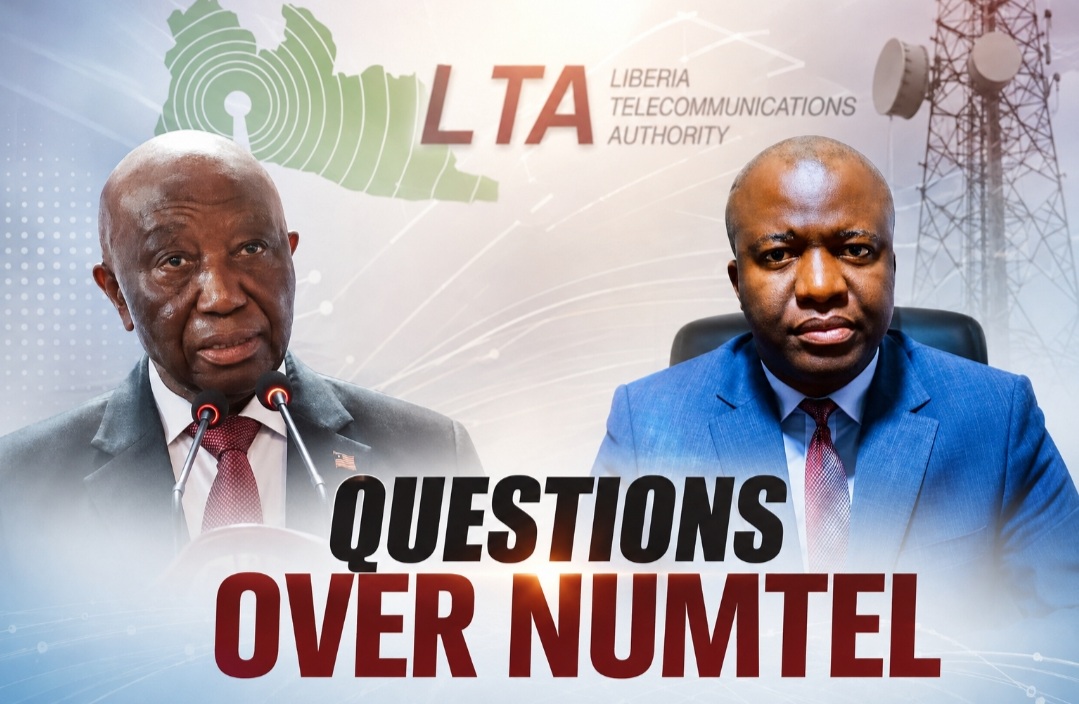
MONROVIA — What began as growing questions about the financial operations of Liberia’s telecommunications regulator is now emerging as a broader test of President Joseph Nyuma Boakai’s pledge to transparency and accountability, with the Liberia Telecommunications Authority (LTA) facing renewed scrutiny over telecom-traffic monitoring, revenues and the role of its Acting Chairperson, Clarence Massaquoi.
The controversy has reportedly reached the Executive Mansion, where Massaquoi was summoned to provide information about activities associated with the authority, according to sources familiar with the matter.
The sources said President Boakai expressed concern over the repeated appearance of the LTA in media reports involving questions about revenues and accountability and urged the LTA leadership to be transparent about its dealings.
Although details of the reported meeting have not been publicly released, the intervention underscores the extent to which the controversy has moved from civil society and media discussions into the highest levels of government.
At the center of the dispute is a relatively little-understood but financially significant area of telecommunications regulation: independent monitoring of telecom traffic and the revenues generated from that activity.
The Numtel Question
Questions surrounding Numtel have become an important part of the controversy. Previous reporting and public discussions have raised concerns about the arrangements surrounding telecom-traffic monitoring and the extent to which revenues associated with the monitoring system have been disclosed.
The issue is particularly sensitive because independent telecom-traffic monitoring is intended to provide the regulator with an independent mechanism for verifying the volume and value of telecommunications traffic reported by operators. Such systems can be used to compare information supplied by telecommunications companies against independently captured traffic data, thereby helping government determine whether the appropriate regulatory fees and other revenues are being declared.
Against that background, questions have been raised about the monitoring arrangements associated with the LTA, including the history of the GVG monitoring system, the condition of equipment used for monitoring, and claims that an important software license was withheld or was no longer available.
Those issues have fueled broader questions about whether Liberia is receiving the full regulatory and revenue benefits expected from an independent telecom-monitoring system.
Massaquoi Under Scrutiny
Massaquoi, who currently serves as Acting Chairperson of the LTA, has become a central figure in the controversy.
According to earlier accounts surrounding the issue, questions have been raised about his handling of information relating to monitoring revenues. Critics have sought greater disclosure of funds generated through telecom monitoring and clarification of how those funds are collected, accounted for and reported.
One of those raising concerns has reportedly been Alfred Togba, who petitioned the Liberia Anti-Corruption Commission (LACC) and the General Auditing Commission (GAC) over issues connected to the telecommunications monitoring arrangements.
Massaquoi, however, has reportedly maintained that he is accountable to President Boakai and enjoys the President’s confidence.
That position has generated additional debate over the relationship between the LTA leadership and the Executive Mansion, particularly because the authority operates under a statutory framework designed to provide regulatory independence.
The LTA commissioners occupy tenured positions and cannot simply be removed at the discretion of the President. Their removal requires established cause or other legally recognized grounds.
The TIA Legacy
The controversy also revives questions surrounding the Telecommunications Intelligence and Analysis (TIA) arrangement, which has a long and complicated history within Liberia’s telecommunications sector.
The TIA contract was reportedly signed in 2018 and subsequently converted into a concession arrangement in 2022. The agreement later became the subject of legal and legislative scrutiny.
In 2024, Justice officials reportedly considered the arrangement valid, while the Legislature favored renegotiation rather than outright cancellation.
The history is significant because the TIA arrangement sits within the broader debate over how Liberia monitors telecommunications traffic, protects public revenue and ensures that systems designed to benefit the state are properly administered.
From GVG to a Larger Accountability Question
The GVG monitoring arrangement has likewise attracted attention because of questions surrounding its effectiveness, equipment and software.
The concern is not merely technological.
At stake is whether Liberia possesses a reliable and independent mechanism capable of verifying telecom operators’ traffic and ensuring that revenues due to the government are properly identified and accounted for.
If the monitoring infrastructure is obsolete, inadequately maintained or operating without the necessary software licenses, questions naturally arise about the reliability of the information available to the regulator.
That, in turn, raises a much larger question: How can government effectively determine whether it is receiving all revenues due from one of the country’s most important and rapidly evolving economic sectors?
A Previous Chairman’s Acquittal
The controversy has also gained additional sensitivity following the recent court acquittal of the LTA’s former chairman, who had previously been suspended amid corruption allegations.
While the former chairman was ultimately acquitted, the episode has contributed to continuing public scrutiny of the independence, governance and accountability of Liberia’s telecommunications regulator.
For the Boakai administration, the timing could hardly be more politically sensitive.
The government has repeatedly emphasized transparency, accountability and responsible management of public resources. Yet the continuing questions surrounding the LTA have created an uncomfortable contradiction for an administration seeking to distinguish itself from past governments.
What Does the Public Need to Know?
The central issue now extends beyond personalities.
The public wants to know how telecom-monitoring revenues are generated, how much money is involved, who collects it, where it is deposited, how it is accounted for and what independent mechanisms exist to verify the figures reported by telecommunications operators.
It also raises questions about the arrangements involving Numtel, the historical GVG monitoring system and the TIA agreement—and whether these systems are functioning as originally intended.
For critics of the administration, the question is no longer simply whether the LTA has complied with its financial and regulatory obligations.
It is whether an institution operating under a government that has made accountability a central pillar of its agenda can continue to face unresolved questions about potentially significant public revenues without providing comprehensive answers.
For President Boakai, the LTA controversy therefore represents more than an administrative headache. It is becoming a test of whether his administration’s promise of transparency applies equally to powerful officials and independent statutory institutions.
Until the questions surrounding the LTA’s revenues, monitoring arrangements and related activities are fully addressed, the controversy risks becoming an avoidable political liability for an administration that came to power promising a higher standard of public accountability.
See more Liberia News Network stories in Google Search by adding LNN as one of your Preferred Sources.
★ Add LNN as a Preferred Source