MONROVIA – As Liberia intensifies its campaign against transnational drug trafficking, the national debate has increasingly expanded beyond law enforcement to include allegations involving public institutions and senior government officials. While authorities insist investigations must be driven by evidence rather than speculation, unverified claims circulating in public discourse have begun raising concerns about their potential impact on Liberia’s diplomatic standing and international credibility. Against that backdrop, Foreign Affairs Minister Sara Beysolow Nyanti has mounted the government’s strongest defense yet of the Ministry of Foreign Affairs, rejecting allegations linking diplomatic missions and diplomatic cargo to narcotics trafficking. As THE ANALYST’s George C. Flomo reports, she argues that protecting Liberia’s global reputation is inseparable from ensuring credible, evidence-based investigations into organized crime.
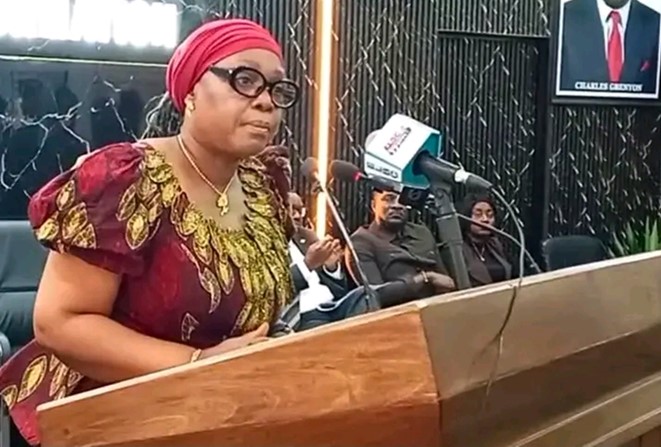
Minister of Foreign Affairs and Dean of the Cabinet, H.E. Sara Beysolow Nyanti, has categorically rejected allegations linking Liberia’s Ministry of Foreign Affairs, foreign diplomatic missions and diplomatic cargo to the country’s ongoing drug trafficking investigations, describing the claims as unfounded, damaging and potentially harmful to Liberia’s international standing.
Speaking Thursday during the Ministry of Information, Cultural Affairs and Tourism’s regular press briefing, Minister Nyanti said she found it necessary to publicly address the allegations because of their potential to undermine Liberia’s credibility abroad and distract from the government’s efforts to dismantle transnational drug trafficking networks.
According to the Foreign Minister, although accusations directed at her and the Ministry have circulated since 2023, the latest claims are particularly troubling because they seek to discredit what she described as a credible international investigation while placing Liberia’s diplomatic relationships at unnecessary risk.
“The issue is no longer about me personally,” she declared. “It is about Liberia’s image, Liberia’s credibility, and Liberia’s fight against becoming a narco-state.”
Minister Nyanti emphasized that President Joseph Nyuma Boakai Sr.’s administration remains firmly committed to combating drug trafficking through lawful institutional processes rather than public speculation or social media narratives.
She disclosed that President Boakai has consistently instructed members of his administration to govern through facts, evidence and established institutions instead of propaganda and misinformation.
Liberia’s Expanding Diplomatic Role
Highlighting Liberia’s growing international influence, Minister Nyanti revealed that the country is currently coordinating both the African Three (A3) and the E10 non-permanent members at the United Nations Security Council, describing the responsibility as one of Liberia’s most significant diplomatic achievements in decades.
She said Liberia now occupies a strategic position in global diplomacy, participating actively in discussions relating to international peace, security and conflict resolution.
“Right now Liberia is leading important conversations at the Security Council. We are being contacted by world leaders and foreign ministers on major international issues. This is a significant moment for our country,” she stated.
The Minister also recounted official diplomatic missions to countries including Sudan and South Sudan, explaining that those engagements were undertaken in fulfillment of Liberia’s responsibilities as a member of the United Nations Security Council rather than for personal purposes.
She added that Liberia has increasingly positioned itself as a bridge between regional organizations and international institutions in addressing peace and security challenges across Africa.
How Diplomatic Cargo Works
Addressing allegations involving diplomatic cargo, Minister Nyanti provided what she described as a detailed explanation of the procedures governing diplomatic shipments under the Vienna Convention on Diplomatic Relations.
She clarified that diplomatic cargo enjoys internationally recognized privileges and immunities extended to accredited diplomatic missions and embassies.
According to her, the Ministry of Foreign Affairs performs only an administrative verification function during that process.
“The Ministry of Foreign Affairs does not handle diplomatic cargo. We do not ship it, we do not receive it, and we do not inspect it,” she explained.
Minister Nyanti said embassies seeking diplomatic privileges for shipments submit requests through the Ministry’s Office of Protocol, whose responsibility is limited to confirming whether the individuals involved possess accredited diplomatic status.
Once that verification is completed, she explained, the documentation is forwarded to the Liberia Revenue Authority and the appropriate customs authorities for processing.
“The only thing the Ministry does is confirm diplomatic status. We do not know what is inside the shipment, and we are not involved in the shipping process itself,” she emphasized.
The Foreign Minister challenged individuals making allegations involving diplomatic cargo to identify the specific embassy or diplomatic mission involved and provide credible evidence supporting their claims.
“If anyone is alleging that diplomatic cargo is being used to transport drugs, they must identify the embassy involved and present evidence. The Ministry of Foreign Affairs is not involved in the handling of diplomatic shipments,” she stressed.
Nyanti cautioned that reckless accusations directed at diplomatic missions not only damage the reputation of government institutions but also risk undermining relationships with foreign partners whose cooperation remains critical to Liberia’s campaign against transnational organized crime.
International Cooperation Intensifies
The Minister disclosed that the Ministry of Foreign Affairs has intensified engagement with several international partners, including the United States, the United Kingdom, Germany, Belgium, the Netherlands, Morocco and Rwanda, to strengthen cooperation in ongoing investigations into international drug trafficking networks.
According to her, Liberia’s international partners have responded positively and continue to provide valuable technical assistance and intelligence-sharing support to the government’s anti-drug efforts.
She further revealed that following the recent seizure of narcotics valued at approximately US$19 million, she personally communicated with senior officials of the United States Government, including members of the White House National Security Council, to secure additional cooperation for the investigation.
See more Liberia News Network stories in Google Search by adding LNN as one of your Preferred Sources.
★ Add LNN as a Preferred Source