
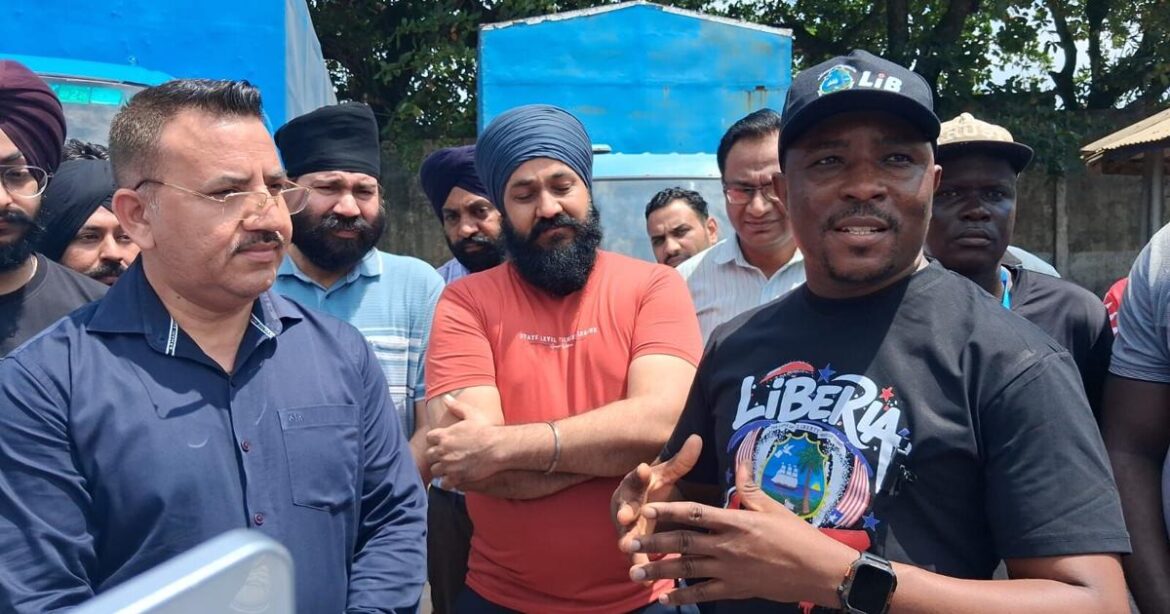
The Ministry of Justice has renewed its call for stronger private sector partnership in Liberia’s correctional system, urging businessman and philanthropist Upjit Singh Sachdeva, popularly known as Jeety, not to abandon efforts aimed at rehabilitating inmates and preparing them for productive lives after incarceration.
The appeal was made during Jeety’s annual July 26 Independence Day food distribution program at the Monrovia Central Prison, where the government praised his years of humanitarian support to vulnerable groups and encouraged him to expand his intervention beyond feeding programs to include skills development, empowerment, and reintegration initiatives for inmates.
Speaking on behalf of Justice Minister and Attorney General Cllr. N. Oswald Tweh, Assistant Minister for the Bureau of Corrections and Rehabilitation Atty. Gabriel F. Ndupellar said Liberia’s correctional system must move away from a model focused only on confinement and embrace rehabilitation as a pathway to national development.
Ndupellar said inmates should not be viewed solely through the lens of their offenses but as individuals with talents, skills, and the potential to contribute positively to society if given the right opportunities.
He appealed to Jeety and other private sector actors to continue supporting the government’s efforts to transform correctional facilities into places where inmates can rebuild their lives.
“Before the coming into being of this government, Mr. Jeety distinguished himself as a philanthropist, a humanitarian, a caregiver, and someone who always wants to identify with the vulnerable population of our country,” Ndupellar said.
He described Jeety’s annual Independence Day outreach at the Monrovia and Kakata Central Prisons as a demonstration of compassion and commitment to some of Liberia’s most marginalized citizens.
According to Ndupellar, the Ministry of Justice has already developed a comprehensive proposal aimed at improving rehabilitation programs within correctional facilities and intends to engage Jeety further on how his support can help advance the initiative.
“We have prepared a comprehensive rehabilitation proposal for inmates, and we intend to come back to Mr. Jeety to discuss how the private sector can support us in transforming our correctional facilities into centers of hope and productivity,” he said.
The assistant minister emphasized that Liberia cannot achieve meaningful national development while ignoring the inmate population. noting that many prisoners possess skills and abilities that can be harnessed for economic growth.
“We cannot build this country without looking back at the inmate population,” Ndupellar stated. “We have people with great potential who can contribute positively if we work together to develop those talents.”
He stressed that rehabilitation is essential to reducing repeat offenses and ensuring that former inmates return to their communities with skills, confidence, and opportunities.
“Our goal is to create opportunities where inmates can use their skills, earn income for their families, and return to society with a better future,” he said.
Ndupellar encouraged Jeety and other partners not to give up on Liberia’s prison population, stressing that inmates remain part of the country’s human capital.
“Don’t give up on our inmates,” he urged, adding that every person deserves an opportunity for transformation and a second chance.
Ndupellar also challenged public misconceptions about prisoners, explaining that not everyone detained at correctional facilities is serving long sentences for serious crimes.
He noted that many inmates remain behind bars while awaiting court proceedings, while others are imprisoned because they cannot meet financial obligations associated with minor offenses.
The assistant minister cited cases involving commercial motorbike riders whose motorcycles were stolen by criminals, leaving them unable to compensate the owners and resulting in their continued detention.
He said the Ministry of Justice has documented such cases as part of efforts to develop interventions that can support vulnerable inmates and promote alternatives that encourage rehabilitation.
According to him, addressing these challenges requires cooperation between government, private sector institutions, civil society organizations, and humanitarian partners.
Delivering remarks on behalf of Jeety, the company’s manager described the Independence Day food distribution as more than an annual charitable activity, saying it represents a commitment to recognizing the dignity and humanity of every Liberian.
“True independence is reflected not only in our nation’s history but also in how we care for one another,” the manager said.
He explained that the initiative seeks to remind inmates that incarceration does not remove their value or their connection to society.
“Our presence here today is Jeety’s way of saying you matter, you are valued, and you are part of this nation’s journey,” he stated.
The manager praised authorities at the Monrovia Central Prison for their continued dedication to caring for inmates despite limited resources and challenging conditions.
He also thanked volunteers and partners who contributed to making the program successful, noting that the outreach was intended to provide both physical nourishment and emotional encouragement.
“We hope this meal provides not only nourishment but renewed hope for a brighter future,” he said.
The Ministry of Justice says Liberia’s correctional system requires greater investment in rehabilitation, vocational training, and reintegration programs to ensure inmates are prepared for life after prison.
Officials believe partnerships with philanthropists such as Jeety can play a critical role in providing opportunities for inmates while reducing pressure on government resources.
As Liberia celebrates its 179th independence anniversary, the government says ensuring that vulnerable populations, including inmates, are not forgotten, which remains an important part of building an inclusive society.
The ministry maintains that true development must include creating opportunities for all Liberians, including those seeking a second chance after incarceration.
