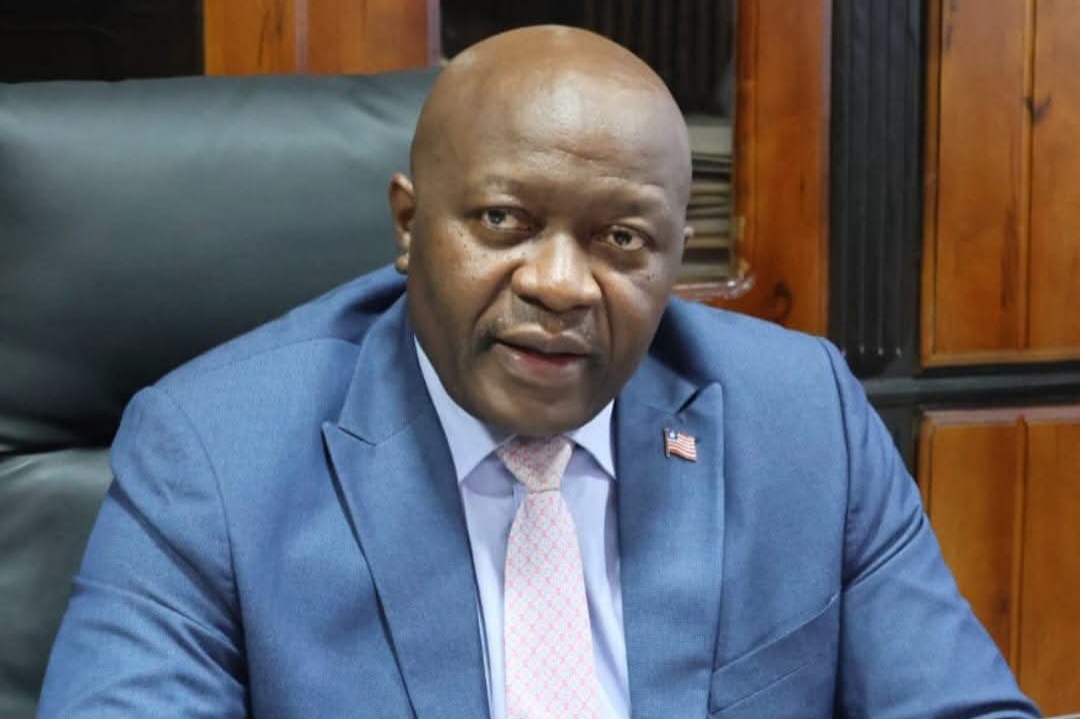
MONROVIA – The Liberian economy is showing stronger signs of expansion, with real GDP growth estimated at 5.1 percent in 2025 and projected to accelerate to about 5.5 percent in 2026, Finance and Development Planning Minister Augustine Kpehe Ngafuan has told West African monetary authorities.
Ngafuan presented the economic outlook Monday, September 7, 2026, at the 56th Meeting of the Convergence Council of the West African Monetary Zone (WAMZ), where he outlined what he described as Liberia’s continued resilience in the face of global economic uncertainty.
The figures offer the government a potentially significant economic narrative: stronger growth, increased revenue collection, falling inflation, improved debt indicators and major infrastructure investments are being combined with reforms intended to strengthen Liberia’s domestic revenue base.
But the outlook also exposes the economy’s continued dependence on mining and its vulnerability to external shocks.
According to Ngafuan, Liberia’s 2025 growth was driven principally by the primary sector, particularly mining and panning.
Iron ore production is expected to more than double in 2026, providing a major boost to overall economic activity.
The government is also projecting a strong recovery in the secondary sector.
After contracting by 2.8 percent, the sector is expected to grow by 5.9 percent, supported by higher cement and beverage production.
The tertiary sector is projected to expand by 3.7 percent, with electricity, construction and related economic activities contributing to the recovery.
Ngafuan said the growth outlook is being reinforced by public investments in roads, energy and other infrastructure.
Among the projects highlighted are the Monrovia-Freetown highway, the southeastern road corridor linking Liberia toward Côte d’Ivoire and the Bong-to-Lofa road.
The government believes these investments will do more than improve transportation.
According to the minister, improved road connectivity is expected to reduce transportation and logistics costs, expand domestic trade and strengthen Liberia’s links with neighboring countries.
The infrastructure strategy is also being linked to the government’s broader ARREST Agenda for Inclusive Development, which prioritizes Agriculture, Roads, the Rule of Law, Education, Sanitation and Tourism.
The Legislature approved a US$1.3 billion national budget for Fiscal Year 2026, described by Ngafuan as Liberia’s largest national budget ever.
The scale of the budget represents a major expansion of the government’s fiscal ambitions and is intended to finance the administration’s development programme.
But the government is simultaneously attempting to strengthen the revenue system needed to sustain those ambitions.
Ngafuan said total revenue and grants increased by 18.6 percent in 2025 to US$887.6 million, compared with US$748.2 million in 2024.
Tax revenue increased by 23.7 percent, while domestic revenue collection reached what the minister described as the highest level in Liberia’s history.
The improvement, he said, was driven in part by digitalization and stronger taxpayer compliance.
The government is also pressing ahead with major tax reforms.
Liberia increased its Goods and Services Tax from 10 percent to 12 percent in 2024 as part of the transition toward a full Value Added Tax system.
Taxpayer registration began in mid-2026 ahead of the planned January 2027 VAT rollout.
The transition, however, has faced delays after the suspension of USAID-supported technical assistance in 2025.
The government says it has continued financing the reform from domestic resources.
Ngafuan also pointed to the expansion of digital financial systems as part of the administration’s economic modernization programme.
The Liberia Integrated Tax Administration System, Inclusive Instant Payment System and full operationalization of the Pan-African Payment and Settlement System are being used to deepen financial inclusion and improve the efficiency of financial transactions.
The government has also enacted the Banking and Financial Institutions Act of 2025 and introduced a new Crisis Management Framework intended to strengthen financial-sector stability.
Energy is another major component of the development strategy.
The government is pursuing additional hydropower generation capacity while expanding the national electricity grid into Grand Bassa County and southeastern Liberia.
Ngafuan said the electricity, gas and steam supply subsector recorded strong growth in 2025, providing a foundation for further industrial and household electricity access.
The economic gains have also been accompanied by an improvement in Liberia’s debt position.
Public debt-to-GDP declined from 56.4 percent in 2024 to 54.9 percent in 2025, even as total expenditure increased by 10.2 percent.
The government therefore enters the remainder of 2026 with a combination of stronger economic growth, increased revenue, lower inflation and a relatively improved debt position.
Yet the minister acknowledged that the positive outlook is not without risks.
Liberia continues to face structural bottlenecks, while international fuel and food prices remain vulnerable to geopolitical tensions and disruptions in global trade.
The suspension of USAID-supported programmes has also created additional pressure on some areas of the economy and development financing.
The question now is whether the current growth can translate into sustained improvements in productive capacity and living standards.
Mining remains a dominant engine of the projected expansion, making diversification increasingly important if Liberia is to shield its economy from commodity-price volatility.
For the Boakai administration, the challenge will therefore be twofold, maintaining the macroeconomic gains highlighted by the Finance Minister while ensuring that the country’s infrastructure, tax, energy and financial-sector reforms produce broader and more durable economic opportunities.
Ngafuan told the WAMZ gathering that Liberia remains committed to the reforms required to sustain macroeconomic stability and achieve full convergence.
With the regional Eco target set for 2027, Liberia’s economic performance will be judged not only by the headline growth rate, but also by whether the country can maintain fiscal discipline, contain inflation, strengthen reserves and transform increased public revenue into tangible development.
The latest figures provide the government with grounds for optimism. The harder test will be whether that optimism can be converted into sustained, broad-based economic transformation.
See more Liberia News Network stories in Google Search by adding LNN as one of your Preferred Sources.
★ Add LNN as a Preferred Source