Published: August 28, 2026
What does a human right mean to an ordinary Liberian when the institution they turn to for protection is the same institution they believe has failed them?
For many Liberians, human rights are not abstract concepts found only in treaties or courtrooms. They become real when someone walks into a police station seeking protection, enters a courtroom hoping for justice, approaches a public institution for a service, or simply expects to be treated with dignity and equality.
By E. Angel Seville, Contributing Writer
That is where the real conversation about human rights begins. The question is not merely whether Liberia has laws that recognize human rights because it does. The deeper question is whether those rights are experienced by ordinary people in their everyday lives.
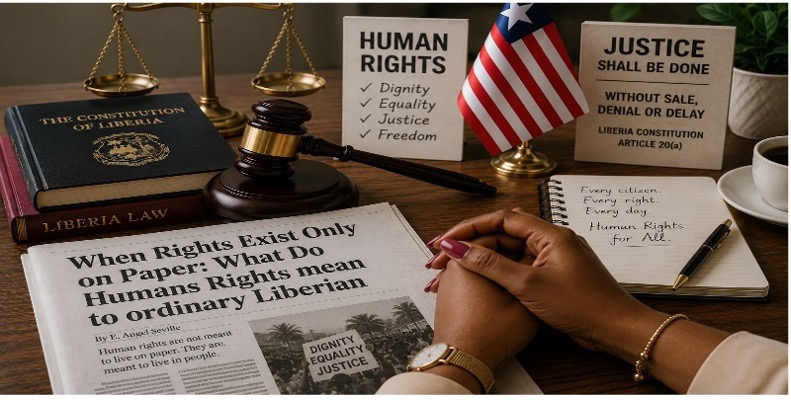
Liberia’s Constitution provides a foundation for fundamental rights and freedoms. Article 20(a) guarantees due process and declares that justice shall be done “without sale, denial or delay.”
Those words carry considerable weight. But what happens when a right promised on paper does not correspond with the experience of the person seeking to exercise it? A constitutional guarantee is essential, but the practical value of that guarantee depends on whether people can understand, claim and enforce it.
For many Liberians, the meaning of human rights becomes clearest when they encounter law enforcement. One person may enter a police station as a complainant seeking protection; another may be there as a suspect facing questioning. These are very different circumstances, but one principle should remain constant: the exercise of lawful authority should not erase human dignity.
The police have a responsibility to enforce the law. Citizens have a responsibility to respect the law. But respect for the law does not mean surrendering one’s rights.
What happens when a person seeking justice feels unheard? What happens when an arrested person does not understand why they are being detained? What happens when someone believes they are being treated differently because of another person’s influence, wealth or connections?
These questions are not accusations against every police officer. They are questions about how a society balances law enforcement with human equality. A strong justice system should be able to do both.
For someone seeking justice, a courtroom can represent hope, the hope that a dispute will be resolved, a wrong addressed, or a right recognized. But what does justice mean to a person who has waited years for a case to be resolved?
Liberia’s constitutional promise that justice should be done without “sale, denial or delay” provides an important standard. Yet the promise is only the beginning; the experience of the person seeking justice matters too.
Reports by Liberian institutions, the United Nations and development partners have identified persistent challenges, including prolonged pretrial detention, inadequate access to legal representation, resource constraints and delays in administering justice. Reform efforts have included strengthening the public-defender system, training judicial personnel and introducing digital case-management systems.
Both realities deserve recognition. Progress should be acknowledged, but it should not prevent society from asking difficult questions. If justice is a right, should the ability to obtain it depend on money, connections, legal knowledge, or extraordinary patience?
A right written in the Constitution is a promise. For the ordinary citizen, however, the real test begins when that promise is put to work.
- Can someone who cannot afford a lawyer obtain meaningful legal assistance?
- Can a person who does not understand the legal system navigate it effectively?
- Can someone who believes their rights were violated find an effective remedy?
- And perhaps most importantly: Does an ordinary Liberian know where to turn when those rights are violated?
These questions are not about condemning institutions. They are about accountability and access. A person who believes that their rights have been violated should be able to seek help from the appropriate authority, whether through a court, a public defender, the Independent National Commission on Human Rights, a lawful police-oversight mechanism or another competent institution and receive clear information about the available remedy.
Human rights are ultimately about more than the relationship between an individual and the state. They are about dignity, equality, fairness and the recognition that every person matters. Those protections belong not only to citizens, but to every person within the reach of the law.
Liberia’s commitment to human rights cannot be measured only by the laws it has passed or the international commitments it has made. It must also be measured by the experiences of its people.
That commitment is tested when a person reports a crime and expects to be heard; when an accused person expects due process; and when a victim seeks justice. It is tested when a woman asks for protection, when a child needs safeguarding, when a person with a disability expects equal treatment and when an older person expects to be treated with dignity. It is also tested when someone without influence, wealth or connections enters a government institution and still expects fair treatment.
That may be the real test of human rights in Liberia: not whether rights exist only on paper, but whether ordinary people can approach institutions of authority, expect dignity and fair treatment, and trust that the law will protect them.
Because ultimately, human rights are not meant to live on paper. They are meant to live with people.
See more Liberia News Network stories in Google Search by adding LNN as one of your Preferred Sources.
★ Add LNN as a Preferred Source