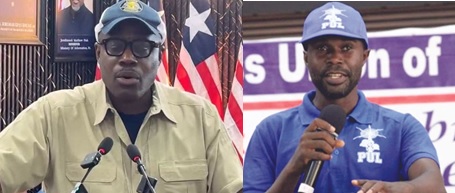
MONROVIA – The Press Union of Liberia (PUL) has summoned the entire Liberian media community to an emergency special meeting on today, Monday, August 3, as the Union’s 72-hour ultimatum to the Government of Liberia over an unproven cartel-bribery allegation runs down to its final hours. In a citation signed by President Julius Kanubah, the Union called journalists, broadcasters, publishers, and more than a dozen affiliate associations to its Warner Avenue headquarters at 12:00 P.M. to decide the profession’s collective next steps. The gathering sets the stage for a direct confrontation with the administration of President Joseph Nyuma Boakai over a scandal that has already seen US$336 million in cocaine burned and senior security officials purged. THE ANALYST reports.
A Full Mobilization of the Press
The citation, dated August 2, directs every arm of the Liberian press to converge on the PUL Head Office on Warner Avenue, 9th Street, at noon. It reaches well beyond individual reporters to a broad coalition of institutions — among them the Reporters Association of Liberia, the Female Journalists Association of Liberia, the Publishers Association of Liberia, the Economic Journalists Association, and the Association of Liberian Community Radio Stations.
Also summoned are the Legislative Press Pool, the Executive Mansion Press Corps, the Association of Judicial Reporters, the Ministry of Information Reporters Network, the Sports Writers Association, the Foreign Stringers Association, the Editors Association, and county-based journalist bodies.
The Union says the meeting is warranted by the gravity of the accusation and its implications for the safety and integrity of journalists and media institutions. Kanubah’s signature on the notice underscores that the full weight of the Union’s leadership stands behind the mobilization, and the breadth of the invitation signals an intent to answer as a united front rather than in scattered voices.
The Allegation That Sparked It
The special meeting traces directly to remarks by Inspector General of Police Gregory O.W. Coleman at the Ministry of Information’s July 30 briefing, where he alleged that drug trafficking organizations had “infused money into the media” to distort coverage and derail the investigation into the country’s largest-ever cocaine seizure.
Coleman named no journalist, cited no outlet, and produced no transaction or documentary evidence to support the charge. Information Minister Jerolinmek Piah moved to narrow the remark, saying the Inspector General had not meant the Liberian press as a whole but only actors posing as media, and Coleman accepted that clarification.
The PUL was unmoved. The Union argues that if only specific individuals are implicated, the burden falls squarely on the government to name them rather than leave an entire profession under a cloud of suspicion. Branding the accusation a reckless and dangerous blanket indictment of Liberian journalism, the leadership issued its 72-hour ultimatum demanding public evidence or a full retraction, and warned that it stands prepared to take appropriate actions should the deadline lapse without proof.
A Deadline Against a Backdrop of Fire
The confrontation is unfolding against a dramatic sequence of state action. Days earlier, authorities burned roughly 4.2 metric tons of cocaine — the US$317 million Duazon consignment together with a US$19 million seizure from Roberts International Airport, a combined US$336 million and the largest narcotics haul in the nation’s history — under a court order, retaining samples as evidence for the seventeen people the Ministry of Justice intends to prosecute. The PUL citation itself characterizes the underlying trafficking as involving over half a billion dollars’ worth of illicit cocaine, a figure that speaks to the scale of the case.
President Boakai has since suspended or dismissed senior officials across the police, the National Security Agency, and the country’s ports of entry as the probe widens, even as his government has appealed for outside help, with United States agents already assisting and other international partners approached.
Compounding the tension, Coleman used the same briefing to assert that the trafficking had been sanctioned by state actors at the highest levels of government — a claim that has left critics asking why the administration’s fire has turned toward the press rather than toward the officials the Inspector General himself implicated.
What Monday May Decide
By the time the media community gathers on Monday, the 72-hour window is expected to have closed. The Union has not disclosed what specific measures it may adopt, leaving open a range of responses from formal protest to legal and international escalation. What is clear is that the leadership intends to speak with one voice, and that Monday’s sitting will set the tone for the next phase of a standoff between the Liberian press and the state.
See more Liberia News Network stories in Google Search by adding LNN as one of your Preferred Sources.
★ Add LNN as a Preferred Source