
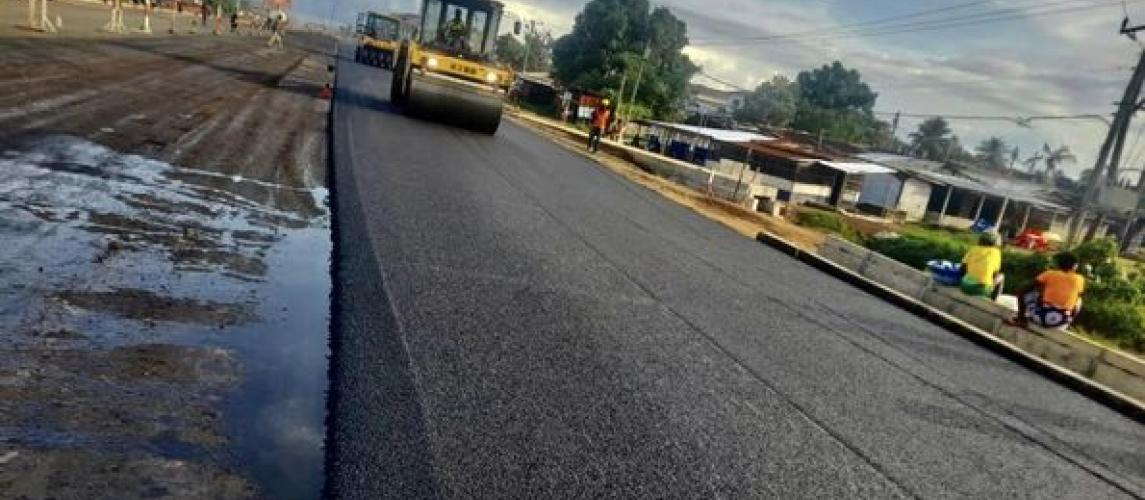
MONROVIA, November 2, 2026: Information Minister Jerolinmek Matthew Piah has defended President Joseph Nyuma Boakai’s handling of the Roberts International Airport (RIA) Road project, claiming that construction would have remained at 10 percent completion without the current administration’s intervention.
Minister Piah said the Boakai administration has accelerated work on the road, increasing its completion rate from 10 percent when it assumed office to approximately 66 percent, despite criticism that the project was initiated under former President George Manneh Weah.
Speaking at the Ministry of Information’s regular press briefing in Monrovia, Piah dismissed arguments that the government should not take credit for projects inherited from previous administrations.
He maintained that development projects belong to the Liberian government and people, rather than individual presidents or political parties.
“When you run a government, you only prioritize government projects. For the fact that people get narrow-minded and start to personalize what government is supposed to be is concerning,” Piah said.
His comments come amid growing political debate over the Boakai administration’s development achievements, with critics questioning whether the government has initiated significant infrastructure projects or is primarily completing those inherited from the Weah administration.
However, Piah argued that successive governments have a responsibility to continue publicly funded projects, particularly those financed through loans that taxpayers must eventually repay.
He described attempts to classify development initiatives as either Unity Party (UP) or Coalition for Democratic Change (CDC) projects as unnecessary political distractions.
According to the Information Minister, the RIA Road project demonstrates the current administration’s commitment to completing inherited infrastructure developments rather than abandoning them for political reasons.
“If somebody is suggesting that because the project started under this person’s era, it is that era’s project and they are not supposed to touch it, then by now it would be at 10%,” he argued.
Piah disclosed that the previous administration committed approximately US$21 million in government resources toward the project, while an additional US$80 million was secured through loans.
He further reported that US$101 million had been disbursed to contractors, citing information presented during President Boakai’s most recent Cabinet meeting.
However, the minister did not clearly establish whether the reported US$101 million represented cumulative project payments or disbursements made under the current administration.
Piah also disclosed that the government had conducted an audit to determine the project’s financial status and establish why additional payments were necessary to sustain construction.
He said the administration subsequently agreed to provide additional funding to ensure that work continued without further setbacks.
“If the government does not put additional money into the RIA Road because it was the past government’s project, what kind of development will that be?” Piah questioned.
The Information Minister maintained that the government could not abandon major infrastructure investments simply because they were initiated by a previous administration.
He emphasized that public infrastructure projects are national assets intended to serve citizens, regardless of political affiliation or changes in leadership.
Piah’s defense comes as opposition critics continue to challenge the Boakai administration to identify major development projects initiated since it assumed office in January 2024.
While critics have questioned the administration’s record of launching new infrastructure initiatives, government officials maintain that completing inherited projects constitutes an important part of national development.
The RIA Road project, a major transportation corridor connecting Monrovia to Liberia’s principal international airport, has become a central issue in the debate over infrastructure development and government performance.
Piah insisted that the administration’s responsibility is to deliver tangible development results rather than engage in political arguments over which government initiated particular projects.
He maintained that the Boakai administration would continue financing and implementing development projects considered important to the country’s economic growth and infrastructure needs, irrespective of their political origins.
See more Liberia News Network stories in Google Search by adding LNN as one of your Preferred Sources.
★ Add LNN as a Preferred Source