
By Christian Appleton
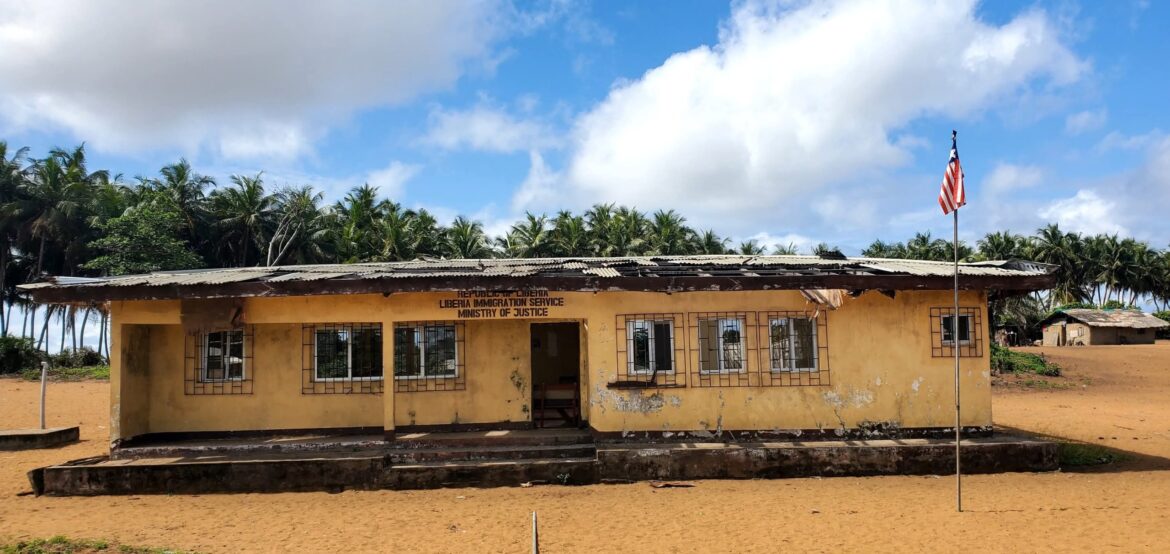
HARPER, MARYLAND COUNTY — The deteriorating condition of the Kablaken Immigration Checkpoint along the Liberia–Côte d’Ivoire border is significantly undermining border security operations, according to the Liberia Immigration Service Maryland County Detachment.
Speaking in an interview, the Maryland County LIS Commander, ACI Abdul Jallahquay, revealed that the critical checkpoint has been abandoned for several years. This prolonged neglect has forced immigration officers to operate from makeshift structures and private residences within the immediate border community. Commander Jallahquay explained that the situation has severely impacted their daily operations, as the main building remains in complete ruins and the men are left to function out of temporary setups.
The Kablaken Checkpoint, which was reportedly constructed by the United Nations Mission in Liberia during the administration of former President Ellen Johnson Sirleaf, has fallen into an advanced state of disrepair. Explaining the rapid deterioration of the facility, Commander Jallahquay attributed the structural damage to its coastal location, where salt-laden winds from the nearby Atlantic Ocean have accelerated the corrosion of the roofing materials. He also noted that inadequate engineering oversight and the initial use of ordinary roofing sheets, rather than more durable, climate-resilient materials, contributed heavily to the building’s quick decline.
Despite these severe infrastructural challenges, the commander emphasized that immigration officers remain deeply committed to protecting Liberia’s borders. He stated that the men are managing to stay within the community to perform their essential duties, and although the living and working conditions are exceptionally difficult, they continue to conduct necessary patrols and fully carry out their official responsibilities.
Commander Jallahquay disclosed that the state of the checkpoint has been reported to the Liberia Immigration Service headquarters in Monrovia on several occasions. However, he clarified that the county detachment completely lacks the financial capacity to renovate such a facility on its own and is currently awaiting a direct intervention from the national headquarters and the Central Government of Liberia.
Currently, the displaced border officers are being temporarily accommodated in a private residence belonging to local resident Tumu Morias. Speaking on the matter, Morias described the ongoing situation as deeply embarrassing for the nation. He claimed that Ivorian border counterparts often ridicule the subpar conditions under which Liberian immigration officers are forced to operate. Furthermore, Morias argued that seeing the Liberian flag flying over a dilapidated, ruined structure projects an image of weakness to outsiders and directly undermines the country’s national dignity at one of its key international border crossings.
The current state of the Kablaken Immigration Checkpoint has renewed urgent concerns among locals and security experts regarding the need for increased government investment in border infrastructure. Stakeholders maintain that immediate funding is required to strengthen national security, improve the harsh working conditions of frontline security personnel, and properly reinforce Liberia’s official presence along its strategic international frontiers.
