Published: August 19, 2026
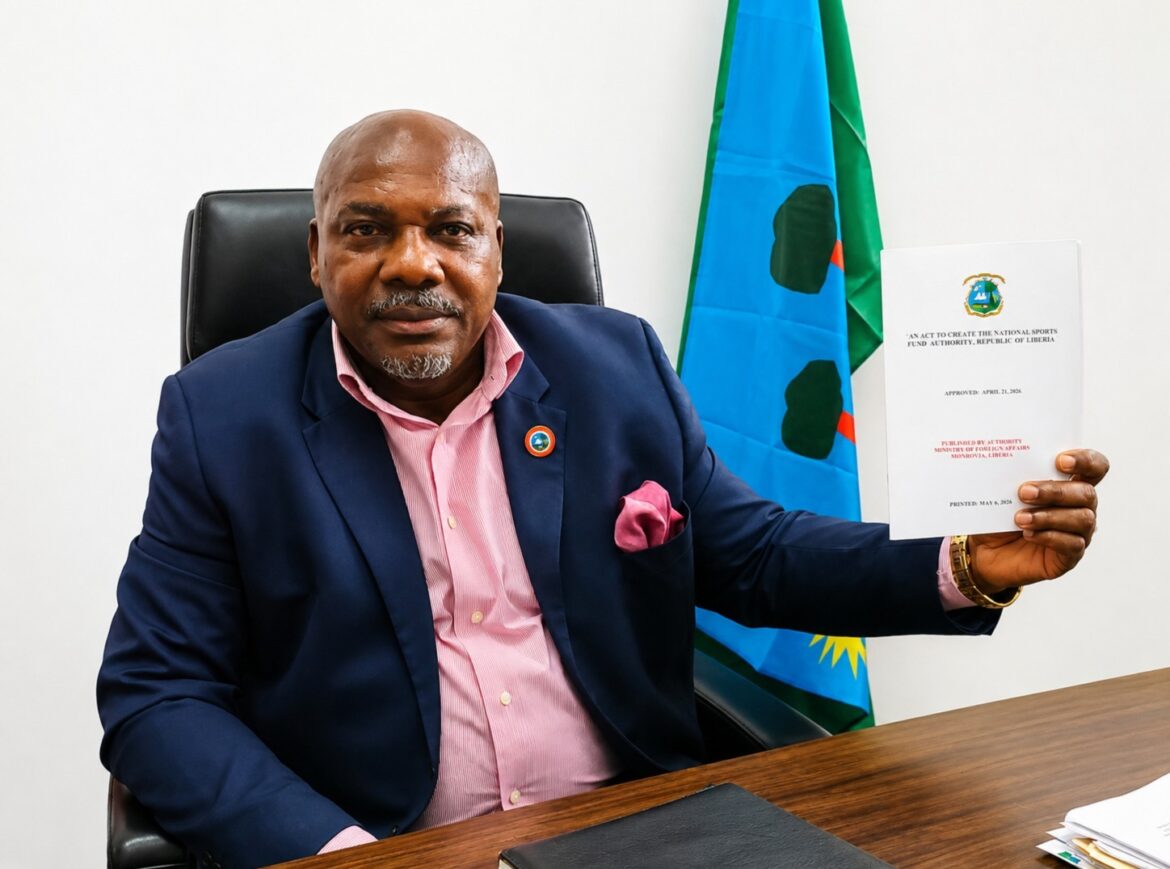
MONROVIA — River Gee County Sen. Jonathan Boye-Charles Sogbie says Liberia’s newly enacted National Sports Fund Authority law could end decades of chronic underfunding that has left national teams scrambling for money, poorly prepared for international competitions and often unable to compete beyond mere participation.
Sogbie, a former Lone Star national team striker who sponsored the legislation, said the new law establishes a dedicated financing mechanism intended to move sports away from near-total dependence on limited national budget appropriations and create sustainable funding for competitions, infrastructure and talent development.
President Joseph Nyuma Boakai recently signed the National Sports Fund Authority legislation into law following legislative approval. The Senate overwhelmingly passed the bill July 23, 2025, before concurrence by the House of Representatives.
Speaking at a news conference Monday, Aug. 17, at his Capitol Building office in Monrovia, Sogbie thanked Boakai, Vice President Jeremiah Kpan Koung and members of both houses of the Legislature for supporting the measure.
“The idea of this bill is simply to enable us to have enough money to be able to participate in these competitions worldwide — not only to participate, but to be a contestant, to actually vie for the big prize,” Sogbie said.
Sogbie drew a sharp distinction between Liberia simply showing up at international tournaments and having the financial resources necessary to adequately prepare athletes to challenge for titles.
“Most times we are only participants,” he said.
The senator rejected suggestions that Liberia’s struggles in international sports are primarily the result of a shortage of talented athletes. Instead, he blamed years of inadequate preparation largely caused by insufficient and unpredictable financing.
“It’s not because we don’t have good players … it is because we don’t prepare adequately,” Sogbie said.
According to him, sports has traditionally relied on national budget allocations of roughly US$250,000 to US$300,000, amounts he said can be exhausted after only a few international engagements.
The new model, he said, is intended to create a permanent financing mechanism capable of generating revenue beyond regular government appropriations, reducing the need for authorities to scramble for money whenever national teams are preparing for competitions.
Funding could come from taxes, levies and other dedicated revenue-generating mechanisms, he said.
Among the potential revenue sources Sogbie highlighted is the accumulation of small change from commercial transactions, arguing that seemingly insignificant amounts could generate substantial resources when collected over time.
“When you go to the store and the thing is 99 cents, they can’t give you the one-cent change. That money can go to sports,” he said. “It may sound infinitesimal, but collectively, it’s plenty. And over the whole year, with the one, two, three, four cents, that money can be put into an escrow account and can be used for sports development in our country.”
Sogbie said discussions are also considering possible revenue streams involving sporting goods and beverages, including alcoholic beverages.
He maintained that the goal is not simply to create another government institution dependent on annual appropriations, but to establish a system capable of generating sustainable resources specifically for sports.
Sogbie said the legislation is designed to confront several longstanding problems that have hindered Liberia’s sporting development, including chronic underfunding, inadequate preparation for international competitions, excessive reliance on government appropriations, poor sporting infrastructure and insufficient investment in identifying and developing young athletes.
He said resources mobilized by the authority would support infrastructure development and help “harness young talent,” creating a more sustained pathway for young athletes to develop their abilities.
The law will cover multiple sporting disciplines, including football, basketball, volleyball and table tennis, among others.
Sogbie argued that without predictable financing, Liberia will continue entering international competitions at a disadvantage, regardless of the quality of its athletes.
“The authority would use resources to support sports infrastructure development and harness young talent,” he said.
The former Lone Star striker also emphasized that sporting federations and people directly involved in sports should play a central role in governing the new authority.
According to him, the arrangement is intended to place responsibility for the management and development of sports largely in the hands of people from within the sector.
“The board of directors is made up of the federations, and it will be only sports people,” Sogbie said. “Why? Because when we mess it up, we will blame ourselves. We will not blame the politicians; we will not blame the lawyers.”
He said greater control by sporting federations should also bring greater accountability, making it more difficult for sports administrators to blame politicians and other professionals when the sector fails to deliver results.
Sogbie disclosed that a steering committee, which he described as a “skeletal system,” is being established to begin implementation of the law until the National Sports Fund Authority can be incorporated into the next national budget.
The authority will be responsible for mobilizing, managing and disbursing funds for sports development across Liberia.
Sogbie said its establishment represents an opportunity to break the longstanding cycle in which sporting federations and national teams search for emergency financing only when international competitions approach.
For the former national team star, sustainable financing could ultimately determine whether Liberia continues traveling abroad simply to participate or begins arriving at major competitions with the preparation and resources necessary to compete for honors.
“The idea of this bill is simply to enable us to have enough money,” Sogbie emphasized, “not only to participate, but to be a contestant, to actually vie for the big prize.”
See more Liberia News Network stories in Google Search by adding LNN as one of your Preferred Sources.
★ Add LNN as a Preferred Source