
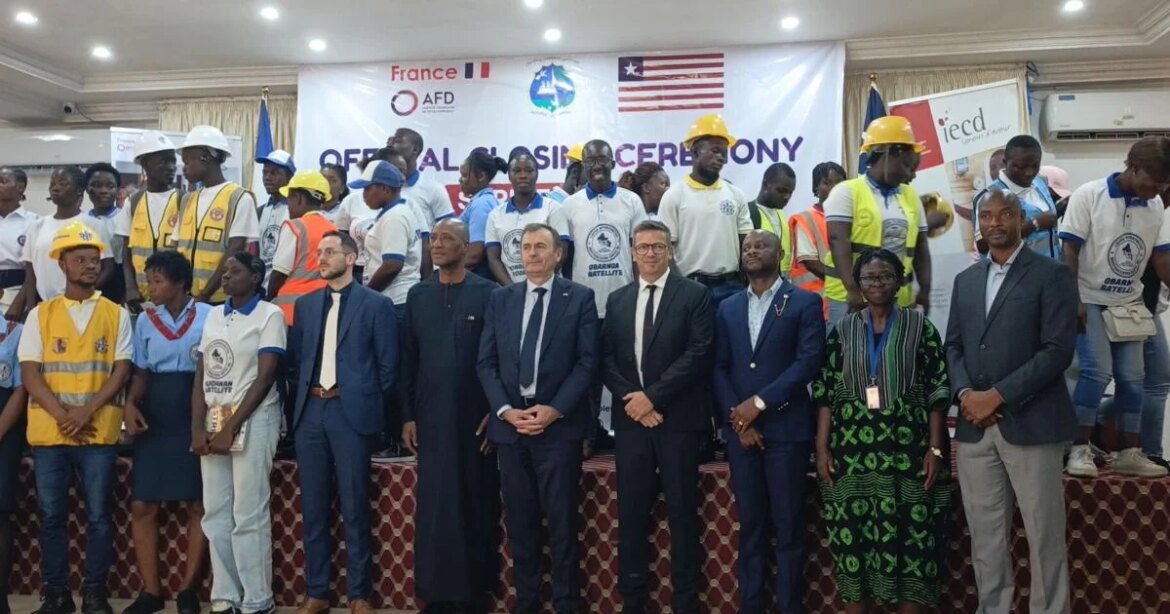
A €10 million vocational education and skills-development project funded by the Government of France has officially ended after six years in Liberia, benefiting approximately 2,500 students and 279 instructors while upgrading training facilities and expanding opportunities for youth employment.
The Strengthening Integration Through Vocational Education (STRIVE) Project, implemented by the Institut Européen de Coopération et de Développement (IECD), supported 10 training centers, renovated and equipped 16 workshops, developed seven vocational curricula and established partnerships with more than 75 companies.
The project also engaged over 350 farmers in one of its intervention areas.
The achievements were highlighted Thursday, November 12, 2026, during the project’s closing ceremony in Monrovia, attended by government officials, French diplomatic representatives, development partners, training institutions, private-sector actors, instructors and students.
Speaking at the ceremony, IECD Country Director Alexandre Vial said STRIVE was launched in 2020 with a €10 million grant from the French Government to strengthen technical and vocational education and training (TVET) and improve the quality of skills development in Liberia.
He said the initiative modernized training facilities, equipped workshops, strengthened instructors’ capacities and developed seven vocational curricula covering hospitality, electricity, masonry, agriculture and entrepreneurship.
However, Vial cautioned that improved facilities and curricula alone would not guarantee employment for graduates, stressing the need for stronger partnerships between government, training institutions and the private sector.
“A well-equipped workshop is not enough. A good curriculum is not enough either. Young people need a bridge between training and employment, and building that bridge cannot be the responsibility of one project alone,” he said.
He urged the Government to institutionalize the seven curricula as national standards, establish stronger regulatory frameworks for vocational education and provide sustainable financing for training institutions and instructors.
Vial also challenged schools to maintain equipment, generate income through production and service delivery, and strengthen partnerships with businesses to improve students’ readiness for employment.
He called on private-sector companies to participate directly in curriculum development, mentorship, internships and apprenticeship programmes rather than waiting until students graduate.
“To the companies: You are not simply the final destination of the training process; you must be part of the entire journey,” he emphasized.
He further encouraged increased participation of women in traditionally male-dominated technical fields, including electricity, solar technology and masonry.
Vial clarified that the closure of STRIVE did not mean IECD was withdrawing from Liberia, disclosing that the organization was continuing its development activities through partnerships with the Ministry of Agriculture and the International Fund for Agricultural Development (IFAD) under the IFSA Project.
IECD is also working with the Ministry of Health, with support from Sanofi, to train health workers in managing diabetes and hypertension.
“This is therefore not a goodbye to the sector. It is a transition to the next phase of our partnership,” he said.
French Ambassador to Liberia Dominique Pierre Delpuech described vocational education as an important driver of economic growth, productivity and employment, particularly in a country where young people account for approximately 75 percent of the population.
He stressed that sustaining the project’s €10 million investment would require continued government ownership and commitment.
“The sustainability of these investments ultimately depends on the ownership and commitment of the Government of Liberia,” Delpuech said.
He urged the Ministries of Education and Youth and Sports to maintain the facilities, equipment and programmes established under STRIVE while strengthening basic education and connections between training institutions and employers.
The ambassador reaffirmed France’s commitment to supporting Liberia’s vocational training, inclusive education and efforts to improve pathways from education to employment.
Meanwhile, AFD Country Representative and Human Capital Project Officer Eliot Sotty described STRIVE as one of the agency’s flagship investments in human capital development.
He disclosed that AFD had committed nearly €62 million in grants to Liberia since 2018, supporting programmes in employment, vocational training, healthcare, biodiversity and urban development.
Sotty said the success of STRIVE should be measured not only by renovated facilities but also by the practical skills acquired by students and the employment opportunities created for graduates.
“The transition from training to employment should not begin on graduation day. It should start during training itself,” he said, calling for stronger private-sector partnerships and expanded internship and apprenticeship opportunities.
For his part, Nathaniel K. Cisco Jr., Assistant Minister for STEM/TVET and Inclusive Education at the Ministry of Education, announced plans to expand vocational education programmes to secondary schools nationwide by the end of March 2027 through the European Union-supported Youth Rising Project.
He said the initiative would expose students to practical skills in agriculture, plumbing and other vocational trades to better prepare them for employment.
Cisco also announced plans to expand TVET certification beyond Level 3 to Levels 4, 5 and 6 while strengthening the Recognition of Prior Learning (RPL) system.
The RPL framework will allow individuals who acquired skills through informal training, apprenticeships and workplace experience to obtain nationally recognized qualifications without necessarily undergoing conventional formal training.
He assured stakeholders that the Ministry would work with institutions benefiting from STRIVE to sustain and integrate the seven vocational curricula developed under the project.
STRIVE Senior Project Manager Adelphe N’Dorman said the initiative was designed to address the mismatch between vocational training and labour-market demands, particularly the difficulties young people face securing employment after graduation.
He recalled that the project began in July 2020 with €10 million in French Government funding through AFD, focusing on institutional capacity-building, curriculum development, quality assurance and instructor training.
“We did not merely expend resources; we built systems intended to endure,” N’Dorman said.
He acknowledged the contributions of the French Government, AFD, the Government of Liberia, the United Nations Industrial Development Organization (UNIDO), UNESCO, the German Agency for International Cooperation (GIZ), training institutions, private-sector partners and project staff.
“STRIVE concludes today as a project. However, its spirit continues in every skill acquired and in every young person now engaged in dignified work,” he added.
Earlier, IECD Training and Learning Manager Harry Doblah welcomed participants, describing the ceremony as an opportunity to celebrate the project’s achievements and renew commitments to empowering young people through vocational education.
He emphasized that the partnerships, institutional capacities and training opportunities established under STRIVE should continue benefiting students and communities beyond the project’s official closure.
See more Liberia News Network stories in Google Search by adding LNN as one of your Preferred Sources.
★ Add LNN as a Preferred Source