
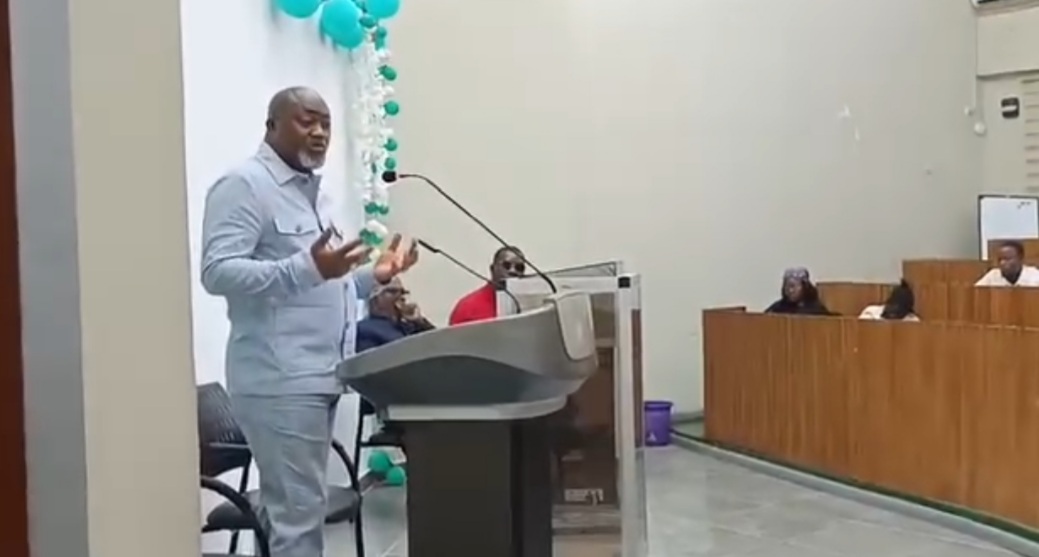
MONROVIA — Liberia’s Permanent Representative to the International Maritime Organization (IMO), Robert Wilmot Kpadeh, has called for stronger international cooperation to protect global shipping routes, safeguard seafarers and preserve maritime security, warning that disruptions in international shipping can trigger economic consequences that reach far beyond the world’s oceans and directly affect ordinary people through rising prices and increased living costs.
Speaking on Friday, November 27, 2026, during a lecture at the African Methodist Episcopal University (AMEU) Graduate School Program of International Relations, Kpadeh emphasized that international maritime security is not merely a concern for shipping companies, maritime institutions or countries with large shipping industries, but a fundamental requirement for global economic stability, national security and the well-being of populations worldwide.
Addressing faculty members and graduate students on the subject of International Maritime Diplomacy, the International Maritime Organization and Liberia’s relevance in international maritime affairs, Kpadeh explained that the world’s dependence on maritime transportation makes the protection of shipping routes an indispensable responsibility of the international community.
He argued that when shipping operations are disrupted, the consequences extend into national economies, affecting the movement of essential commodities, the cost of transportation, industrial production and the purchasing power of ordinary citizens.
According to him, the relationship between maritime security and economic stability is so direct that disruptions at sea can eventually influence political outcomes in countries experiencing rising living costs.
“But not only that, it undermines economies of countries. And when economies are undermined, the people become the direct victim because pricing goes up,” Kpadeh said, explaining how disruptions in the maritime sector can translate into higher commodity prices and increasingly difficult living conditions.
He further illustrated the political consequences of economic hardship, noting that voters frequently hold governments accountable when economic policies or circumstances make everyday life difficult.
For Kpadeh, the connection between international shipping and domestic economic conditions demonstrates why governments must pay greater attention to maritime security and the international agreements governing the use of the oceans.
He maintained that the movement of petroleum, medicines, vehicles, industrial equipment, food supplies and other essential commodities depends heavily on the uninterrupted operation of international shipping networks.
For developing countries such as Liberia, the importance is particularly pronounced because of their dependence on imported goods and essential supplies.
He explained that a disruption affecting a major international shipping route can create a chain reaction across several economic sectors, increasing transportation costs, raising production expenses and eventually placing additional financial pressure on households.
Kpadeh pointed to disruptions affecting important international maritime corridors as an illustration of how instability at sea can influence petroleum supplies and commodity prices across the world.
He noted that petroleum remains central to transportation, electricity generation, industrial operations and manufacturing, meaning that interruptions in its international movement can affect virtually every sector of the economy.
The Liberian diplomat stressed that maritime security must therefore be approached as an international responsibility requiring cooperation among governments, international organizations, maritime administrations and other stakeholders.
Explaining the concept of maritime diplomacy, Kpadeh said countries must engage one another through agreements, mutual understandings and established international instruments to protect shared maritime interests.
He noted that maritime diplomacy involves advancing national interests while simultaneously working toward the protection of international shipping, the marine environment, seafarers and the broader global economy.
Against this background, he highlighted Liberia’s historical position within the IMO, describing the country as an influential participant in international maritime governance.
According to Kpadeh, Liberia joined the IMO in 1948 as a founding member and has since developed into the world’s largest ship registry, with thousands of vessels operating under the Liberian flag.
He attributed the country’s position to its commitment to international maritime standards, regulatory compliance, the protection of seafarers and the maintenance of a credible international registry.
Kpadeh explained that shipowners select flags based on confidence in the regulatory systems, professional standards and international reputation of the countries administering their vessels.
He maintained that Liberia’s standing in the global maritime industry is not simply a product of the number of vessels registered under its flag, but also reflects its participation in international maritime governance and its willingness to uphold established rules and regulations.
He further disclosed that Liberia is among the 50 member states serving on the IMO Council and occupies a particularly important position in Category A, which comprises 10 countries considered to have the greatest interest in providing international shipping services.
Kpadeh described Liberia’s presence in this category as an important diplomatic achievement, noting that the country participates alongside major maritime and industrial powers, including the United States, the United Kingdom, Japan, France and Norway.
He explained that the IMO Council plays an important role in shaping decisions and policies affecting international maritime administration, making Liberia’s participation an opportunity to influence issues that extend beyond its national boundaries.
He also highlighted Liberia’s involvement in the IMO’s Marine Environment Protection Committee, which he said is chaired by his deputy, Dr. Howard Conway.
Beyond its institutional participation, Kpadeh referenced Liberia’s hosting of the eighth summit of the Association of Maritime Administrations of African Countries, describing it as another demonstration of the country’s growing role in regional maritime cooperation.
He said Liberia continues to advocate for stronger maritime security, the protection of seafarers, environmental preservation, women’s participation in the maritime industry and respect for international shipping regulations.
However, the diplomat emphasized that Liberia’s international maritime reputation must be matched by continued efforts to protect those whose work sustains the global shipping industry.
He expressed concern over attacks against seafarers, including incidents involving rockets, projectiles and other forms of violence against vessels and their crews.
Kpadeh described seafarers as essential contributors to the movement of goods and services around the world, noting that many leave their families and countries for extended periods to ensure that essential supplies reach international markets.
He argued that exposing these workers to violence undermines the fundamental purpose of international shipping and threatens the safety of people who perform critical services for humanity.
“The ocean must be a place for peace, not war,” he emphasized, insisting that international waters should remain safe for people transporting goods and supporting the economic activities of nations.
He called for stronger international commitments to protect seafarers and ensure that shipping lanes remain secure, accessible and free from threats that could endanger lives or interrupt the movement of essential supplies.
Kpadeh also linked Liberia’s maritime diplomacy to its upcoming presidency of the United Nations Security Council in December 2026, arguing that the country’s international position provides an opportunity to advance discussions on maritime security and the protection of major shipping routes.
He suggested that Liberia could use its diplomatic standing to rally international support for maritime security as part of wider efforts to promote international peace, economic stability and cooperation.
According to him, the significance of maritime transportation makes it necessary for students of international relations to understand the sector, particularly because shipping intersects with international law, global commerce, national security and diplomatic relations.
He cautioned that international relations cannot be adequately understood without examining the maritime industry, which remains central to the movement of goods and the functioning of the global economy.
Kpadeh concluded by urging the international community to recognize that protecting the maritime sector is ultimately about protecting human lives, national economies and the peaceful exchange of goods among countries.
His lecture placed Liberia’s maritime influence within a wider international context, presenting the country’s IMO membership, global ship registry and diplomatic participation as important instruments through which it can contribute to international cooperation and the protection of the world’s oceans.
See more Liberia News Network stories in Google Search by adding LNN as one of your Preferred Sources.
★ Add LNN as a Preferred Source