MONROVIA, October 6, 2026 — For more than two decades, China has been one of Liberia’s most visible development partners, supporting major projects in infrastructure, health, education and public administration.
Cooperation between Monrovia and Beijing has expanded beyond aid and grants to include increased people-to-people ties, with many Liberians in both the public and private sectors benefiting from the growing bilateral relationship since relations were restored in 2003.
No single publicly available document shows China’s exact contribution to Liberia’s post-war recovery and development.
But Government records and development-finance databases show a relationship that includes grants, concessional loans, technical assistance, and financing commitments for future projects.
Liberia reaffirmed its One-China policy in October 2003, paving the way for renewed relations with Beijing. Since then, Chinese assistance has supported several prominent public facilities.
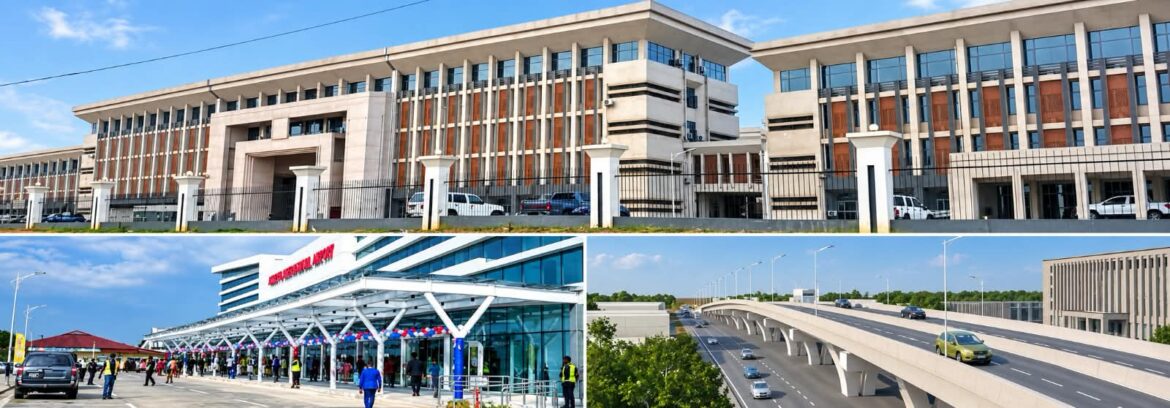
These include the Ellen Johnson Sirleaf Ministerial Complex, the Roberts International Airport, the University of Liberia’s Fendall Campus, the Jackson F. Doe Memorial Regional Referral Hospital in Tappita, annexes to the Capitol Building, and support for the Liberia Broadcasting System.
One of the latest major projects is the construction of two overpass bridges along Tubman Boulevard at the Ministerial Complex and SKD Boulevard junctions.
The Liberian government puts the project at approximately US$36.6 million, financed entirely through a Chinese government grant. Liberia’s Development Dashboard similarly records the project as 100 percent grant-funded, with no loan component.
Construction officially began in September 2025 and is expected to last 24 months.
AidData records China’s commitment for the project at 261.7 million yuan and classifies the financing as a grant.
The project illustrates an important distinction in assessing Chinese development financing: grants do not create the same repayment obligations for Liberia as loans.
Not all Chinese financing to Liberia, however, has been grant assistance.
A major example is the upgrade and expansion of Roberts International Airport. In 2016, Liberia and China signed a framework agreement for a 350-million-yuan concessional loan, then valued at about US$50 million, from the Export-Import Bank of China.
Liberian government records show the loan carried a 2 percent annual interest rate with a 20-year maturity.
The financing funded the airport’s new passenger terminal and related improvements, meaning that, unlike grant-funded projects, the Chinese portion of the airport project created a repayment obligation for Liberia.
China has also provided broader economic and technical cooperation grants.
In February 2021, Liberia and China signed an agreement providing 150 million yuan, then valued at about US$23 million, in grant assistance for projects to be agreed upon by the two governments.
Additional commitments were announced during President Joseph Boakai’s September 2024 visit to Beijing.
Following talks with Chinese President Xi Jinping, the Liberian government announced that China had committed a 200-million-yuan grant, valued at approximately US$28.2 million, while another US$100 million was announced for road financing to be negotiated between the two governments.
The distinction between an announcement and finalized financing is important. A commitment does not necessarily mean that the entire amount has been disbursed, while proposed financing does not automatically constitute a loan until the terms and agreements are concluded.
Chinese support to Liberia has also extended beyond physical infrastructure to scholarships, medical teams, technical assistance, training and other forms of cooperation.
The challenge in calculating the overall value of that relationship is that publicly available information is spread across different government agencies, Chinese records and independent development-finance databases.
Some figures represent grants, others loans, while still others represent commitments for projects that may be under implementation or awaiting final financing arrangements.
That makes simply adding announced figures together potentially misleading.
A comprehensive accounting would therefore need to identify each project, its original financing value, whether the support was a grant or loan, how much was actually disbursed and, in the case of loans, how much Liberia has repaid or still owes.
Available records nevertheless show that grants have financed several of the most visible Chinese-supported public projects in Liberia, while concessional lending has also played a role.
As Liberia prepares for additional Chinese-backed infrastructure, greater public clarity over the financing terms could provide a more complete picture of more than two decades of cooperation with Beijing, including what Liberia has received, what remains outstanding and what financial obligations the country must ultimately repay.
See more Liberia News Network stories in Google Search by adding LNN as one of your Preferred Sources.
★ Add LNN as a Preferred Source