
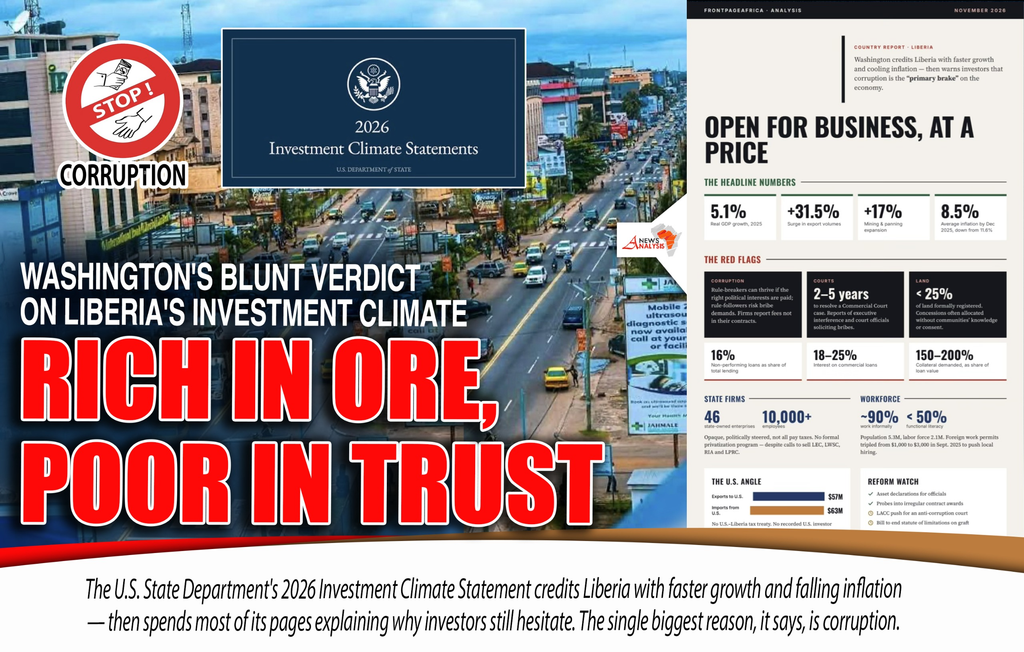
MONROVIA — On paper, Liberia has rarely looked better. The economy grew 5.1 percent in 2025, mining and panning expanded by 17 percent, export volumes jumped 31.5 percent, and headline inflation eased to an average of 8.5 percent by December, down from a peak of 11.6 percent. The International Monetary Fund, the World Bank, the African Development Bank and the European Union are all underwriting the recovery.
Yet the United States government’s newest assessment of Liberia as a place to put money, published in early November in the State Department’s 2026 Investment Climate Statements, reads less like a sales brochure than a warning label.
Strip away the diplomatic packaging and the message to American companies is plain: the opportunities are real, the minerals are in the ground, the coastline is strategic — but bring patience, bring lawyers, and bring a plan for dealing with officials who expect to be paid.
Corruption as the “primary brake”.
The report’s harshest language is reserved for governance. It describes corruption as the main obstacle to both Liberia’s democratic consolidation and its economic growth, saying it raises costs, causes delays and exposes investors to legal and reputational risk.
Citing business surveys and U.S. Embassy reporting, the statement says some officials put short-term personal gain ahead of the investment climate, and that political cronyism often shapes decisions that should rest on merit. In one of its most striking passages, it says businesses can find it easy to operate illegally if the right political interests are paid — while companies that follow the rules get little help at best and, at worst, become targets for bribe demands.
Multinational firms, the report adds, frequently say they are charged fees that appear nowhere in their investment agreements, and accounts of extortion “at multiple levels of government” are common. The worst areas, it says, are procurement, contract and concession awards, customs and tax administration, regulatory approvals and government payment systems.
Liberia has signed the relevant regional, continental and United Nations anti-corruption conventions. The State Department’s assessment is that membership “has not produced measurable reductions in corruption.” Enforcement of domestic anti-graft laws, it says, is inconsistent, and even-handed application is “the exception rather than the rule.”
The report does give President Joseph Boakai’s administration some credit: asset declaration requirements, investigations into irregularly awarded contracts, a push by the Liberia Anti-Corruption Commission for a specialized criminal court for corruption cases, and a proposed amendment that would remove the statute of limitations on corruption prosecutions. But it labels these “nascent” efforts — a polite way of saying the results are not yet visible.
Courts that cannot keep up
For investors, a corruption problem becomes a courtroom problem the moment a contract goes wrong. Here the report is equally blunt.
The Commercial Court, which handles disputes of $15,000 and above, is described as severely backlogged, with cases taking two to five years. Judgments — especially against government entities — are hard to enforce. The report notes regular media accounts of executive interference in judicial and legislative matters, and widespread reports that court officials solicit bribes to act on cases. Appeals land at a five-member Supreme Court that is buckling under the volume.
The consequences ripple into the wider economy. Because collateral is so hard to recover through the courts, banks demand more of it and lend less, which feeds high rates of bad loans. Unsurprisingly, the report says, investment contracts with the government often specify arbitration outside Liberia, and investors prefer not to rely on local courts at all.
Liberia does belong to the ICSID and New York conventions, which oblige its courts to recognize foreign and international arbitration awards. But even there, enforcement can take years.
Land: the oldest fault line
No issue in Liberia is more combustible than land, and the report treats it as a core investment risk.
The constitution limits land ownership to citizens of “Negro descent,” so foreign investors lease — typically for 25 to 50 years. The difficulty is knowing who actually owns what.
According to the Liberia Land Authority, less than a quarter of the country’s land is formally registered, and conflicting records are common.
The report also states that much land has been allocated to commercial companies through agriculture, forestry and mining concessions, often without local communities’ knowledge or consent. Investors, it warns, can face costly disputes even after signing agreements with the government — or after years in operation. The 2018 Land Rights Act was meant to settle historical claims, but public awareness of it remains limited.
A thin, expensive financial system
Liberia has no stock exchange. It has nine commercial banks, mostly foreign-owned, and four deposit-taking microfinance institutions. The Central Bank reports a comfortable liquidity ratio of 50 percent, well above the 15 percent minimum, and calls the sector resilient.
But the State Department notes that bad loans account for about 16 percent of total lending, that commercial interest rates run between 18 and 25 percent, and that lenders often demand collateral worth 150 to 200 percent of a loan. Some Liberian banks struggle to keep correspondent relationships with international banks. The banking system, the report concludes, is adequately capitalized but “not well positioned to withstand shocks.”
There are bright spots. The Central Bank switched on a national instant-payment system in December 2025 that lets money move in real time between mobile networks, and all government-to-person payments now run through the new national electronic payment platform, which is due to be fully operational by December 2026. Investors can also repatriate 100 percent of their funds, with no exchange controls, in a country where the U.S. dollar is legal tender.
State firms in the shadows
Liberia’s 46 state-owned enterprises employ more than 10,000 people in ports, power, water, petroleum, fisheries, forestry and telecommunications. The report describes them as politically governed, financially weak, inefficient and opaque.
It says senior officials, including some who sit on SOE boards, reportedly steer these companies in ways inconsistent with sound corporate governance; that not all of them pay taxes, or do so transparently; and that their revenues and debts are not always properly reflected in national budgets. There is no formal privatization program, despite public calls to privatize the Liberia Electricity Corporation, the Liberia Water and Sewer Corporation, Roberts International Airport and the Liberia Petroleum Refining Company.
The welcome mat, with conditions
The report does not suggest Liberia is closed. Its corporate law, modeled in part on Delaware’s, allows 100 percent foreign ownership with no residency requirements for directors. Tax incentives — duty and GST exemptions, tax holidays and deductions of up to 30 percent on qualifying equipment — are on offer in sectors from agriculture and energy to tourism, health and waste management. Extra incentives apply to projects in poorer regions, those creating more than 100 jobs, and those using at least 60 percent local materials.
Infrastructure is moving, too. APM Terminals is pushing the Freeport of Monrovia toward round-the-clock operations and aims to raise activity by 40 percent. A $40 million World Bank trade project is building a single window for customs. Special economic zones are planned, including a 94-acre free zone beside the Monrovia port and a 200-hectare agro-processing zone at Buchanan funded by the African Development Bank.
But the doors are not open everywhere. Sixteen lines of business — from sand supply and block making to taxis, gas stations, used clothing and used cars — are reserved for Liberians. Fully foreign-owned firms in other sectors must invest at least $500,000; joint ventures need $300,000 and at least 25 percent Liberian ownership. In September 2025, the Labour Ministry tripled work permit fees for foreigners from $1,000 to $3,000 to push companies toward local hiring.
That local hiring is not easy. The report puts the population at 5.3 million and the labor force at 2.1 million, with functional literacy just under 50 percent and as many as nine in ten people working in the informal economy. Employers, it says, should expect to invest heavily in training.
The American angle
For a country with Liberia’s historic ties to the United States, the commercial relationship is strikingly small. Central Bank data cited in the report show $57 million in exports to the United States against $63 million in imports. There is no bilateral tax treaty, meaning U.S. companies may face double taxation, and the report notes there has been no recorded investment dispute involving a U.S. investor in a decade — a sign, perhaps, of how few have tried.
Washington’s advice to American firms is cautious: do thorough due diligence, find strong local partners, stay close to the U.S. Embassy, and expect licenses and projects to take longer than planned. Mining and energy are flagged as the most promising sectors.
What it means
The 2026 statement captures the paradox at the heart of Liberia’s economy. The headline numbers show a country recovering; the fine print shows a state whose institutions have not caught up with its resources.
None of the individual criticisms will surprise Liberians — they are the stuff of daily headlines. What gives this report weight is its source and its audience. It is read by boardrooms, development financiers and risk analysts deciding where capital goes. When the U.S. government tells its own companies that rule-breakers can thrive if they pay the right people, and that rule-followers risk being shaken down, that sentence travels further than any investment conference speech.
For the Boakai administration, which has staked its reputation on fighting corruption and reviving the economy, the report is both a mirror and a test. The reforms it cites — asset declarations, contract probes, a proposed anti-corruption court — are the right ones. The question investors will ask is whether they become convictions, cleaner concessions and faster courts before the next edition of this report is written.
See more Liberia News Network stories in Google Search by adding LNN as one of your Preferred Sources.
★ Add LNN as a Preferred Source